
Getty Images Holdings: Balancing Content Licensing Growth with Operational Challenges
Getty Images advances revenue through strategic licensing and partnerships while facing profitability pressures and liquidity constraints.
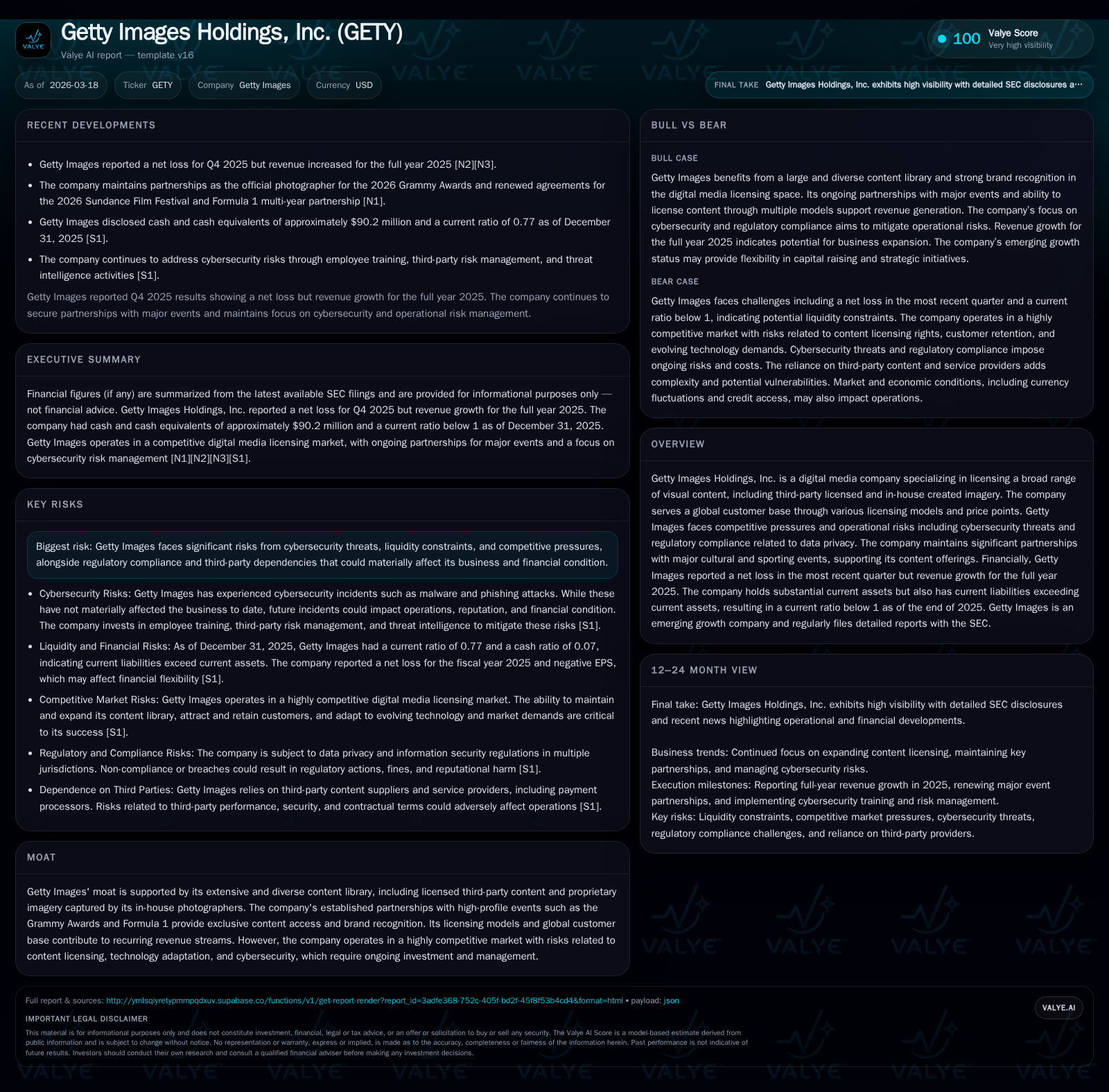
Getty Images Holdings, Inc. demonstrates ongoing revenue expansion driven by diversified content licensing and exclusive event alliances, but its operating income has contracted significantly due to escalating costs and investments in technology infrastructure. The company's liquidity profile is challenged with a current ratio below one, reflecting working capital imbalances. Future growth hinges on leveraging a rich content library and AI enhancements balanced against cybersecurity risks and regulatory compliance demands. Capital deployment remains conservative, absent dividends or buybacks, emphasizing cautious stewardship amid emerging growth dynamics.
Revenue Growth Fueled by Strategic Licensing and High-Profile Partnerships
Getty Images has sustained its top-line momentum through an expansive portfolio of content licensing agreements catering to a broad global customer base. The company's multi-tier pricing structure enables differential monetization across market segments, from individual content purchasers to large enterprise clients. Formidable partnerships with marquee cultural and sporting events such as the Grammy Awards and Formula 1 have fortified Getty's exclusive content pipeline, reinforcing brand differentiation in the crowded digital media space [F1][N1][S7].
This breadth of content ingestion, both from licensed third-party contributors and Getty’s in-house photographers, underpins a steady stream of recurring revenue. However, the cost structure for acquiring and producing such diverse assets has risen in tandem, partly attributable to escalated rights fees and investments in digital platform enhancements to support seamless delivery.
Analyzing the Shift in Profitability: Operating Income Declines Amid Increased Costs
Despite revenue gains, operating income plummeted by approximately 54% year-over-year to $83.9 million at fiscal year-end 2025 [F1]. This contraction is primarily attributable to heightened expenses linked to operational scale-up efforts including AI integration into Getty’s content ingestion pipelines, bolstering digital rights management capabilities, as well as increased cybersecurity measures.
Short-term profitability bears the imprint of these necessary outlays which aim to position Getty competitively over the long term, but current financials reflect margin pressures intensified by rising costs across licensing fees, technology infrastructure, and security operations [F1][N1][S6]. Nonetheless, management underscores potential returns from these investments as foundational for future sustainability.
Liquidity Landscape and Working Capital Pressures: Current Ratio Below One
Getty’s current assets totaled approximately $1.01 billion whereas current liabilities exceeded $1.30 billion at the close of 2025 resulting in a current ratio near 0.77—a metric traditionally viewed as a liquidity risk signal [F1][S17][S18]. This imbalance suggests challenges in meeting short-term obligations without recourse to additional financing or operational adjustments.
Working capital pressures could stem from factors such as slower receivables turnover or elevated short-term debt issuances tied to operational demands. This tight positioning imposes constraints on operational flexibility and necessitates vigilant cash management strategies going forward.
Future Outlook: Leveraging Content Assets While Managing Cybersecurity Threats
Looking ahead, Getty aims to capitalize on its voluminous blend of proprietary and licensed images alongside AI-powered tooling designed to streamline content discovery and rights enforcement processes. Expanding the global customer footprint remains a strategic priority though tempered by increased regulatory scrutiny around data privacy given varied international legal frameworks [N1][S5][S8].
On cybersecurity fronts, Getty actively conducts third-party cyber risk assessments aligned with contractual requirements imposed on vendors connecting to its networks. Threat intelligence operations involving predictive modeling and penetration testing are integral facets of its defense posture against prevalent threats like malware intrusions or account takeover attempts [S1]. Failure in these areas could incur substantial reputational damage alongside financial penalties.
Capital Allocation Insights: Modest Returns Amid Conservative Cash Deployment
Getty’s return on equity approximates 3.9%, reflective of subdued net income relative to its sizeable equity base ($552 million) at fiscal year-end 2025 [F1]. Operating cash flow declined nearly 45% year-over-year to about $65.2 million while capital expenditures remained relatively stable around $59.5 million yielding positive but restrained free cash flow near $5.7 million [F1].
The absence of dividend payments or share repurchase programs signals a conservative approach focused more on reinvestment into growth initiatives than on immediate shareholder distributions. Such capital discipline aligns with its emerging growth company status but highlights ongoing tradeoffs between fueling innovation versus delivering direct shareholder returns [F1][S19][S27].
Risks Spotlight: Cybersecurity, Regulatory Compliance, and Market Competition
Getty contends with layered risk factors including persistent cybersecurity threats such as phishing campaigns and denial-of-service attacks evidenced historically though deemed non-material to date; however unpredictability remains high [S1][S5][S8]. Regulatory compliance mandates globally concerning data privacy impose complex operational burdens needing constant adaptation.
Competitive intensity arises not only from established image providers but also new digital disruptors harnessing evolving technologies that may alter licensing economics or user engagement paradigms. Added legal contingencies include ongoing litigation connected to warrant exercises resolved partially unfavorably but fully reserved for in financial statements indicating prudent risk management [S13][S14]. These dynamics collectively underline a continually evolving operational environment demanding agility.
Key Financial Metrics Trend Table: Historical Performance Review
Historical performance (annual)
| FY | Net ($mm) | CFO ($mm) | OpInc ($mm) | Capex ($mm) | Net YoY |
|---|---|---|---|---|---|
| 2025 | 22 | 65 | 84 | 60 | +955.5% |
| 2024 | -3 | 118 | 181 | 57 | +86.3% |
| 2023 | -18 | 133 | 128 | 57 | +84.4% |
| 2022 | -118 | 163 | 202 | 59 |
Source: SEC companyfacts cache [F1].
Capital returns and efficiency (annual)
| FY | FCF ($mm) | ROE% |
|---|---|---|
| 2025 | 6 | 3.9 |
| 2024 | 61 | -0.4 |
| 2023 | 76 | -2.9 |
| 2022 | 104 | -21.7 |
Source: SEC companyfacts cache [F1].
*Net income figure for FY2025 covers only up to Q3 period per available data.
This table encapsulates notable volatility in operating income reflecting investment cycles alongside marked improvement in net income compared to previous losses attributed primarily to Q3 figures reported for FY2025 via quarterly disclosures rather than full year numbers [F1]. Operating cash flows have contracted materially consistent with margin compression patterns discussed earlier.
Getty Images Holdings exemplifies a legacy digital media company actively transitioning through an investment phase aimed at sustaining competitive advantage via broad content licenses allied with technological upgrades including AI capabilities for digital rights governance. The juxtaposition of rising revenues against profitability headwinds combined with liquidity issues urges careful monitoring into future quarters particularly on execution outcomes concerning cost control and cyber risk mitigation strategies.
While emerging growth company metrics constrain immediate shareholder reward programs such as dividends or buybacks; the firm’s robust asset base provides a platform for measured reinvestment funneling toward long-term value creation amid a complex regulatory and competitive milieu.
Investors following Getty should focus on forthcoming quarterly updates detailing the harmonization of revenue expansion with margin recovery efforts alongside liquidity improvements before any reassessment of capital return ambitions.
Disclaimer: This analysis is based solely on publicly available information up to March 18th, 2026 from SEC filings and reputable news sources without offering investment advice.
Disclaimer: This is research-only, informational analysis and not investment advice. It may include AI-generated interpretation and general industry context. Always verify important details using primary sources.

Comments