
Generation Income Properties’s Strategic Rebound Tests Nasdaq Compliance and Refinancing Resolve
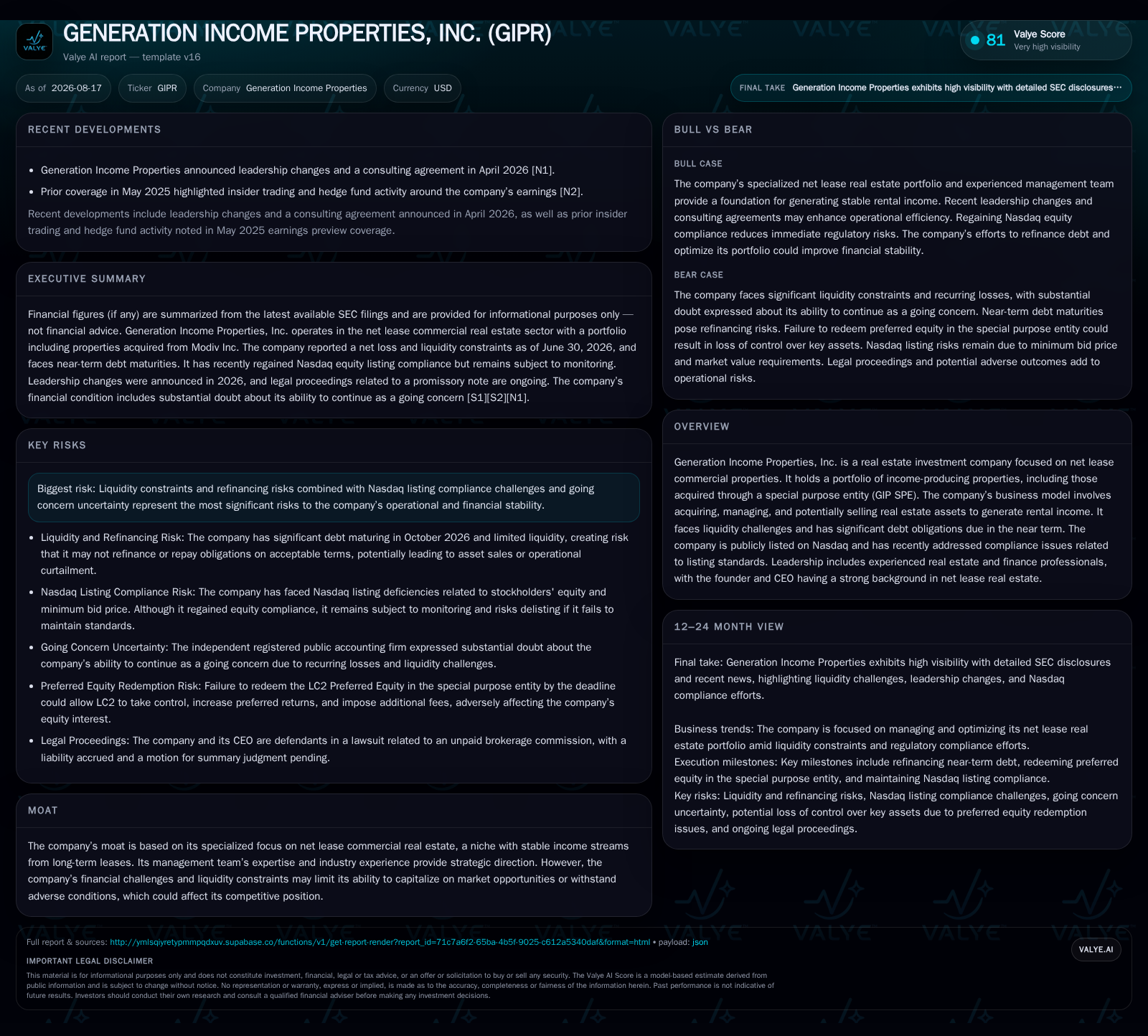
GIPR’s recent filings highlight regained Nasdaq equity compliance amid significant debt maturities and liquidity constraints that challenge its operational stability.
Generation Income Properties, Inc. restored compliance with Nasdaq’s stockholders' equity requirement following a multi-month battle involving asset sales, capital raises, and a reverse stock split, yet remains under a year-long regulatory monitor. The company’s net lease REIT business generates steady rental income from triple-net leases but is strained by elevated near-term debt maturities, including a $5.5 million loan due in October 2026. Ongoing refinancing risks and limited liquidity underpin substantial going concern doubts. Recent strategic amendments to preferred equity terms aim to provide operational flexibility, while selective asset dispositions are prioritized to bolster balance sheet strength.
Nasdaq Compliance Restoration Amid Persistent Balance Sheet Risks
Generation Income Properties (GIPR) regained compliance with Nasdaq's minimum stockholders' equity requirement in August 2026 after a prolonged period below the $2.5 million threshold. This was achieved through a combination of property dispositions, capital raises including securities offerings, and a reverse stock split consolidating shares on a 10-to-1 basis to elevate per-share price levels [S2][S3]. The Nasdaq Listing Qualifications Panel granted only a limited extension until August 4, 2026, emphasizing the provisional nature of this compliance achievement [S2].
Despite this success, GIPR is subject to a mandatory one-year panel monitor commencing August 10, 2026. Any failure to maintain compliance during this period risks prompt delisting without further relief [S2]. This oversight highlights the tenuousness of the company's equity base and capital structure. While management has executed some debt-to-equity conversions to ease financial strain, residual market skepticism and governance challenges continue to constrain capital access.
Net Lease Rental Income Stability Countered by Refinancing Pressures
Operating as a net lease REIT, GIPR derives rental income from commercial properties leased under triple-net agreements where tenants cover property taxes, insurance, and maintenance costs—factors that typically stabilize landlord cash flows [S1][S4]. The portfolio includes assets held via the special purpose entity GIP SPE, which provides some diversification within this niche [F1]. However, persistent operating losses indicate that financing expenses and overheads outweigh rental income at present [F1].
As of June 30, 2026, the company held approximately $2 million in cash against nearly $54 million in total debt, resulting in net leverage of about $51.8 million—a heavily leveraged position relative to liquidity reserves [F1]. Operating income was negative by nearly $7 million annually through December 31, 2025, evidencing ongoing profitability challenges driven largely by interest costs and fixed charges [F1].
Refinancing risk is acute given looming maturities such as the $5.5 million loan due in October 2026 owed to Brown Family Enterprises. This obligation represents a significant near-term liquidity hurdle requiring timely repayment or restructuring [S8][F1]. Failure could trigger cascading defaults or creditor enforcement.
Lease Portfolio Quality Anchors but Does Not Fully Offset Liquidity Constraints
While detailed lease metrics like occupancy rates or weighted average lease term (WALT) are not disclosed recently, the triple-net lease structure generally implies longer lease durations with tenant responsibility for operating expenses reducing landlord risk [S1]. This should support stable net operating income assuming tenant creditworthiness holds.
Management Amendments Provide Temporary Flexibility Amid Elevated Costs
In mid-July 2026, GIPR amended key partnership agreements governing Series B-1 and B-2 Preferred Units held by principal investors to waive forced redemptions and extend standstill periods temporarily [S10]. These measures defer imminent cash outflows but accrue higher cumulative preferential returns with punitive rates and risk transferring control rights if unresolved.
Concurrent conversion of certain debt tranches into common stock modestly reduces leverage but dilutes existing shareholders—a balancing act reflecting efforts to preserve solvency at the expense of equity value [S23][S24]
Critical Near-Term Debt Maturities Heighten Refinancing Imperative
October 2026 marks a critical deadline with significant borrowings due repayment including the $5.5 million Brown Family Enterprises loan posing intense refinancing pressure amid limited liquidity and weakened investor confidence compounded by Nasdaq listing concerns [S8][F1]. Success depends on accessing credit markets willing to accommodate the company's elevated risk profile.
Failure would likely necessitate accelerated asset sales at potentially discounted prices or restructuring negotiations detrimental to creditors and shareholders alike.
Risks: Listing Compliance and Liquidity Shortfalls Remain Key Watchpoints
Post-panel monitoring period ending August 2027 will be pivotal; renewed deficiencies could trigger swift delisting leading to valuation declines and severely restricted capital market access [S2][S6]
What To Watch: Redemption Deadlines and Asset Sale Execution
Upcoming deadlines for LC2 Preferred Equity redemption extensions—August 31, 2026 or potentially August 10, 2027 if extension conditions are met—will determine managerial control over GIP SPE assets with implications for financing costs and operational authority [S9]. Progress in asset disposition efforts will also be critical indicators of improving liquidity.
Financial Profile Discussion
Disclaimer: This is research-only, informational analysis and not investment advice. It may include AI-generated interpretation and general industry context. Always verify important details using primary sources.

Comments