
HF Foods Group's Strategic Expansion and Financial Performance in 2025
HF Foods advanced its distribution capacity with a new automated Georgia facility while managing ongoing net losses and maintaining liquidity in 2025.
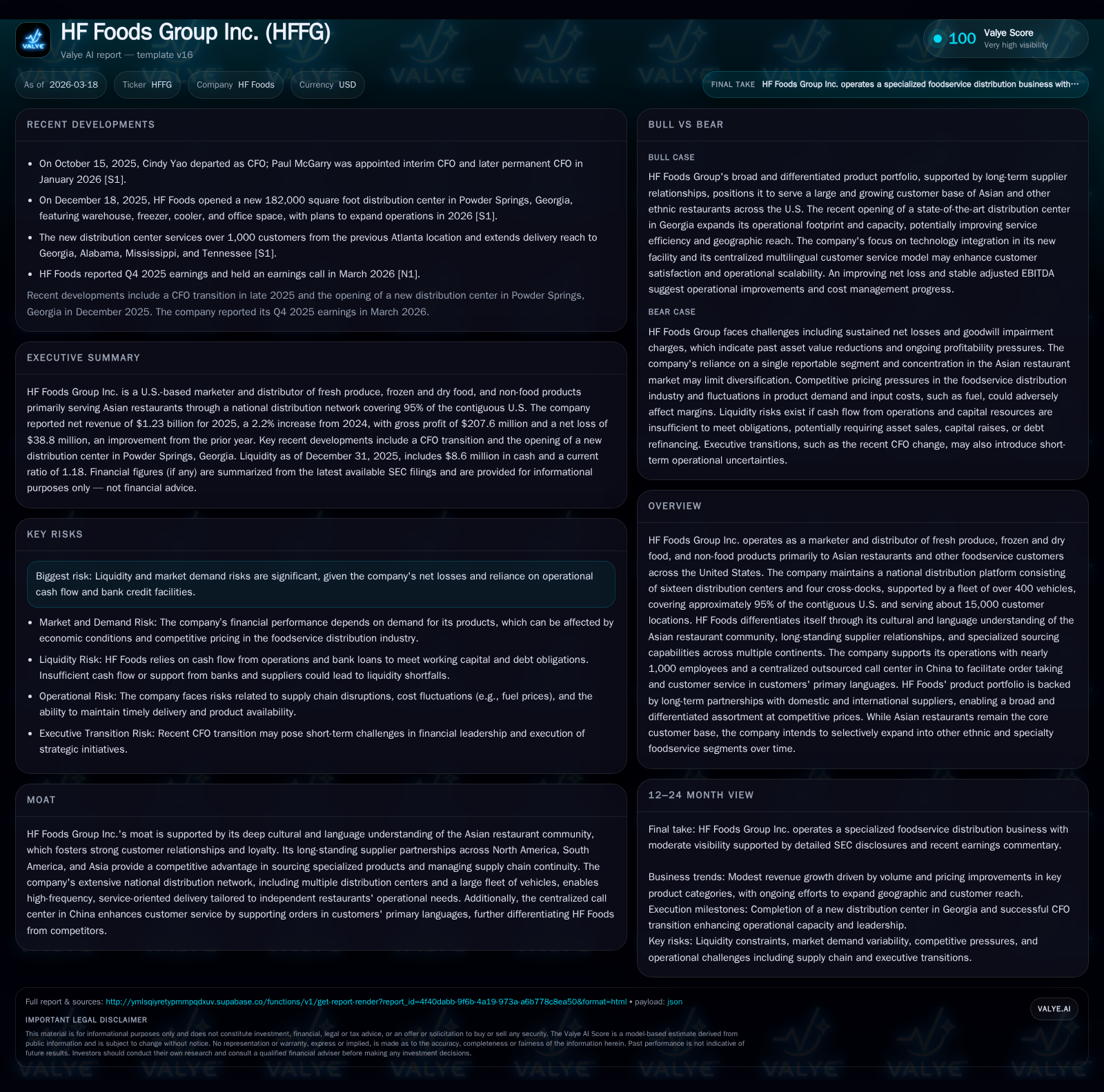
HF Foods Group Inc. expanded its national distribution network with the opening of a state-of-the-art automated facility in Powder Springs, Georgia, enhancing service coverage across the southeastern U.S. Despite modest revenue growth and improved operating cash flow in 2025, the company continued to report net losses influenced by goodwill impairments and increased depreciation costs. HF Foods maintains manageable liquidity supported by a $125 million revolving credit facility and a $106 million long-term debt portfolio secured by real estate assets. Capital expenditures surged as the company invested in infrastructure and technology improvements, focusing on operational efficiency and selective customer base expansion beyond core Asian restaurant clients.
Unique Market Position: The Cultural Moat of HF Foods Group
HF Foods Group specializes in marketing and distributing fresh produce, frozen and dry food, and non-food products primarily to Asian restaurants across the United States [S1]. The company leverages deep cultural understanding through a centralized outsourced call center in China that supports customer service in primary languages, fostering strong customer loyalty among independent ethnic foodservice operators [S1].
Its supply chain spans North America, South America, and Asia with longstanding supplier partnerships enhancing sourcing capabilities and mitigating supply disruptions [S1][S9]. The national distribution platform comprises sixteen distribution centers and four cross-docks supported by over 400 vehicles servicing approximately 15,000 customers across roughly 95% of the contiguous U.S. [S1][S9].
This combination of cultural insight, scale, and specialized sourcing presents significant barriers to entry for competitors lacking comparable language services or supplier relationships.
Historical Growth Drivers and Financial Trends Through 2025
HF Foods’ net revenue increased modestly from $1.20 billion in FY2024 to $1.23 billion in FY2025 driven by stable demand and product inflation [F1][S4]. Profitability remains challenged as shown below:
Historical performance (annual)
| FY | Net ($mm) | CFO ($mm) | OpInc ($mm) | Capex ($mm) | Net YoY |
|---|---|---|---|---|---|
| 2025 | -39 | 25 | -33 | 19 | +19.9% |
| 2024 | -49 | 23 | -39 | 13 | -2131.4% |
| 2023 | -2 | 16 | 9 | 4 | -572.6% |
| 2022 | 0 | 31 | 11 | 6 |
Source: SEC companyfacts cache [F1].
Capital returns and efficiency (annual)
| FY | FCF ($mm) | ROE% |
|---|---|---|
| 2025 | 7 | -19.2 |
| 2024 | 10 | -20.3 |
| 2023 | 12 | -0.8 |
| 2022 | 25 | 0.2 |
Source: SEC companyfacts cache [F1].
Operating income losses narrowed by about 15.7% year-over-year due partly to operational efficiencies offsetting higher depreciation and amortization related to asset growth [F1][S4][S8]. Net loss improved nearly 20% but remained significant due largely to goodwill impairment charges (~$38.8 million) and elevated amortization expenses [F1][S4][S19].
Operating cash flow increased by approximately 12.6%, indicating stronger operational liquidity despite heavy reinvestment reflected in a more than fifty percent rise in capital expenditures primarily funding infrastructure expansion including the new Powder Springs facility [F1][S11][S19].
Strategic Leap: New Powder Springs Distribution Center
On December 18, 2025 HF Foods opened a new flagship distribution center near Atlanta in Powder Springs, GA—a modern facility spanning about 182,000 square feet incorporating warehouse space with freezer/cooler capabilities plus office space [S1][S15]. This replaces the previous Atlanta location while expanding service reach into Georgia plus Alabama, Mississippi and Tennessee.
The site integrates automated material handling systems alongside advanced warehouse management technologies designed to boost operational throughput and efficiency across picking accuracy and fleet utilization rates [S1]. Initial staffing exceeds fifty employees with plans for further expansion reflecting expected business volume growth from enhanced fulfillment capacity.
This investment underscores HF Foods' commitment to meeting complex ethnic foodservice logistics demands emphasizing timely delivery at competitive freight costs.
Profitability Headwinds: Operating Loss Drivers
Key factors impacting profitability include:
- Significant goodwill impairment charges totaling approximately $38.8 million in FY2025 reflect ongoing asset value write-downs related to acquired units or reporting segments underperforming expectations [F1][S4][S19].
- Increased depreciation/amortization expenses resulting from expanded property plant & equipment investments including technology solutions such as internal-use software capitalized costs [S20].
- Margin pressures driven by supplier cost volatility including freight/logistics expenses sensitive to fuel price fluctuations affecting overall unit economics despite scale advantages [S8].
- Product mix shifts away from higher-margin Asian specialty categories toward commodity lines dilute average margins further impacting operating results [S13][S14].
- Interest expense remained steady near $11.47 million attributable to the company's debt levels; interest rate swap contracts partially hedge floating rate exposure though baseline borrowing costs weigh on earnings amid rising rates [S6][S10][F1].
These factors combined have sustained net losses despite efforts toward expense management and operational improvements.
Liquidity Posture and Capital Structure
As of December 31, 2025 HF Foods held cash balances of approximately $8.6 million complemented by around $61.2 million available under its $125 million asset-backed revolving credit facility subject to borrowing base calculations [F1][S6][S16]. Long-term debt totaled roughly $106 million secured primarily by real estate assets with maturities extending through January 2030; principal amortization schedules include balloon payments due between now and maturity dates [F1][S7].
The company manages interest rate risk via an interest rate swap contract fixing payments around mid-4% range through March 2028 reducing exposure despite floating rate loan components [S6][S10]. Financial covenants such as fixed charge coverage ratio remain compliant at fiscal year-end though management acknowledges risks from economic slowdowns or market dislocations potentially impacting working capital availability or refinancing flexibility [S6][S11].
Capital Allocation: Focused on Growth Capex without Shareholder Returns
Capital expenditures rose substantially to nearly $18.9 million in FY2025 (+50.8%) mainly funding the new Powder Springs facility buildout alongside technology investments including warehouse management software development capitalized as internal-use software assets [F1][S19][S20].
Operating cash flow expansion amid heavy capex resulted in positive free cash flow approximating $6.56 million (CFO minus capex), signaling constrained but positive cash generation capability [F1].
No dividends or share repurchases were recorded during this period; retained earnings are prioritized toward reinvestment rather than distributions reflecting management’s focus on scaling infrastructure capacity and automation efficiency enhancements for future growth [F1][S10].
Navigating Future Demand: Customer Base Expansion Strategy
While Asian restaurants remain HF Foods’ core customer segment underpinning majority revenues, the company has indicated intentions to selectively broaden its customer reach into other ethnic specialty foodservice verticals aiming for revenue diversification over medium-term horizons amidst intensifying competition within core markets [S1].
This strategy aligns with demographic trends favoring diverse culinary offerings while leveraging HF Foods’ expertise in culturally tailored logistics services.
Key Metrics To Monitor Going Forward
Stakeholders should track:
- Compliance with financial covenants such as fixed charge coverage ratios serving as early indicators of liquidity stress requiring proactive management responses [S12].
- Operational efficiency gains realized through automation deployment at Powder Springs impacting cost per order fulfillment metrics including labor productivity improvements needed for margin recovery.
- Lease obligations spanning offices and warehouses represent fixed costs requiring careful absorption amid economic uncertainties or slower revenue growth.
- Legal contingencies stemming from ongoing litigation including SEC-related settlements present reputational risks warranting cautious financial forecasting separated from normalized operating trends.
Transparency regarding these factors will be critical for assessing HF Foods’ trajectory through this transformative phase.
Disclaimer: This analysis uses data solely derived from cited SEC filings ([F1],[S#]) and publicly disclosed news transcripts ([N#]). It avoids speculative projections lacking grounded evidence.
Disclaimer: This is research-only, informational analysis and not investment advice. It may include AI-generated interpretation and general industry context. Always verify important details using primary sources.

Comments