
Hut 8 Corp’s Power-First Infrastructure Strategy Faces Capital and Market Demand Challenges
Hut 8 develops vertically integrated energy infrastructure for high-intensity computing but contends with substantial capex and volatile returns.
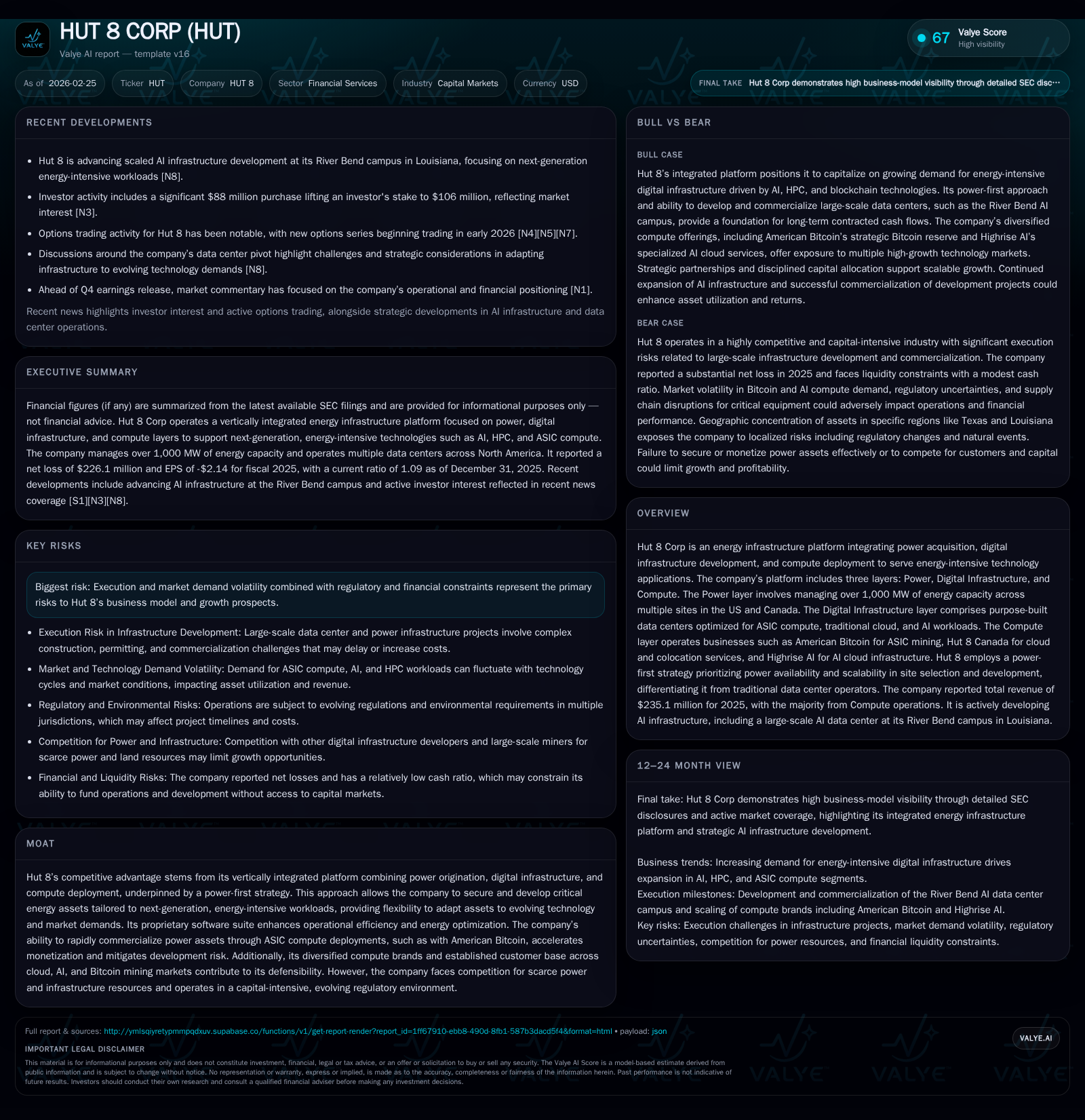
Hut 8 Corp operates a three-layer platform comprising power acquisition, digital infrastructure, and compute services focused on next-generation technology applications such as AI and Bitcoin mining. While the company expanded rapidly through capital-intensive projects including its River Bend campus, it incurred significant losses and negative cash flow in 2025. Its future growth hinges on successful commercialization of large-scale power assets and data centers amid competitive pressures and execution risks. Capital allocation balances aggressive infrastructure investment against liquidity constraints, with no dividends or buybacks reported.
Company Overview
Hut 8 Corp is a vertically integrated energy infrastructure platform specializing in developing power acquisition assets, digital infrastructure tailored for high-performance computing workloads, and compute operations aimed at next-generation technology applications. Their three-layer platform consists of the Power layer—managing over 1,000 MW capacity across North America; the Digital Infrastructure layer—purpose-built data centers optimized for ASIC compute, cloud colocation, and AI workloads; and the Compute layer—operating businesses like American Bitcoin for ASIC mining, Hut 8 Canada for traditional cloud services, and Highrise AI focused on AI infrastructure.
The company differentiates itself through a ‘power-first’ strategy that prioritizes securing scalable electricity resources early in site selection and design. This contrasts with traditional data center operators who often start with real estate considerations and procure power reactively. Hut 8’s approach aims to address the increasing demand for specialized infrastructure capable of supporting energy-intensive technologies such as artificial intelligence (AI), high-performance computing (HPC), and cryptocurrency mining.
Historical Performance
From 2023 through 2024, Hut 8 saw strong expansion supported by acquisitions including Far North JV and American Bitcoin alongside new managed service agreements. Revenue details are not available from provided XBRL tags but narrative references confirm growth during this period. However, FY2025 marked a sharp reversal:
Historical performance (annual)
| FY | Net ($mm) | CFO ($mm) | OpInc ($mm) | Capex ($mm) | Net YoY |
|---|---|---|---|---|---|
| 2025 | -226 | -139 | -322 | 353 | -168.1% |
| 2024 | 332 | -69 | 461 | 7 | +5246.0% |
| 2023 | 6 | -20 | 10 | 7 |
Note: Omitted columns lack sufficient annual XBRL coverage in the provided tags (need ≥2 annual points): Rev, Div, Buybacks. Source: SEC companyfacts cache [F1].
Capital returns and efficiency (annual)
| FY | FCF ($mm) | ROE% |
|---|---|---|
| 2025 | -492 | -15.9 |
| 2024 | -76 | 34.0 |
| 2023 | -27 | 1.3 |
Source: SEC companyfacts cache [F1].
Operating income swung from strong positive gains in prior years to a significant loss driven by heightened expenses related to rapid infrastructure scaling and asset development costs. Net income followed suit with a notable decline into negative territory. Operating cash flow remained negative throughout but worsened in FY2025 due to increased investments exceeding operational cash generation.
Capital expenditures surged nearly fifty-fold in FY2025 reflecting significant spending on data centers—most notably the River Bend campus—and other infrastructure expansions. Equity grew substantially likely via issuance under At-The-Market (ATM) offerings used to support these investments.
Return on equity was approximately -15.9% in FY2025 based on net loss relative to stockholders’ equity [F1]. There were no disclosures on dividend payments or share repurchases in available filings.
Platform Segments Performance
Power: As of end-2025, Hut 8’s Power layer manages approximately 1,020 MW capacity across U.S. and Canadian sites following divestiture of some generation assets earlier that year. This segment focuses on land acquisition, interconnects, substations, and electrical systems designed specifically to meet load demands of AI and HPC workloads.
Digital Infrastructure: The company operates five ASIC compute-focused facilities plus five traditional cloud/colocation centers serving more than two hundred customers via Hut 8 Canada. Development continues on purpose-built AI-optimized data center projects including the River Bend campus targeting initial commissioning in Q2 2027.
Compute: This segment comprises businesses operating compute hardware tailored to markets such as Bitcoin mining through American Bitcoin (majority-owned), traditional cloud/colocation services via Hut 8 Canada, and emerging AI compute platforms under Highrise AI branding.
Future Growth Prospects
Growth drivers include:
- Commercialization of large-scale utility capacity currently under construction or development—such as the planned AI-focused data center at River Bend expected mid-2027.
- Expansion across multiple sites encompassing an additional ~1,230 MW utility capacity pipeline indicating substantial room for scaling digital infrastructure.
- Increasing adoption of AI workloads alongside sustained demand for ASIC mining powered by proprietary software enhancing operational efficiency.
These opportunities face execution risks such as construction delays or cost overruns affecting revenue timing; supply chain constraints on critical components like GPUs or ASIC chips; regulatory challenges including permitting delays; competition for scarce electrical power resources impacting cost and availability [S1][S20][S25].
Financial Health & Capital Allocation
Hut 8 carries over $411 million in debt as of December 31, 2025 with financial covenants that may restrict operational flexibility [S6][S13]. The company uses tools including ATM equity programs which raised approximately $183 million during FY2025 to fund growth while minimizing dilution risk [S9].
Operating losses reflect both elevated depreciation/amortization expenses tied to asset base growth as well as costs associated with development initiatives. Negative operating cash flow (-$139 million) combined with aggressive capital expenditures ($353 million) resulted in a free cash flow deficit estimated around -$492 million [F1].
No dividends or share repurchases were disclosed indicating all retained earnings are reinvested into growth initiatives.
Project-level financing strategies are pursued alongside corporate-level capital management to optimize cost of capital while mitigating enterprise risk.
Industry Context & Competitive Landscape
Demand for digital infrastructure outpaces supply especially where power grids are constrained—particularly critical for HPC/AI workloads requiring dense power provision multiple times legacy standards [S20]. Competitors range from hyperscale cloud providers expanding data center footprints to specialized miners optimizing ASIC compute efficiency.
Supply chain disruptions continue impacting timely facility builds emphasizing operational agility's importance. Hut 8’s vertical integration provides competitive advantage by enabling faster monetization of greenfield power assets bundled with data center solutions co-located with compute operations—a synergy less common among traditional operators focused separately on real estate or power procurement.
What to Watch Next
Key near-term milestones include:
- Progress toward commissioning phases at River Bend campus targeting initial delivery in Q2/Q3-2027 given scale (~330 MW).
- Signing long-term customer contracts securing colocation commitments underpinning revenue visibility.
- Managing capital expenditure spending alongside liquidity without resorting to heavily dilutive equity issuance or onerous refinancing.
- Monitoring supply chain dynamics affecting GPU/ASIC chip availability influencing capex efficiency and uptime.
- Competitive pressures around power procurement impacting margin structures across segments.
Conclusion
Hut 8 Corp has built a differentiated platform integrating energy procurement with innovative digital infrastructure tailored for emerging high-intensity computing applications like AI and cryptocurrency mining. While historical expansions delivered scale between ’23–’24 cycles ([N11],[N14]), FY2025 showed pronounced losses largely due to aggressive capital deployment toward foundational assets including large hubs such as River Bend.
Future success depends on balancing capital-heavy buildout strategies with timely commercialization amidst competitive pressures on energy access alongside regulatory/commercial uncertainties inherent to their sector within Financial Services.Capital discipline paired with milestone achievements will be crucial to convert current investments into sustainable returns.
Disclaimer: This report is based solely on publicly available information as of February 25, 2026. It does not constitute investment advice or recommendations regarding securities transactions.
Disclaimer: This is research-only, informational analysis and not investment advice. It may include AI-generated interpretation and general industry context. Always verify important details using primary sources.

Comments