Integrated Electrical & Tech Systems in Flux: IES Holdings’ Strategic Expansion and Market Position
IES Holdings navigates diversified industrial electrical contracting with strategic acquisitions and operational discipline amid evolving sector dynamics.
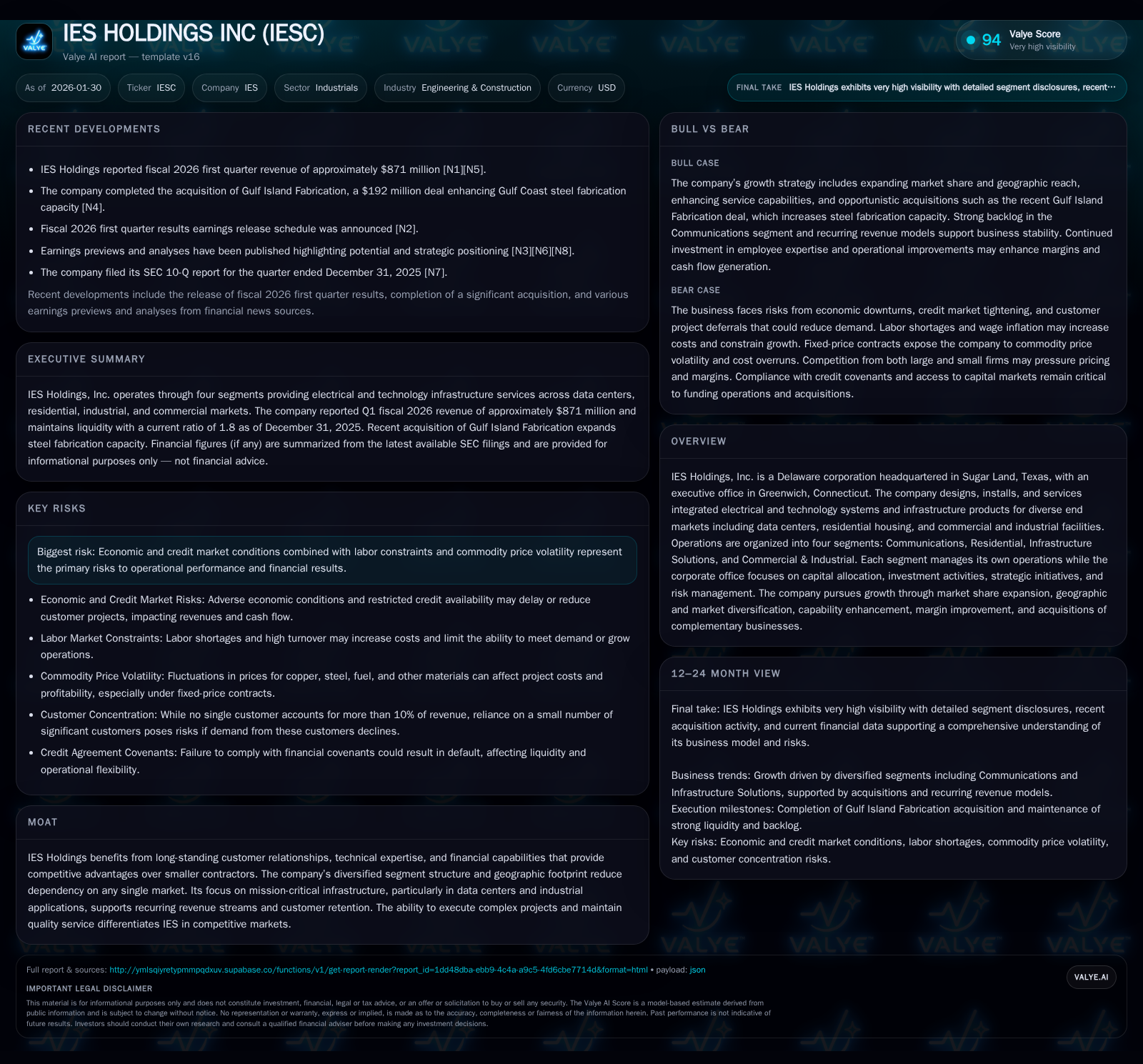
IES Holdings Inc. operates a multi-segment electrical and technology systems business serving data centers, residential, infrastructure, and commercial-industrial markets. Recent acquisition of Gulf Island Fabrication expands its footprint in steel fabrication and industrial services, complementing its Infrastructure Solutions segment. The company’s decentralized segment management paired with centralized capital allocation enables nimble market targeting and operational control. Key risks include economic cyclicality, labor availability, commodity price volatility, and regulatory compliance. IES’s competitive advantages hinge on its technical expertise, long-term customer relationships, and financial strength relative to smaller contractors.
What Changed Recently
In January 2026, IES Holdings announced the completion of its acquisition of Gulf Island Fabrication, a significant step that expands its steel fabrication capacity and enhances its service offerings within the Infrastructure Solutions segment, especially in industrial markets along the Gulf Coast [N6][N7]. This $192 million deal signals IES’s intent to deepen capabilities in electro-mechanical solutions and custom-engineered products such as generator enclosures, which are critical for data centers and heavy industrial facilities.
Alongside this, the company released its fiscal 2026 first quarter results showing revenue of approximately $871 million, slightly below FactSet estimates but reflecting solid operational execution across its segments [N1][N5]. Market commentary emphasizes the potential unlocked by IES’s acquisition strategy and its ability to capitalize on infrastructure spending and data center growth trends [N2][N8][N9].
Business Model as a System
IES Holdings operates as a diversified electrical and technology systems contractor with four distinct segments, each targeting specific end markets with tailored services and products [S1]:
Communications: Provides nationwide technology infrastructure services focused on data centers, encompassing design, build, and maintenance for co-location and managed hosting customers. A significant portion of volume comes from long-term, repeat clients who often designate IES as a preferred provider. This segment benefits from recurring service contracts, which smooth revenue volatility [S1][S3].
Residential: Focuses on electrical installation primarily in single-family and multi-family housing, plus HVAC and plumbing services in select markets. This segment is more regional and subject to typical housing market cycles and seasonality, with concentration in Texas and Florida for single-family homes [S1][S8].
Infrastructure Solutions: Delivers electro-mechanical solutions including apparatus repair and custom-engineered products like generator enclosures and metal-enclosed bus systems. This segment serves diverse industrial markets such as energy, petrochemical, steel, and transportation, with geographically dispersed facilities enabling rapid customer response [S1][S4][S6]. The recent acquisition of Gulf Island Fabrication enhances these capabilities.
Commercial & Industrial: Offers electrical and mechanical design, construction, and maintenance services across commercial buildings (data centers, healthcare, offices) and industrial facilities (manufacturing, power, agriculture). Services include design-build and LEED-certified solutions, as well as emergency and preventive maintenance [S1][S7].
Each segment operates with autonomy over day-to-day functions, including local sales and project execution, while the corporate office focuses on capital allocation, strategic acquisitions, leadership selection, and risk management. This decentralized operational model supports flexibility and responsiveness to local market conditions, while leveraging centralized financial and talent resources [S1][S2].
Industry Map & Competitive Battlefield
The electrical contracting and integrated technology infrastructure industry is fragmented, comprising large national players and numerous small, privately held local firms. Barriers to entry vary by segment: residential and some commercial electrical services have relatively low barriers, resulting in many small competitors; conversely, the Communications and Infrastructure Solutions segments demand higher technical expertise and capital, favoring larger, well-capitalized firms like IES [S3][S6][S7][S8].
Competition is intense on price and quality, with IES leveraging its technical skill set, long-standing customer relationships, and financial capabilities to outbid smaller contractors that lack scale and capital access. In critical markets like data centers, reliability and service continuity are paramount, creating an advantage for IES’s integrated solutions and maintenance contracts that underpin recurring revenue streams [S1][S3].
Within Infrastructure Solutions, competition includes domestic and international manufacturers of custom-engineered products, where product quality, customization, and geographic proximity to customers are decisive. Here, IES holds a competitive edge via its engineering depth and regional footprint [S4][S6].
Regulatory complexity and compliance costs add to competitive dynamics, especially with environmental and safety regulations affecting project execution and costs. Firms with robust risk management and compliance infrastructure, such as IES, can mitigate these risks better than smaller operators [S12][S16].
Where the Economics Become Real
IES’s economics vary across segments but share common drivers:
Revenue Drivers: New construction projects, maintenance contracts, and upgrade or retrofit activities drive top-line growth. Especially in Communications and Commercial & Industrial, recurring maintenance provides revenue stability against cyclical new build activity [S1][S3][S7].
Margins: Margins fluctuate with project complexity, labor costs, and commodity prices. Early procurement of materials and contract provisions for cost escalation help to mitigate commodity price volatility, but not all contracts provide full pass-through, exposing the company to some margin pressure [S13].
Labor and Capacity: Skilled labor availability is a critical bottleneck. IES invests in employee training and technical expertise to maintain competitive differentiation and meet project demands. Labor shortages can delay projects and increase costs [S3][S12].
Working Capital and Cash Flow: IES maintains a significant working capital base to support project execution and acquisitions. The company reported cash and equivalents of $88.8 million and a current ratio of approximately 1.8 as of December 2025, indicating adequate liquidity to fund near-term obligations and investment [XBRL].
Capital Allocation: Strategic acquisitions are central to growth and margin improvement. The Gulf Island Fabrication acquisition exemplifies this approach, adding capabilities and geographic reach, while expanding higher-margin product offerings [N6][N7].
Seasonality and Cyclicality: Residential segment revenues are seasonal with weather-dependent construction cycles. Communications segment is less seasonal but subject to technology sector cycles. Infrastructure and Commercial segments depend on broader industrial and commercial construction cycles, which are influenced by economic conditions and financing availability [S1][S8][S7].
Diligence Questions / Disconfirming Signals
Acquisition Integration Risk: How successfully will Gulf Island Fabrication’s operations be integrated without disrupting existing segment performance or diluting focus? What are the expected synergies and timeline?
Economic Sensitivity: Given exposure to cyclical end markets (housing, commercial construction, industrial capital projects), how resilient is IES’s backlog and pipeline to potential downturns or credit tightening?
Labor Market Dynamics: Are there signs of worsening skilled labor shortages or wage inflation that could constrain growth or compress margins?
Commodity Price Exposure: How frequently are escalation clauses triggered, and what percentage of contracts lack pass-through provisions? What is the impact on margins if commodity prices remain elevated?
Regulatory and Environmental Compliance: Are there pending regulations or litigation risks, particularly in Infrastructure Solutions, that could materially affect operations or costs?
Customer Concentration and Credit Risk: What portion of revenues comes from large customers, and how does credit risk factor into receivables management, particularly in a tightening credit environment?
Capital Structure and Liquidity: With acquisitions and working capital needs, does the current leverage and liquidity profile support further growth without undue financial strain?
Technology and Competitive Differentiation: How does IES plan to sustain its technical leadership and competitive edge amid evolving technology infrastructure demands and emerging competitors?
Conclusion
IES Holdings operates a complex, multi-segment business with substantial breadth in engineering, construction, and maintenance of electrical and technology infrastructure. Its recent acquisition activity and focus on mission-critical infrastructure markets—especially data centers and industrial applications—position it to capitalize on secular growth drivers while mitigating typical industry cyclicality through diversification and recurring revenue streams. However, execution risks linked to integration, labor, commodity costs, and regulatory compliance remain critical areas for ongoing scrutiny. The company’s decentralized operational model combined with centralized strategic oversight appears effective in managing segment-specific challenges and harnessing growth opportunities.
This analysis is based on publicly available information as of January 2026 and does not constitute investment advice. It reflects the author's best effort at synthesizing company disclosures, market news, and industry context without projecting specific financial outcomes.
Disclaimer: This is research-only, informational analysis and not investment advice. It may include AI-generated interpretation and general industry context. Always verify important details using primary sources.

Comments