
Itau Unibanco’s 2025 Annual Results Signal Strength Amid Brazil’s Banking Sector Dynamics
The bank's 2025 performance and latest quarterly disclosures reflect resilience in loan growth and capital management within a competitive and evolving regulatory environment.
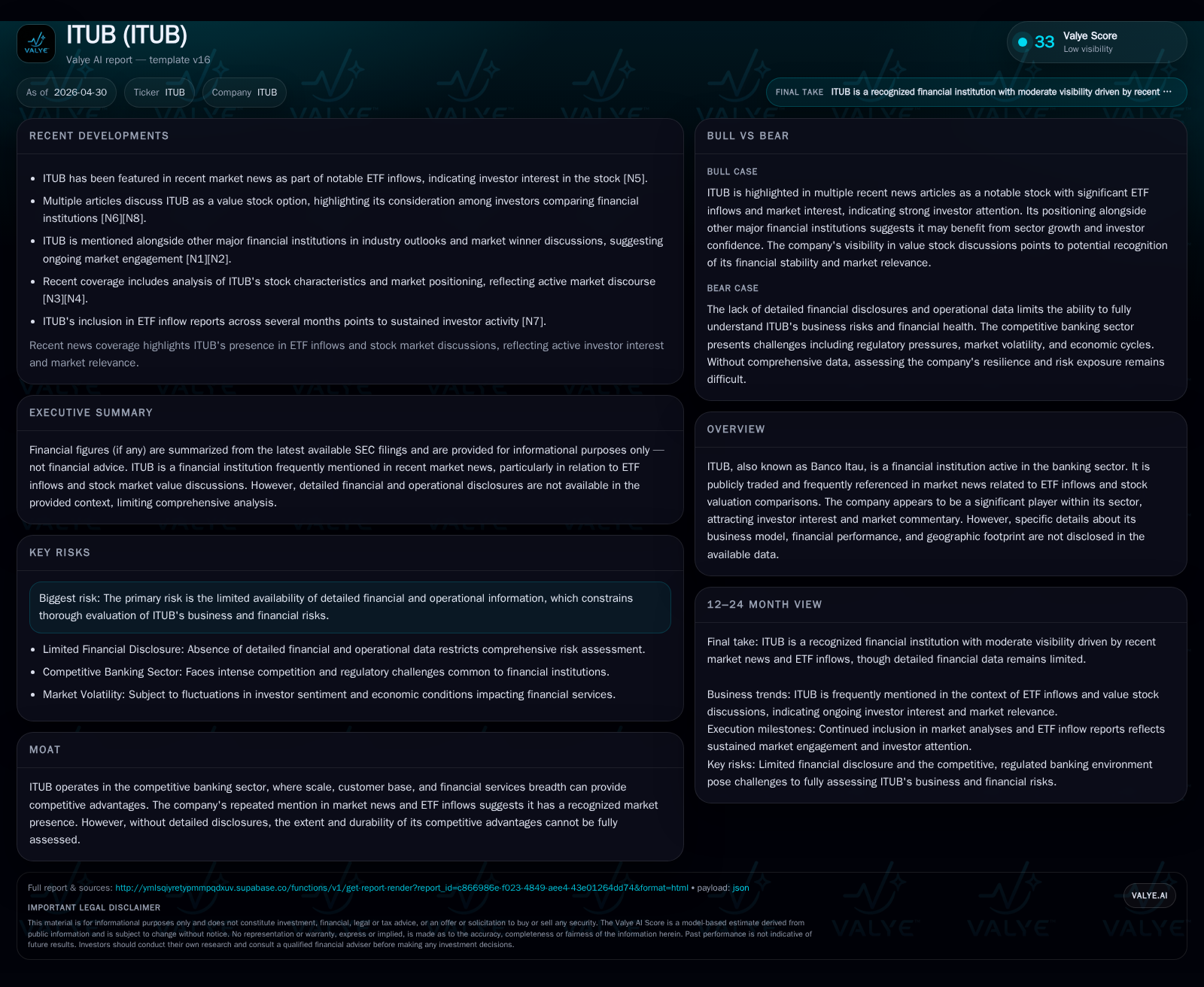
Itau Unibanco's 2025 annual results, supplemented by its April 2026 quarterly filings, demonstrate modest loan book expansion alongside disciplined capital allocation amid Brazil’s shifting economic landscape. The group’s integrated retail and wholesale banking model, complemented by digital initiatives, sustains competitive advantages despite increasing regulatory capital demands. Key risks include capital pressure from dividend payouts and macroeconomic uncertainties. Monitoring credit demand, regulatory updates, and digital adoption metrics will be critical for assessing the near-term trajectory.
Latest Quarterly Operating Update Highlights
The latest IFRS-based quarterly disclosure as of April 30, 2026 [S2][S3] reaffirms Itau Unibanco’s continued growth trajectory. The company reported sustained loan portfolio expansion alongside rigorous capital management. Its Tier I Capital ratio declined slightly to 13.8% by the end of 2025 from the previous year’s higher levels due mainly to dividend distributions (72% payout ratio), stock buybacks, and an increase in risk-weighted assets (RWA) [S1]. Despite a moderate dip in capitalization ratios, this movement was partly offset by positive net income generation during the period. This reflects an ongoing tradeoff between deploying capital to satisfy shareholder returns versus maintaining buffers for regulatory compliance or organic growth.
Additionally, customer funding increased significantly to R$1.6748 trillion by December 31, 2025 from R$1.5676 trillion a year earlier [S1], suggesting successful deposit base reinforcement aligned with the growing loan book needs which rose from R$1.0255 trillion to R$1.0838 trillion. This dual increase supports core banking profitability and evidences demand for credit products within Brazil’s financial ecosystem.
Business Model and Service Offering: Deep Roots in Retail and Wholesale Banking
Itau Unibanco originates from the merger of two historically significant Brazilian banks—Banco Itaú and Unibanco—to create one of Latin America’s largest financial conglomerates [S1]. The group operates a diversified business model spanning retail banking including mortgages, personal and auto loans; extensive wholesale corporate banking services; asset management; insurance underwriting; pension fund administration; and credit card issuance.
Revenue generation is principally driven by interest margins achieved through credit lending alongside non-interest income from commissions on insurance products, fees on wealth management services, pension plan contributions, and digital banking transaction fees. The bank leverages its large client base across segments to cross-sell products and deepen customer wallet share while creating switching costs through integrated offerings.
This scale is vital in Brazil’s competitive environment where breadth of services strengthens revenue vis-à-vis pure-play lenders or fintech peers that may maintain narrower product sets. The operational structure also benefits from legacy technological capabilities inherited post-merger that facilitate transactions efficiency and support emerging digital channels transforming Brazilian consumer behavior.
Competitive Landscape: Scale Advantages and Regulatory Environment
Itau Unibanco holds a dominant position among Brazilian banks primarily due to its asset size (total assets approx. R$3.07 trillion at end-2025) [S1]. Its vast branch network combined with investments in technology provide advantages over smaller institutions less able to absorb regulatory costs stemming from Basel III standards or evolving macroprudential policies.
The Bank’s consolidated efficiency ratio within Brazil at 36.9% [S1] reflects careful cost containment balanced against revenue protection—critical given Brazil's intense competition often compresses pricing power on retail lending rates while requiring robust operational platforms to retain customers.
Basel III-driven capital requirements impose continuous pressure on Tier I ratios through heightened risk weightings on certain corporate exposures or market-sensitive assets resulting in strategic shifts toward safer asset classes or expanded deposit funding [S1]. Meanwhile, burgeoning fintech competitors focusing on niche lending or payments segments create new dynamics by pressuring traditional fee sources but also opening partnership avenues enhancing Itau’s digital reach.
Growth Drivers: Expansion in Credit Portfolio and Digital Innovations
Loan book growth remains a critical metric for Itau Unibanco's top-line expansion with volume increases recorded notably in retail segments supported by consumer demand trends amid Brazil's recovering economy [S1]. Funding increases via stable deposits reduce reliance on wholesale funding markets helping control net interest margins.
On the innovation front, investments in digital banking platforms target efficiency improvements while enhancing client acquisition especially among younger demographics increasingly favoring mobile-first experiences [S1]. This not only boosts transaction volumes but also generates data analytics capabilities facilitating customized financial solutions — a key differentiator versus traditional branches or competing fintechs.
By linking growth KPIs like loan origination rates with digital user adoption statistics disclosed periodically by Itau Unibanco's IR releases [S2][S3], one can gauge execution effectiveness beyond vanilla balance sheet expansion.
Risks and Constraints: Capital Pressure, Regulatory Compliance, and Macroeconomic Factors
Noteworthy is the tension between high shareholder payouts—72% payout ratio—and maintaining strong capital adequacy levels as mandated by Brazil's Central Bank regulations that incorporate Basel III frameworks [S1]. This squeeze could limit room for aggressive loan growth or require issuance of Additional Tier I instruments (AT1) noted at ~1.5% of Tier I capital [S1], presenting refinancing or market sentiment risks.
Regulatory risk is actively managed via a structured three-lines-of-defense framework encompassing business units’ self-monitoring to centralized risk departments overseeing compliance plus independent audit functions [S1]. Still evolving international financial norms present compliance complexity exacerbated by social-environmental governance requirements highlighted under Itaú’s dedicated ESG risk committees.
Externally, persistent macroeconomic risks such as inflation volatility impacting real interest rates or political uncertainty specific to Brazil add uncertainty around borrower creditworthiness potentially inflating non-performing loans ratios which remain key watchpoints moving forward [S1][S2]. Foreign exchange fluctuations tied to BRL may also affect cross-border liabilities or earnings translation impacting reported equity measures.
Outlook: Monitoring Key Milestones and Demand Indicators
Looking ahead into mid-2026 and beyond [S2][S3], attention should focus on several execution milestones: quarterly loan originations reflective of sustained credit demand; trajectories of non-performing loans indicating portfolio quality stability; evolution of Tier I capitalization ratios after dividends and share repurchases; plus progress in digital channel metrics that serve both as growth accelerants and cost reducers.
External policy changes such as adjustments in Selic (Brazilian benchmark interest rate) can materially impact lending spreads while regulatory announcements related to capital definitions or prudential limits warrant close observation for their influence on risk appetite.
Investors or stakeholders following Itau Unibanco would benefit from scrutinizing quarterly interim disclosures which frequently update RWA amounts impacting leverage calculations alongside commentary on strategic initiatives involving fintech partnerships or new product launches fostering enhanced penetration across underserved consumer segments.
Summary Financial Snapshot Supporting Strategic Assessment
By December 31, 2025 [S1], Itau Unibanco reported total assets around R$3.07 trillion with corresponding liabilities near R$2.85 trillion resulting in equity ownership approximating R$204.5 billion attributed to controlling shareholders. Loan portfolio reached approximately R$1.08 trillion fueling recurring revenue streams while Tier I Capital ratio stood at 13.8%. Net income rose by roughly 9.2% year-on-year underpinning a return on average equity around 21.6%, highlighting operational profitability despite competitive pressures.
These figures validate the bank’s dual priorities: sustain profitable asset growth anchored by prudent risk management alongside delivering consistent shareholder returns through dividends supported by robust earnings generation capacity.
This analysis is based strictly on SEC filings dated April 29-30, 2026 ([S1],[S2],[S3]) supplemented by company-provided data with no forward-looking investment advice offered.
Disclaimer: This is research-only, informational analysis and not investment advice. It may include AI-generated interpretation and general industry context. Always verify important details using primary sources.

Comments