
Eason Technology’s Board Refresh and Strategic Pivot to Digital Security
Recent governance changes accompany Eason Technology’s marked shift from microfinance lending to real estate management and proprietary digital security tech.
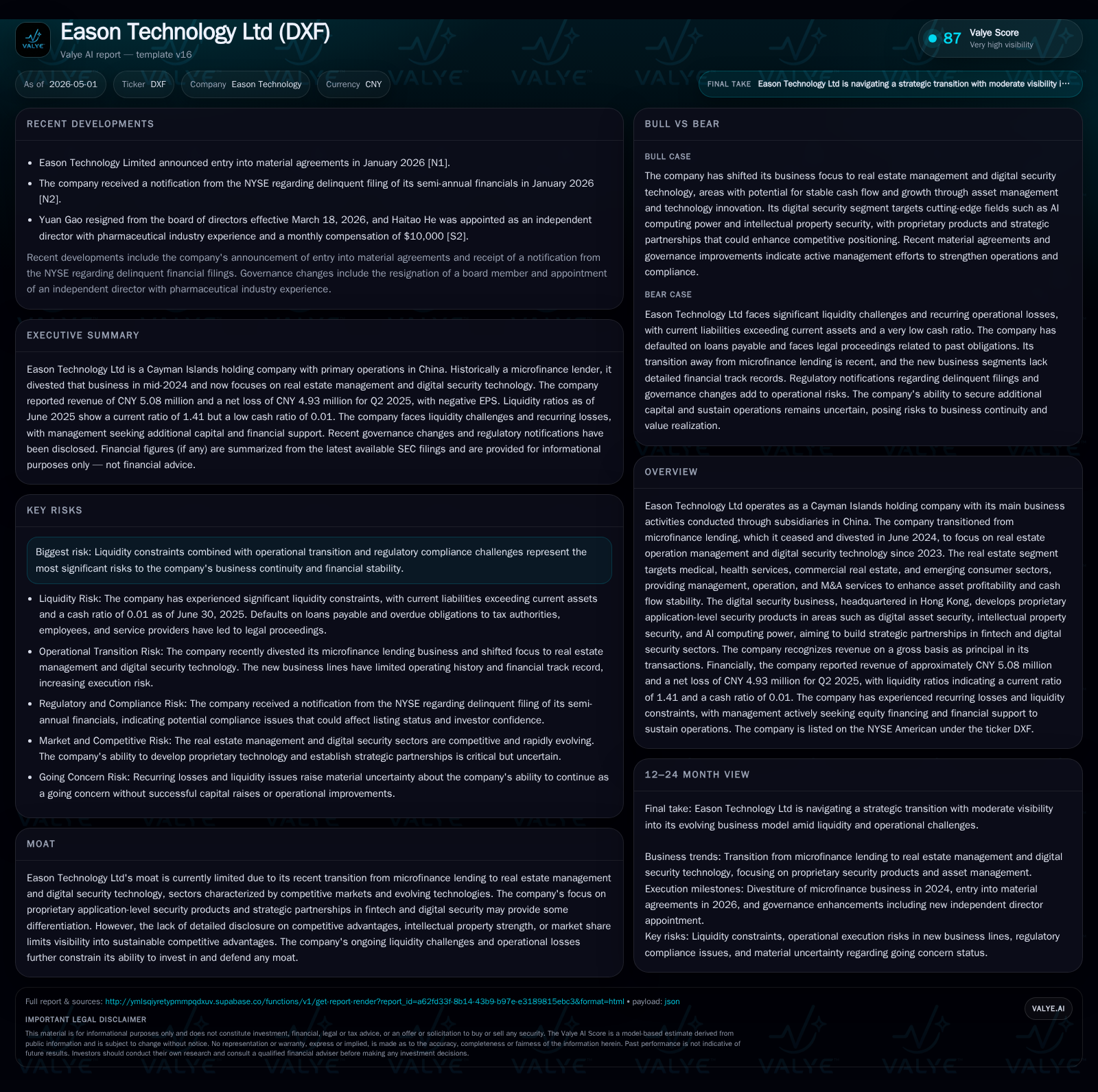
In its latest quarterly filing dated March 19, 2026, Eason Technology announced a key board appointment signaling a professionalization push aligned with its pivot towards healthcare-themed real estate operations and cutting-edge digital security. The company has fully exited microfinance and now concentrates on managing assets in commercial, medical, and emerging consumer real estate, alongside developing proprietary application-level fintech security products in Hong Kong. Competitive visibility remains limited as the firm wrestles with liquidity constraints and operational challenges during this transition. Growth depends heavily on successful M&A execution in real estate and fostering strategic fintech partnerships for its digital security solutions.
Executive Leadership Update: Board Composition and Expertise
The quarter ended March 19, 2026 marked a significant governance update for Eason Technology as Haitao He joined the Board of Directors as an independent member [S2]. Mr. He brings over a decade of pharmaceutical industry experience specializing in marketing, sales channel development, and business operations. His prior leadership roles include Marketing Manager at Sichuan Datong Xinhong Pharmaceutical Group and General Manager at Midou Industry (Shanghai), where he developed domestic and overseas pharmaceutical distribution networks [S2]. This skill set is directly relevant to Eason's focused expansion into healthcare-related real estate assets and emerging consumer sectors — areas benefiting from strong supply chain coordination and regulatory knowledge. The monthly compensation of $10,000 signals a step towards professionalizing governance critical for navigating new markets [S2]. Meanwhile, director Yuan Gao resigned effective March 18 without operational disagreements [S2]. Concurrently, the March 18 AGM reaffirmed incumbent directors including Mr. He pledging continuity in leadership amid transformation [S3].
Eason Technology’s Business Model Transformation
Eason Technology has undergone a fundamental reinvention from its legacy microfinance lending operation to a dual-segment business model emphasizing real estate operation management alongside proprietary digital security technology [S1]. The company divested all interests in its Variable Interest Entity (VIE) microfinance subsidiaries by June 2024 after suspending loan issuance amid severe financial constraints dating back to second half of 2019 [S1]. Post-divestiture, the firm rebranded from Dunxin Financial Holdings Limited to Eason Technology Ltd early 2025 reflecting strategic repositioning [S1][S10].
The real estate segment operates predominantly within China targeting key industries: medical and health services facilities, commercial retail spaces, and emergent consumer asset classes. Eason acts as asset manager/operator with capabilities extending to mergers & acquisitions advisory aimed at elevating portfolio profitability while ensuring stable cashflow generation [S1]. The arrangement generally involves managing entrusted or self-owned assets with revenues recognized on a gross principal basis denoting direct responsibility for service delivery [S1][S22].
In tandem, the digital security business is headquartered in Hong Kong operating global fintech/digital security initiatives. This unit develops application-level security offerings focusing on digital asset protection, intellectual property rights safeguarding through blockchain technologies, as well as AI computing power management tools [S1]. The emphasis on proprietary intellectual property underpins attempts at forging comprehensive strategic partnerships with financial institutions and smart technology firms intending to carve out competitive differentiation within the fast-evolving fintech sector.
Reviewing Product and Service Quality in Real Estate and Digital Security
The quality proposition of Eason's offering hinges on niche specialization coupled with technical innovation. Within real estate management, specialization in medically oriented health services properties signifies longer-term demand durability anchored by structural demographic trends such as aging populations necessitating sustained healthcare infrastructure investment. Commercial properties leverage urban consumer spending patterns while emerging consumer sectors present higher growth prospects albeit with increased operational complexity [S1].
On the technology front, developing proprietary application-layer cybersecurity solutions that integrate blockchain-enabled intellectual property protections represents an advanced entry point addressing critical vulnerabilities in digital finance ecosystems. This approach potentially offers some switching cost advantages over commodity cybersecurity providers but remains nascent amid intense competition across global fintech hubs [S1]. The company's emphasis on building partnerships rather than purely selling standalone software aligns with broader industry moves toward ecosystem integration.
Competitive Environment and Industry Structural Dynamics
Eason’s pivot confronts structural headwinds inherent in both targeted sectors. The Chinese real estate operation market is fragmented with many local players serving regional portfolios; navigating regulatory scrutiny remains complex particularly around commercial land use and healthcare facility licensing [S1]. In digital security technology, rapid innovation cycles demand continuous R&D investment that Eason has yet to substantively undertake; existing major competitors operate with stronger IP moats or deeper venture capital backing [S1][S7].
Valye analysis indicates limited sustainable moat given recent transition efforts combined with ongoing operational losses constraining scale economies or technological lead establishment. Regulatory uncertainty within China’s dual economic reform policies targeting financial sector tightening further complicates market entry especially for foreign-associated entities like its Hong Kong-based tech subsidiary [S1][S14].
Drivers Behind Eason’s Growth Outlook
Key growth levers center on two fronts: expanding medical-related commercial real estate holdings through acquisitions or long-term management contracts promises incremental fee income plus recurring operational cash flow enhancements per portfolio scale effects [S1]. Revenue recognition practices reflect principal activities indicating asset control which may improve margin profiles if execution stabilizes.
Simultaneously, adoption of blockchain-based intellectual property protection tools alongside AI-powered computing resource management holds potential for fee-based revenue streams stemming from licensing or managed service agreements targeting fintech clientele [S1]. The company’s acquisition agreement signed late 2025 to buy into Hongkong Starlux Intelligent Technology—focused on blockchain security—indicates concrete moves towards technology domain expansion though completion remains pending [S20].
Strategic partnerships are positioned as crucial accelerants for market penetration especially linking their security offerings into embedded fintech workflows where trustworthiness is paramount. Success depends on not only product maturation but also capitalization adequacy enabling sustained commercial development amid upfront investment needs.
Risks, Liquidity Constraints, and Operational Challenges
Liquidity constitutes a prominent risk factor limiting operational flexibility. Despite a director-signed financial support letter evidencing intra-company confidence injections, inability to access formal banking credit lines due to impaired loan receivables tightened funding severely starting early 2019 continuing into recent periods [S4][S5][S18]. The current ratio near 1.41 signals only moderate buffer against short-term liabilities without surplus liquid reserves reported as RMB3.3 million (~$0.5 million) end-2025 amidst net current liabilities around RMB8.6 million ($1.2 million) [F1][S16][S17].
The legacy from credit-impaired loans payable dating back several years compounds legal proceedings risks related to former VIE entities disposed of mid-2024 although currently no direct legal exposure exists for Eason post-divestiture [S20]. Management must balance pursuit of long-term business plans against immediate cash conservation measures including expense controls or possible asset disposals if new financing falls short.
Additionally, sector-specific risks encompass regulatory complexities affecting healthcare-related property operation rights in PRC markets coupled with rapid technological evolution in fintech cybersecurity demanding continual adaptation lest products become obsolete [S1][S14]. Execution risks associated with integrating acquired blockchain security firms remain material given limited historical R&D investment demonstrated.
Near-Term Milestones and Monitoring Points
Upcoming events warrant close attention: the outcomes of board member re-elections finalized at the March AGM provide governance clarity that can affect strategic continuity especially under transformation pressures [S3]. Progress on securing licenses or certifications validating digital security product compliance will be critical for industry acceptance.
Real estate portfolio valuation trends reflecting macroeconomic shifts or local policy changes will directly impact revenue sustainability while effective execution of mergers or acquisitions signed late 2025—such as the approximately RMB24.6 million purchase of a commercial property paid partly by new shares—will indicate traction on stated growth objectives [S20].
Finally, any announcements regarding new equity financings or private placements aimed at alleviating capital constraints will be pivotal given stated capital insufficiency concerns which otherwise threaten development curtailment per management commentary [S4][S5][S21].
Condensed Financial Overview Supporting Operating Developments
Although deep financial drill-down is constrained by recent quarter disclosure limits, available data illustrates persistent operating losses juxtaposed with small positive cash flow improvements recently: net loss was RMB8 million ($1.1 million) during year ended December 31, 2025 versus a significantly higher loss exceeding RMB500 million ($69 million) previous year due largely to divesture impacts per annual filing notes [F1][S17]. Interest expenses remain material mainly driven by convertible notes carrying an approximate annual rate of 8% adding financing burden [S1].
Cash equivalents totaled approximately RMB3.3 million ($0.5 million), underscoring tight liquidity despite management’s expectation that forthcoming operating improvements combined with equity/debt fundraising may maintain solvency for coming fiscal year windows [F1][S4][S16]. While cost structure adjustments lowered general administrative expenses post-divestiture by nearly RMB2.7 million year-over-year supporting leaner operations, the overarching challenge lies in realizing scale effects required to sustainably bridge losses into profitability.
This financial backdrop substantiates operational risks described earlier yet validates that ongoing transitional efforts may be yielding modest early stability gains contingent upon successful capital injection execution.
Disclaimer: This report is an independent analysis grounded exclusively on publicly filed documents dated up through April 30, 2026; it does not constitute investment advice or endorsements but aims solely to inform understanding of Eason Technology Ltd's current strategic posture and operating environment based on disclosed facts.
Disclaimer: This is research-only, informational analysis and not investment advice. It may include AI-generated interpretation and general industry context. Always verify important details using primary sources.

Comments