
Zimmer Biomet Strengthens Market Position with Strategic Acquisitions and Restructuring
Recent quarterly filings highlight Zimmer Biomet’s acquisition progress, operational restructuring, and financial posture supporting its competitive medical device market presence.
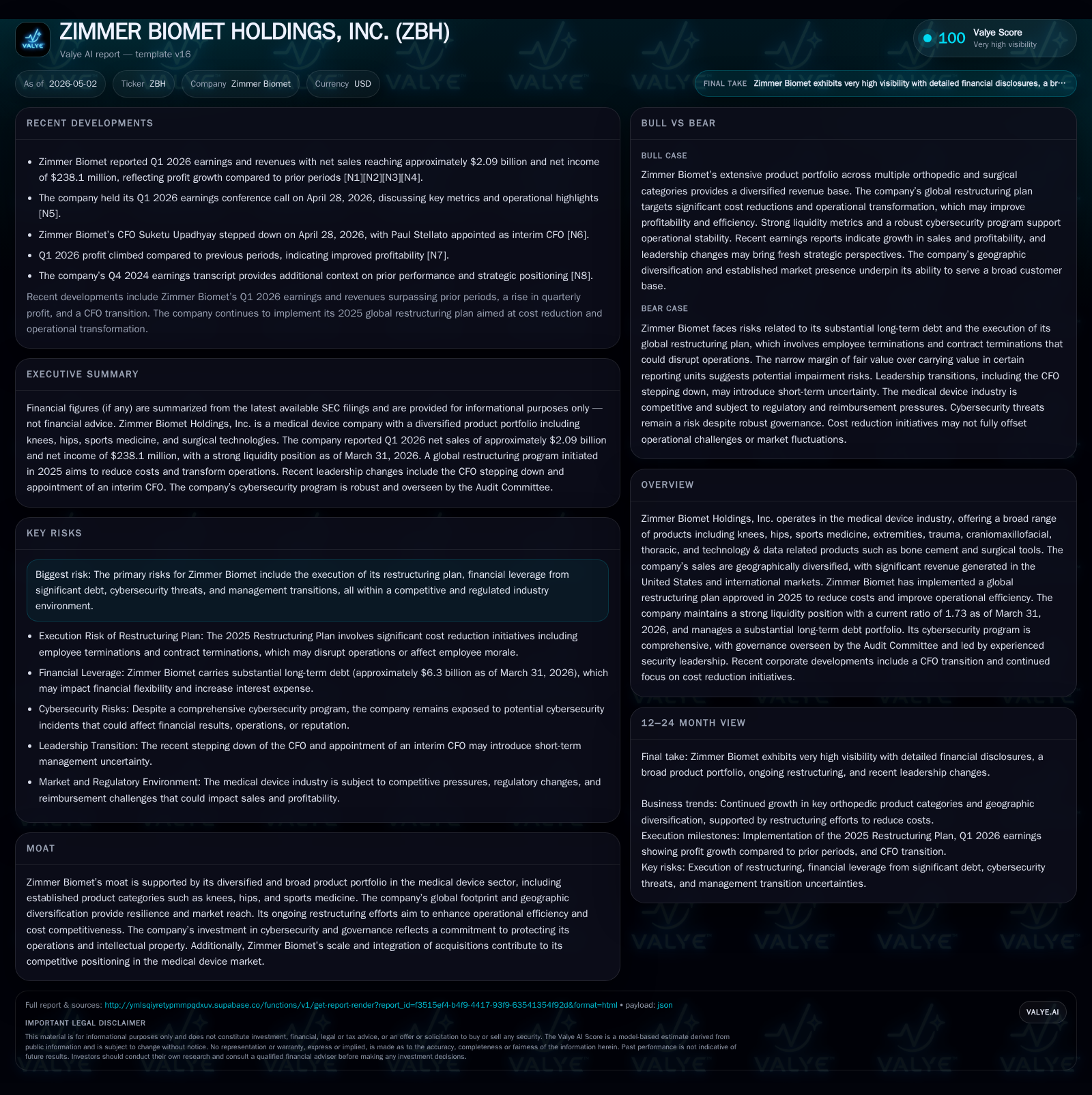
Zimmer Biomet's latest quarter underscores its commitment to expanding technological capabilities through acquisitions like Monogram Technologies and Paragon 28. The company maintains a strong liquidity position despite significant debt, aided by a strategic global restructuring plan approved in 2025 aimed at improving efficiency. Its diversified product portfolio across orthopedic segments, paired with geographic reach and cybersecurity initiatives, fortify its competitive moat amid industry challenges. Key risks include execution of restructuring and managing financial leverage.
Recent Operating Update
Zimmer Biomet’s Q1 2026 filing (10-Q dated May 1) reveals significant operating activity focused on strategic acquisitions and structural improvements. The company invested $175.9 million upfront for Monogram Technologies with contingent value rights offering up to approximately $570 million through achievement of specified product development, regulatory approvals, and revenue milestones extending to 2030 — underscoring an aggressive focus on next-generation technology integration [S2]. The acquisition-related expenses totaled $19.6 million in the quarter.
Meanwhile, the Paragon 28 acquisition from April 2025 remains under preliminary purchase price allocation review as tax-related accounts and contingent assets are finalized with completion expected within one year post-acquisition date. These deals diversify Zimmer Biomet’s product portfolio notably in extremities and robotic-assisted surgery solutions.
The company has also restructured to streamline operations into five main reporting units: Americas excluding CMFT (Craniomaxillofacial) and Foot & Ankle; Americas CMFT; EMEA excluding Foot & Ankle; Asia Pacific excluding Foot & Ankle; and a Global Foot & Ankle business unit [S2]. This segmentation reflects both geographic diversification and product grouping enabling sharper operational focus.
Liquidity remains solid with a current ratio of 1.73 at quarter end supported by total current assets of approximately $4.96 billion against current liabilities near $2.86 billion [F1]. However, Zimmer Biomet manages substantial long-term net debt nearing $1.56 billion (total debt minus cash) indicating financial leverage that warrants attention for cash flow management [F1].
Additionally notable is leadership evolution with the CFO stepping down in April 2026 and an interim CFO appointed—a transition period that may impact financial strategy execution briefly but is managed proactively [N10][S3].
Business Model Overview
Zimmer Biomet operates predominantly within the orthopedic medical device sector specializing in surgical implants and related products that include knees, hips, sports medicine devices, trauma products, craniomaxillofacial implants, thoracic solutions, bone cement technologies, and surgical tools. Revenue streams derive from hospitals, ambulatory surgical centers, specialty distributors, and group purchasing organizations worldwide.
Sales volume is influenced by demographic trends such as aging populations increasing demand for joint replacements alongside rising sports injuries fueling the sports medicine segment. Pricing power is underpinned by proprietary designs backed by clinical efficacy data while regulatory approvals create high barriers to entry for competitors.
Technology adoption—especially robotic-assisted surgery platforms stemming from Monogram Technologies acquisition—signals attempts to capture share from evolving procedural techniques enhancing surgeon accuracy and patient outcomes.
Renewable contracts with healthcare providers and integrated customer service strengthen customer retention. Geographic diversification reduces exposure to single-market reimbursement pressures while scale allows investment in R&D as well as supply chain efficiencies.
Industry Structure and Competitive Position
The global orthopedic device market is highly competitive featuring players like Stryker Corporation, DePuy Synthes (Johnson & Johnson), Smith & Nephew, among others. Zimmer Biomet commands a meaningful share due to its breadth of product offerings spanning multiple musculoskeletal categories.
Barriers include stringent FDA/regulatory compliance requirements globally along with the need for continuous innovation driven by clinicians’ evolving procedural preferences. Consolidation trends favor companies capable of scale economies or niche specialization supported by digital health integration.
Zimmer Biomet's expanded footprint through acquisitions (Monogram Technologies for robotics; Paragon 28 for extremities) boosts its differentiated offering along clinical efficacy lines. The company’s focused restructuring to control costs improves agility relative to entrenched yet sometimes less nimble competitors.
Cybersecurity strategy led by veteran CISO underscores risk sensitivity especially given intellectual property exposure inherent in medtech innovation pipelines [S1].
Growth Drivers
- Acquisitions Enhancing Innovation: Adding Monogram Technologies integrates robotics into Zimmer’s surgeries enabling improved procedural accuracy—a fast-growing space globally reflecting surgeon adoption trends.
- Global Restructuring Program: Streamlining operations into focused reporting segments anticipates cost reductions boosting margins while maintaining necessary R&D investment flexibility.
- Product Portfolio Diversification: Broad category coverage cushions cyclical swings seen in elective surgeries susceptible to reimbursement changes or macroeconomic factors.
- Geographic Expansion: Increasing penetration in Asia Pacific and emerging markets diversifies growth beyond mature North American/European markets where pricing pressure intensifies.
- Technological Differentiation: Advances in bone cement formulations and data-driven surgical tools build intellectual capital defensibility bolstering physician preference.
- Demographic Tailwinds: Aging populations worldwide expand eligible patient pools for joint replacement surgeries supporting sustained volume growth.
Risks and Growth Constraints
- Execution Risk on Restructuring: Cost-saving plans must be implemented without compromising product development pipelines or customer service quality—failure could impair competitiveness.
- High Leverage: Net debt remains elevated (~$1.56 billion), creating interest expense burdens that could limit financial flexibility amid potential economic headwinds or unforeseen costs [F1].
- Cybersecurity Threats: Despite robust governance frameworks, medtech firms remain targets due to sensitive IP which if compromised could damage reputation or disrupt production cycles [S1].
- Management Transitions: CFO departure presents short-term leadership continuity challenges affecting financial oversight precision though mitigated by interim appointment [N10][S3].
- Regulatory Complexity: Multiple jurisdictions' differing medical device regulations require sustained compliance investments slowing new product rollout timelines.
- Competitive Pressures: Intense rivalry with peers committed to similar innovation trajectories pressures pricing power especially outside specialty niches.
What to Watch Next
Investors following operational cues may monitor:
- Progress on achievement of Monogram Technologies' milestone payments indicating commercial traction of robotic platforms through 2030 [S2].
- Updates on Paragon 28 final purchase price allocation completing tax-related accounts within one-year post-acquisition timeline [S2].
- Realization of projected cost savings from the global restructuring plan as reflected through margin expansion or SG&A improvements [S2][N3].
- New product launches or clinical study results validating innovations across knee/hip replacements or sports medicine segments impacting physician adoption.
- Debt servicing capacity given interest expenses against cash flow generation especially factoring any macroeconomic tightening scenarios [F1][N10].
- Cybersecurity incident reports or audit committee disclosures hinting at risks materializing despite controls framed in risk environment statements [S1].
- Executing smooth CFO transition maintaining stable financial communication transparency during this interval [N10][S3].
Financial Profile Summary
Latest financial snapshot
| Metric | Value | Period |
|---|---|---|
| Cash & equivalents | $424mm | |
| 2026-03-31 | ||
| Current assets | $5.0bn | |
| 2026-03-31 | ||
| Current liabilities | $2.9bn | |
| 2026-03-31 | ||
| Current ratio | 1.73x | |
| 2026-03-31 |
Source: SEC companyfacts cache [F1].
Zimmer Biomet maintains liquidity marked by $424 million cash plus equivalents against current liabilities generating a current ratio of approximately 1.73 as of March 31, 2026—a healthy buffer for short-term obligations aligned with operational needs [F1][S2]. Total long-term debt approximates $1.98 billion (based on last available figure), netting roughly $1.56 billion after cash consideration reflecting meaningful leverage although aligned with industry norms for medtech firms emphasizing acquisition-fueled growth strategies [F1]. Interest expenses are offset partially by disciplined refinancing activities illustrated by issuance notes like recent NYSE listed bonds maturing through the early ’30s signaling diversified funding sources [S3]. Acquisition costs such as Monogram Technologies transaction fees weigh on near-term profitability but aim accretive long-term returns reflecting strategic priorities.
This analysis synthesizes latest SEC filings combined with recent industry context without providing investment advice or recommendations.
Disclaimer: This is research-only, informational analysis and not investment advice. It may include AI-generated interpretation and general industry context. Always verify important details using primary sources.

Comments