
Catalyst Pharmaceuticals Advances its Orphan Drug Franchise Amid Patent Litigation Developments
A delayed patent trial and strategic product positioning are pivotal to Catalyst’s outlook in specialized rare disease therapeutics.
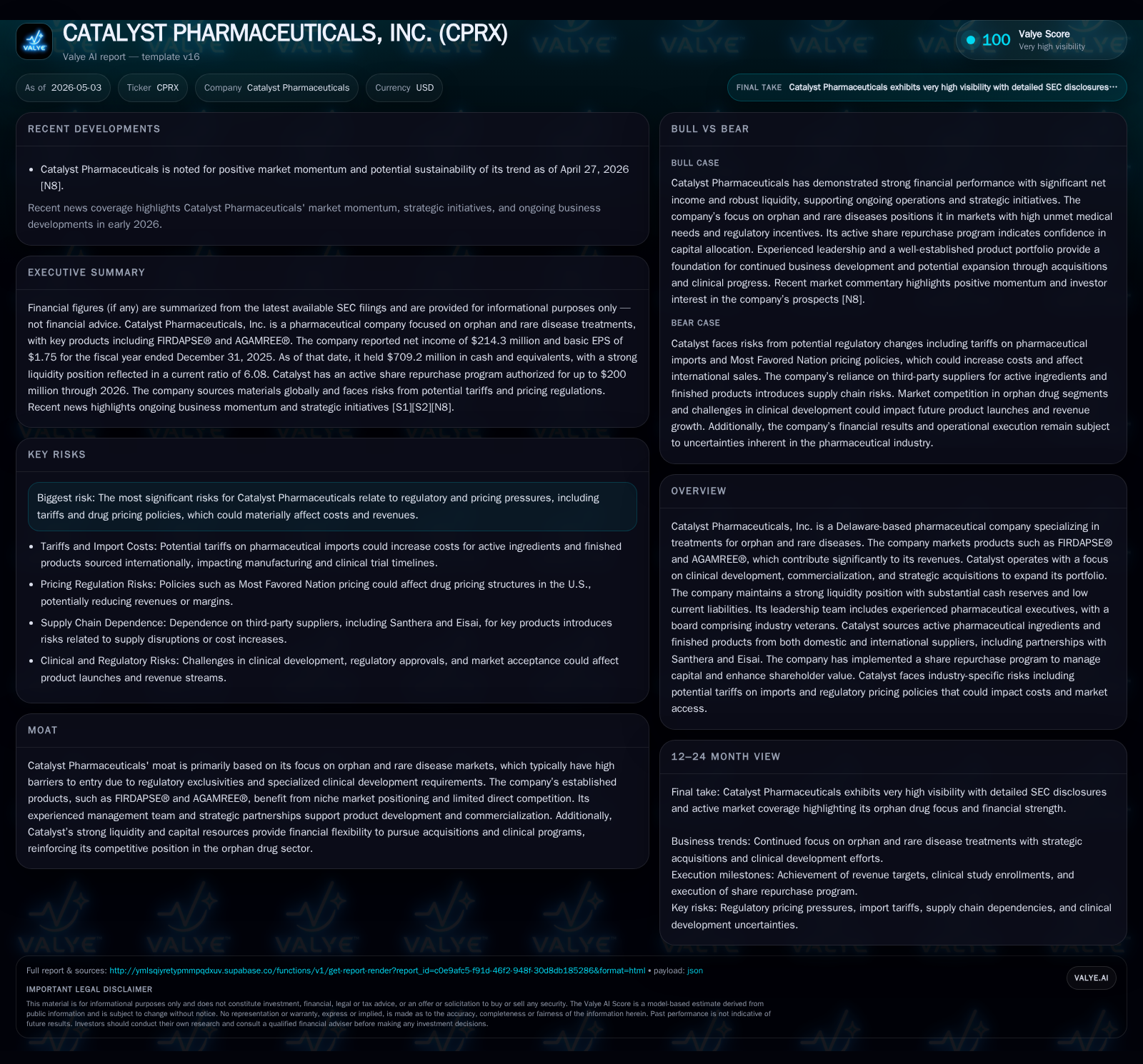
Catalyst Pharmaceuticals recently announced a postponement of its critical bench trial concerning FIRDAPSE® patent validity, extending exclusive rights protection risks into mid-2026. This delay underscores the ongoing litigation dynamics impacting its flagship orphan drug’s competitive landscape. Catalyst’s core business model capitalizes on niche orphan and rare disease markets with proprietary products benefiting from regulatory exclusivities, backed by strong liquidity and experienced leadership. Future growth will hinge on pipeline progression, commercial expansion, and navigating pricing and tariff-related headwinds.
Recent Operating Update: Patent Trial Delay and Market Implications
Catalyst Pharmaceuticals announced in an 8-K filing dated March 18, 2026, that the District Court for the District of New Jersey postponed the start of the bench trial against Hetero USA, Inc. from March 23 to May 18, 2026 [S3]. This trial concerns the validity of Catalyst's Orange Book-listed patents for FIRDAPSE®, which have expiration dates extending through 2032, 2034, and 2037. The delay introduces a temporal extension of uncertainty around generic entry risks but also preserves potential exclusivity if patents hold.
This patent litigation represents a critical defensive pillar for Catalyst's flagship drug in an orphan indication (Lambert-Eaton Myasthenic Syndrome), a high-barrier niche market with limited direct competition [S1]. The upheld patents could sustain market exclusivity well into the next decade. However, even with limited generic threats currently realized due to settled litigations with other defendants (e.g., Lupin agreement ensuring no generic launch before February 2035) [S17], any adverse ruling could materially influence FIRDAPSE®'s revenue trajectory.
Business Model and Core Product Portfolio
Catalyst focuses exclusively on developing and commercializing therapies targeting orphan and rare diseases. Its revenue largely stems from proprietary products like FIRDAPSE® (amifampridine) for Lambert-Eaton myasthenic syndrome and AGAMREE®, both catering to narrowly defined patient populations requiring specialized treatment [S1]. These products benefit from orphan drug exclusivity provisions granted by regulatory authorities, facilitating premium pricing supported by relatively inelastic demand due to few alternatives.
The company’s business model integrates active pharmaceutical ingredient sourcing and finished product distribution through partnerships with international entities such as Santhera (for AGAMREE®) and Eisai (for FYCOMPA®), which it secures via long-term supply agreements extending at least through 2029 [S2]. Additionally, Catalyst has embarked on internalization strategies for manufacturing capabilities to reduce supplier dependency risks seen across industry supply chains.
Revenue streams are driven by sales volumes in rare disease markets with highly specific diagnostic criteria; volume growth correlates closely with efforts to expand physician awareness and improve testing adoption rates for voltage-gated calcium channel (VGCC) antibodies linked to associated conditions [S1]. Pricing power remains strong due to regulatory protections but is tempered by evolving healthcare reimbursement landscapes.
Competitive Position within Orphan and Rare Disease Therapeutics
The orphan drug space is characterized by intrinsic high barriers including costly clinical development programs tailored to small patient populations, regulatory exclusivities lasting up to seven years post-approval under the Orphan Drug Act, and patent protections like those held on FIRDAPSE® ["Valye_report_excerpt", S1]. Catalyst leverages these structural moats alongside an experienced management team versed in rare disease niches. This focus reduces direct competition risk while enabling sustained pricing premiums.
Nonetheless, the company faces indirect competition pressures from alternative therapeutic modalities or emerging entries pending patent adjudications [S17]. Catalyst’s capability to defend its intellectual property aggressively has led to settlement agreements deferring generic launches to mid-2030s timelines. Strategic alliances augment its commercial reach despite resource constraints typical of smaller biopharma entities.
Growth Drivers: Pipeline, Market Expansion, and Strategic Partnerships
Potential growth avenues for Catalyst include expanding indications for FIRDAPSE® via clinical trials such as the SUMMIT study enrolling patients with small cell lung cancer-related Lambert-Eaton syndrome [S1]. Increasing uptake of VGCC antibody testing aligns with National Comprehensive Cancer Network guideline inclusions updated in August 2025—efforts expected to double testing volumes compared to prior periods—facilitating earlier diagnosis and broader patient treatment candidacy [S8].
Moreover, Catalyst intends to deepen manufacturing autonomy for AGAMREE®, reducing reliance on Santhera-supplied inventory thus improving cost control and supply chain reliability [S2]. Strategic acquisitions remain part of management's playbook targeting late-stage assets complementary to existing orphan portfolios with confirmed diligence processes underway [S29].
Geographically, the company explores incremental market penetration opportunities beyond the U.S., although export initiatives face potential challenges linked to retaliatory tariffs under trade probe considerations [S2]. Upsides from favorable label expansions or new regulatory approvals would extend product lifecycle value considerably.
Risks and Challenges: Regulatory, Pricing Pressure, and Supply Chain Vulnerabilities
Catalyst operates amid significant headwinds relating primarily to U.S. trade policy uncertainties. The Department of Commerce's April 2025 Section 232 investigation into pharmaceutical imports raises the specter of tariffs on key imported active ingredients or finished dosage forms sourced internationally—a material concern given current supplier geographies including Santhera (Switzerland) and Eisai (Japan) [S2]. Escalated costs or delays could adversely affect production timelines.
Further complicating end-market dynamics are Most Favored Nation (MFN) pricing proposals targeting alignment between international drug prices and U.S. Medicaid/Medicare payments. Although large pharmaceutical firms have engaged with administrative relief attempts, these policies threaten established pricing frameworks sustaining profitability in orphan segments like those addressed by Catalyst [S2].
Patent litigation outcomes remain an existential variable with ongoing disputes against Hetero USA unresolved at present; any unfavorable judgment jeopardizes exclusivity windows vital for financial forecasting [S3]. Supply chain disruptions related to foreign sources add additional operational complexity requiring mitigations such as developing domestic production capacity.
Forward-Looking Considerations: Key Milestones and Catalysts Ahead
Key upcoming events include the scheduled commencement of the patent bench trial on May 18, 2026 against Hetero USA—a pivotal legal determinant affecting long-term protection of FIRDAPSE®'s market exclusivity [S3]. Success or adverse rulings here will materially influence competitive risk assessments.
On clinical fronts, tracking enrollment progress within studies like SUMMIT provides visibility into potential label expansions enhancing addressable patient populations ["Valye_report_excerpt"]. Monitoring evolving tariff investigation outcomes under Section 232 remains critical given their impact on cost structures and supply resilience.
Management’s execution on internal manufacturing rollouts for AGAMREE® production remains another watchpoint influencing margin profiles. Additionally, progress toward acquisitions within orphan drug spaces will serve as strategic growth indicators through late-2026 [S29].
Latest Financial Snapshot
Latest financial snapshot
| Metric | Value | Period |
|---|---|---|
| Cash & equivalents | $709mm | |
| 2025-12-31 | ||
| Current assets | $894mm | |
| 2025-12-31 | ||
| Current liabilities | $147mm | |
| 2025-12-31 | ||
| Current ratio | 6.08x | |
| 2025-12-31 |
Source: SEC companyfacts cache [F1].
Catalyst displays a solid financial base underpinning its operational initiatives. As of December 31, 2025, cash and cash equivalents stood at approximately $709 million versus current liabilities of roughly $147 million — yielding a strong current ratio near 6.08 — indicative of healthy liquidity coverage reflecting conservative balance-sheet management [F1]. Net income was reported at about $214 million for fiscal year 2025 illustrating profitable operations supported by robust product revenues from FIRDAPSE® and AGAMREE® [F1].
Furthermore, Catalyst has authorized a fresh $200 million share repurchase program effective October 2025 through year-end 2026 signaling confidence in cash flow generation capacity alongside capital return strategies aimed at enhancing shareholder value without compromising financial flexibility [S2].
Disclaimer: This analysis is based solely on publicly filed SEC documents as noted in citations without financial advice or investment recommendations. All data reflects reported figures as of stated filing dates.
Disclaimer: This is research-only, informational analysis and not investment advice. It may include AI-generated interpretation and general industry context. Always verify important details using primary sources.

Comments