
Eaton Corp plc Advances Power Management and Signals Strategic Mobility Spin-Off
Eaton unveils strong quarterly results with a new Mobility segment and strategic acquisitions enhancing its power management and aerospace portfolios.
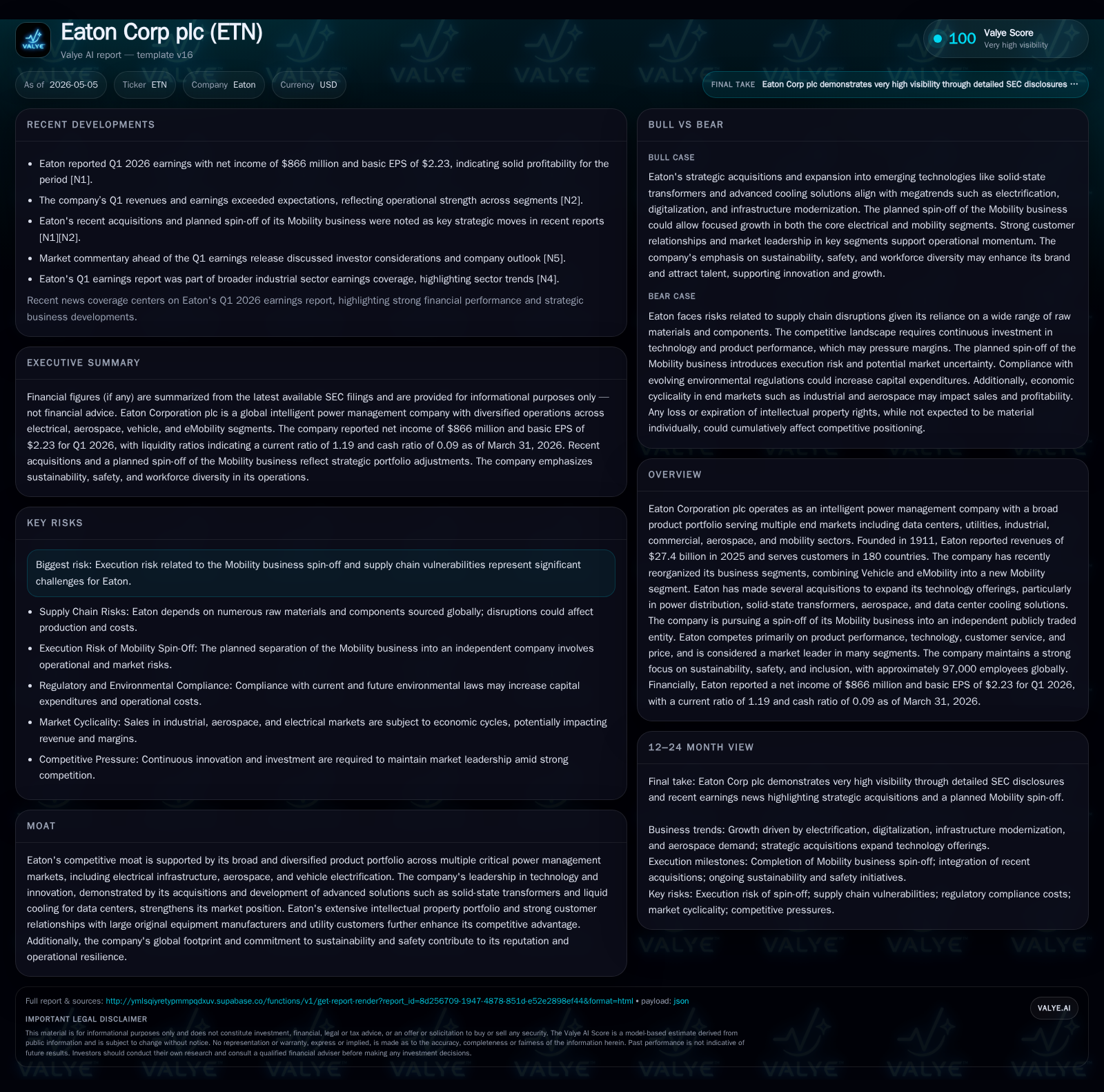
In the latest 10-Q filing for Q1 2026, Eaton Corporation plc reorganized its business segments by combining Vehicle and eMobility into a new standalone Mobility segment ahead of a planned spin-off. The company also completed key acquisitions in power distribution, data center cooling, and aerospace technologies, reinforcing its innovation-driven growth strategy. Eaton’s extensive product portfolio serves critical infrastructure markets worldwide, supported by strong competitive positioning amid favorable industry megatrends such as electrification and digitalization. Near-term risks include execution challenges related to the Mobility spin-off and supply chain continuity.
Latest Quarterly Operating Highlights
Eaton’s Q1 2026 10-Q filing [S2] details a significant reorganization of its reporting segments by consolidating the legacy Vehicle and eMobility segments into a new 'Mobility' segment. This re-segmentation aligns with the company’s announced intention in early 2026 to spin off this combined Mobility business as an independent publicly traded entity [S4]. The 10-Q marks the first formal quarterly disclosure incorporating this structure though comprehensive segment financials for Mobility will appear starting in Q2.
The quarter also saw completion and expansion on multiple strategic acquisitions made during late 2025 and early 2026: Resilient Power Systems (solid-state transformer commercialization), Fibrebond (modular data center infrastructure), Ultra PCS (aerospace electrification), and agreement to acquire Boyd Thermal (critical liquid cooling for hyperscale data centers) [S1]. These moves underscore Eaton’s commitment to enlarging its footprint in technologically advanced power management solutions across data center cooling, power conversion innovation, and aerospace electrification.
Importantly, the company reports no material changes to risk factors since its 2025 Form 10-K [S9], indicating stable operating risk profiles despite ongoing strategic shifts.
Eaton’s Business Model and Segment Dynamics
Eaton generates revenue through a diversified portfolio spanning electrical infrastructure (Electrical Americas & Global), Aerospace, Vehicle, eMobility (now part of Mobility), industrial applications, commercial building systems, machine building, residential sectors, and more [S1][S7]. The newly formed Mobility segment encapsulates both traditional Vehicle components alongside advanced eMobility technologies reflecting EV transitions.
Revenue is driven by sales to utilities, hyperscale data centers, automotive OEMs, aerospace manufacturers (both commercial and military), industrial firms, and commercial real estate operators. Customers pay for well-engineered products that promote reliability, safety, efficiency gains, total cost of ownership benefits, sustainability credentials, as well as aftermarket service support which creates switching cost barriers.
Technological differentiation is evident with offerings like solid-state transformers facilitating next-generation power distribution with smaller size and enhanced efficiency; liquid cooling systems addressing energy-intensive data center heat loads; aerospace electric propulsion components advancing more sustainable aircraft platforms [S1]. Product mix improvements in these areas correlate directly with expanding margins potential given premium pricing on cutting-edge engineering solutions.
Competitive Position and Industry Context
Within several fragmented yet capital-intensive industries—power management components for grid modernization; vehicle electrification drivetrains; aerospace systems—the competitive landscape sees players competing heavily on product performance metrics such as efficiency and durability; innovation cadence; systemic integration capabilities; service quality; price competitiveness; and compliance with robust environmental regulations [S7].
Eaton holds leadership status characterized by an extensive IP portfolio protecting proprietary technologies alongside global manufacturing scale enabling proximity to major OEM customers worldwide. Its presence across multiple critical points in the electrical value chain—from chip-to-grid control systems—further elevates barriers to entry thus constituting a durable moat supported by deep customer relationships at multi-year contract levels.
Supply chain resiliency efforts remain proactive amid global pressures to secure raw materials including copper alloys, specialty metals like titanium for aerospace parts, electronic components crucial for advanced modules [S19].
Growth Drivers and Strategic Initiatives
Growth trajectories gravitate strongly around key emerging technologies with near-term visibility:
- Commercial ramp-up of solid-state transformer deployments targeting data centers demanding scalable highly efficient power conversion infrastructure.
- Expanded thermal management solutions through Boyd Thermal acquisition addressing escalating cooling requirements within colocation/hyperscale operator ecosystems.
- Accelerated electrification uptake in commercial aerospace platforms via Ultra PCS integrated solutions aligning with sustainability mandates.
- The separation of the Mobility unit is seen as an enabler for sharper strategic focus enabling dedicated investment targeting EV powertrains balanced alongside ICE innovations within vehicle markets [S4].
Additionally banking on megatrends tied to regulatory pushes for carbon reduction underscores demand for electric grid modernization projects globally—utility-scale upgrades involving smart protective relay systems—and increased digital infrastructure spending supporting hyperscale cloud computing expansion drive sustained end-market growth [S1].
KPIs to watch include organic growth rates within Electrical sectors post acquisitions integration; adoption rates indicated by order backlog expansions for new transformer tech; early mobility standalone financial disclosures post-spin completion.
Risks and Operational Challenges
Two principal risk domains command attention:
- Execution risk related to disentanglement of the Mobility business — Any delays or operational dislocations surrounding this spin-off could affect investor sentiment or disrupt revenue continuity within the broader enterprise despite current disclosure indicating no material risk factor change since last annual report [S9].
- Supply chain vulnerabilities — Although Eaton invests in supplier diversification strategies there remains elevated exposure to raw materials price volatility alongside geopolitical tensions impacting component availability which could pressure costs or delivery timelines.
Cybersecurity governance remains sound backed by dedicated CISO reporting structures deployed at board level oversight but persistent threat vector evolution necessitates ongoing vigilance [S1].
Looking Ahead: Key Milestones and Market Indicators
Stakeholders should monitor forthcoming quarterly filings where detailed financial metrics will be separately reported for the new Mobility segment allowing clearer assessment of operational profitability trends within vehicle electrification businesses [S2][N1]. Integration milestones tied to recently acquired companies specializing in transformative technologies will be important early indicators validating management’s inorganic growth rationale. Additionally tracking multi-year frameworks of large utility renewals or hyperscale data center buildouts will offer forward-looking demand signals particularly around adoption velocities of Eaton’s solid-state transformers or liquid cooling modules [N3]. Earnings call commentary may provide incremental color on margin trajectories shaped by pricing discipline amid inflationary environments.
Current Financial Snapshot and Balance Sheet Overview
Latest financial snapshot
| Metric | Value | Period |
|---|---|---|
| Cash & equivalents | $565mm | |
| 2026-03-31 | ||
| Total debt | $18.5bn | |
| 2026-03-31 | ||
| Net debt | $18.0bn | |
| 2026-03-31 | ||
| Current assets | $14.0bn | |
| 2026-03-31 | ||
| Current liabilities | $11.7bn | |
| 2026-03-31 | ||
| Current ratio | 1.19x | |
| 2026-03-31 |
Source: SEC companyfacts cache [F1].
The latest balance sheet reflects diligent capital stewardship amid aggressive acquisition activity:
| Metric | Value | Period End |
|---|---|---|
| Cash & Equivalents | $565 million | |
| 2026-03-31 | ||
| Total Debt | $18.535 billion | |
| 2026-03-31 | ||
| Net Debt | $17.97 billion | |
| 2026-03-31 | ||
| Current Assets | $14.005 billion | |
| 2026-03-31 | ||
| Current Liabilities | $11.741 billion | |
| 2026-03-31 | ||
| Current Ratio | 1.19 | |
| 2026-03-31 |
Despite substantial net leverage primarily associated with financing recent acquisitions and strategic investments in emerging technologies such as solid-state transformers and aerospace electrification modules, liquidity remains adequate supported by a current ratio above unity indicating short-term payable coverage from available assets [F1]. Capital structure appears positioned to fund ongoing technology commercialization while awaiting cash flow synergy realizations post-spin.
This analysis is based solely on information publicly available through SEC filings dated up to May 5th, 2026 ([S1], [S2], [S3]) supplemented with authorized company facts ([F1]) and relevant market news ([N1],[N3]). No forward-looking statements or investment recommendations are offered herein.
Disclaimer: This is research-only, informational analysis and not investment advice. It may include AI-generated interpretation and general industry context. Always verify important details using primary sources.

Comments