
Schrodinger’s Dual Path: Software Innovation and Drug Discovery Trials
Schrodinger balances its computational software business with early-stage drug discovery, managing ongoing losses while investing in growth.
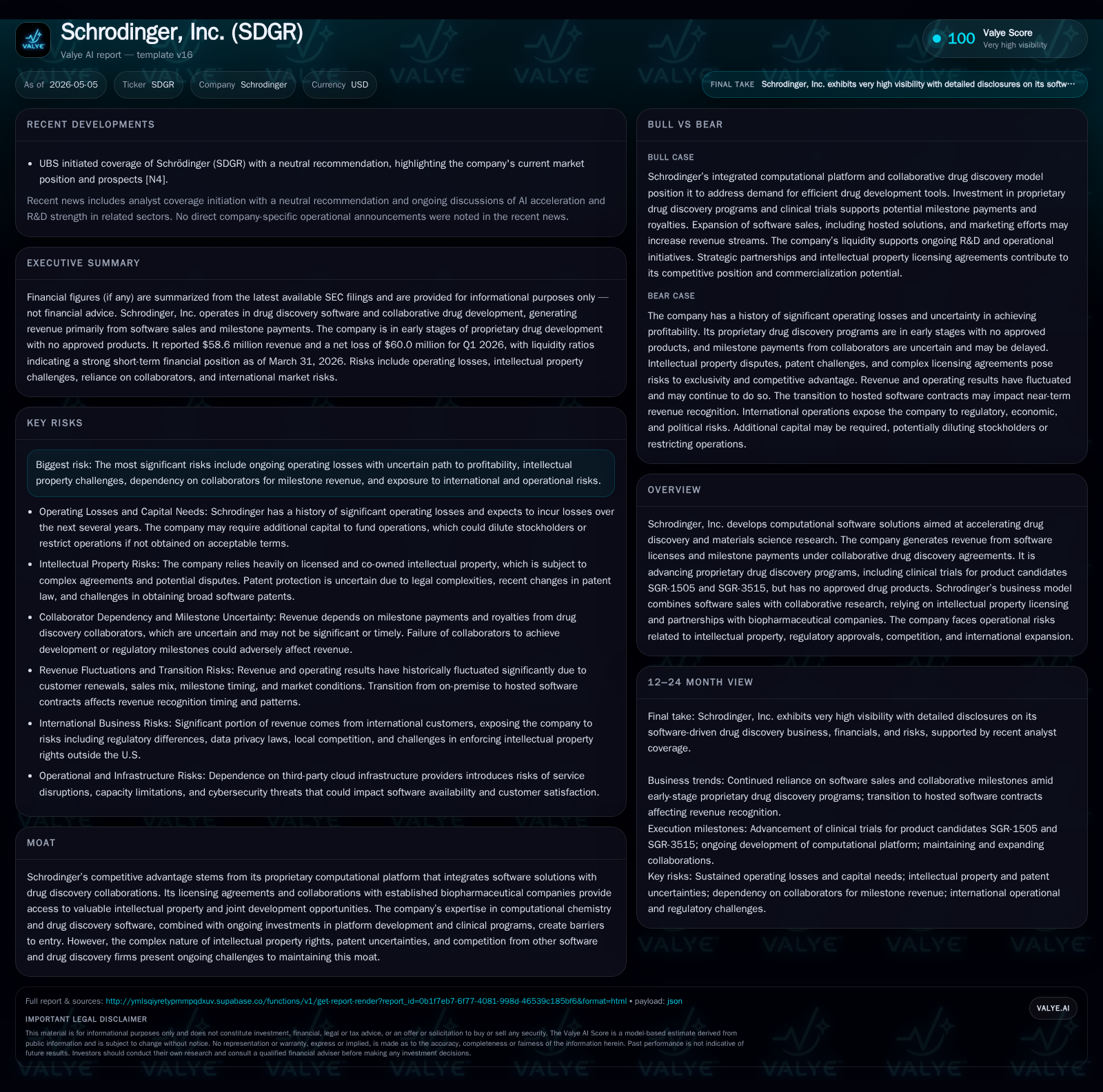
In its latest quarterly filing, Schrodinger reported stable operating losses of approximately $60 million in Q1 2026, reflecting continued investments in both its proprietary drug candidates and computational software platform. The company generates revenue primarily from software licensing and milestone payments through partnerships but has yet to commercialize its own drug products. Its competitive strength lies in an integrated computational platform combined with biopharma collaborations, while growth depends on expanding software adoption and clinical trial progress. Key risks include sustained operating deficits, intellectual property complexity, and regulatory hurdles. Upcoming clinical milestones and collaboration developments will be critical indicators of execution success.
Latest Quarterly Operating Update: Continued Investment Amid Stable Losses
Schrodinger’s Q1 2026 results detailed in the May 5, 2026 Form 10-Q reflect a consistent operating loss profile with a net loss of $60.0 million, essentially flat year-over-year compared to Q1 2025 [S2]. This steady cash burn underscores ongoing expenditures directed toward advancing the company’s dual thrust: software platform enhancement and proprietary drug discovery programs. Specifically, the firm continues dose-escalation clinical trials for its lead candidates SGR-1505 and SGR-3515 while simultaneously investing to expand its computational tools [S2][S3].
The company highlights no revenues have been generated from proprietary product sales to date; instead, income arises mainly from license fees for its computational chemistry software and achievement of milestones under collaborative research agreements with pharmaceutical partners [S2]. Schrodinger reported solid liquidity as of March 31, 2026, with cash & equivalents totaling approximately $260 million and a current ratio of 2.74, indicating sufficient near-term financial flexibility to sustain investments [F1].
This quarterly disclosure confirms the company's strategic commitment to maintain balanced growth investments despite persistent operating losses.
Business Model: Integrated Software and Collaborative Drug Discovery
Schrodinger operates a hybrid model combining sale of sophisticated computational software solutions with participation in collaborative drug discovery programs that may yield milestone payments [S1][S2]. Customers primarily include biopharmaceutical companies leveraging Schrodinger's computational platform to accelerate candidate identification and optimization. Licensing fees provide recurring revenue streams driven by contract volume, duration, and usage terms.
Simultaneously, Schrodinger pursues internally developed drugs through research programs targeting novel therapeutic modalities. While no products have yet reached commercialization stages, these internal projects — exemplified by SGR-1505 and SGR-3515 — are designed to complement software offerings by ultimately delivering proprietary pharmaceuticals [S2]. This integrated approach aims to diversify revenue sources beyond licensing into higher-margin drug sales upon successful approvals.
However, this business model also introduces complexity in scaling profitability due to the capital-intensive nature of clinical development combined with relatively lower-margin software sales at present. Effective coordination between platform innovation supporting partner needs and advancing in-house programs is critical for long-term value creation.
Competitive Positioning: Proprietary Platform and Partnership Moat
At the core of Schrodinger’s competitive edge is a proprietary computational platform that integrates advanced methodologies in physics-based modeling, machine learning algorithms, and chemical informatics tailored for drug discovery workflows [S1]. This technology serves as an enabling toolset not only for Schrodinger’s own pipeline but also as a foundational asset in collaborations with leading biopharma firms.
License agreements conferring access to this technology alongside joint development efforts erect significant entry barriers by blending cutting-edge innovation with strategic partner access to intellectual property. Yet these advantages require continuous investment in technology upgrades and vigilant protection of IP rights amid an industry rife with patent complexities.
Competition arises from both startups specializing in niche AI-driven discovery platforms and legacy pharmaceutical IT vendors broadening their digital offerings. Maintaining differentiation hinges on demonstrating superior predictive power combined with scalable integration into collaborators' R&D pipelines [S1].
Growth Drivers: Software Sales Expansion and Clinical Milestones
Software Adoption and Licensing Upsell
One principal lever for revenue growth lies in broadening the adoption of Schrodinger’s computational software across more customers or within existing accounts extending usage breadth. Enhanced capabilities aimed at improving predictive accuracy or ease-of-use can drive higher contract values or multi-year renewals contributing margin-rich license fees [S2].
Clinical Trial Progression Impacting Milestone Payments
Parallel advancement of internal drug candidates through clinical phases offers potential step-changes in revenue via milestone payments from collaborations or eventual downstream royalties should products reach commercial launch [S3]. Progress updates from Phase 1 dose-escalation trials for SGR-1505 and SGR-3515 are pivotal events likely to influence near-term revenue recognition patterns.
Platform Innovation Attracting New Partners
Continuous R&D investment enhances platform efficacy fostering appeal to additional biopharma partners seeking collaborative discovery arrangements. These agreements potentially generate upfront payments or ongoing service income bolstering top-line growth even before clinical milestones materialize [S2][S3].
Together these elements compose growth vectors that must be tracked via metrics such as increase in licensed seats/users, milestone achievements timing, renewal rates, and pipeline progression status.
Risks and Constraints: Profitability Pressure, IP Complexity, and Regulatory Challenges
Ongoing Operating Losses With Uncertain Profitability Horizon
Despite robust revenues from licenses and collaborations, Schrodinger continues incurring substantial net losses—$60 million per quarter recently—with expenses set to rise as clinical trials scale [S2]. The absence of approved products precludes direct commercial drug sales revenue today.
Intellectual Property Disputes And Licensing Risks
The intricate nature of multiple license agreements involves risk around contractual interpretation disputes or challenges concerning invention ownership. Should licensors consider agreements breached or litigate royalty obligations, the company could face delays or limitations impacting both product development timelines and software commercialization [S1].
Regulatory Hurdles In Drug Development Process
Pharmaceutical regulatory pathways impose numerous milestones fraught with uncertainty including trial outcomes scrutiny by FDA or foreign agencies subjecting candidates to delay or failure risks affecting associated financial milestones [S14][S25]. Moreover data security regulations pose incremental compliance costs especially given global operations.
Dependency On Collaborators For Revenue Streams
Much revenue depends on performance of partner pharmaceutical companies advancing co-developed projects; failure or postponement on their side directly depresses milestone inflows accentuating financial risk exposure.
Collectively these constraints demand cautious operational management paired with diversified collaboration strategies.
Upcoming Catalysts: Clinical Data, Collaboration Milestones, and Market Adoption
Investors should monitor several high-impact near- to mid-term events:
- Reporting updates on Phase 1 dose escalation outcomes for SGR-1505 and SGR-3515 that will validate safety/efficacy profiles necessary for advancement decisions [S2][S3].
- Announcements regarding new collaboration agreements or renewals that would confirm market acceptance of Schrodinger’s platform tech enhancing recurring revenues [S3].
- Achievement of collaboration-driven milestones triggering one-time payments providing cash flow inflection points.
- Progress reports on platform enhancements or customer onboarding reflecting traction in computational chemistry adoption trends. These catalysts effectively serve as operational barometers signalling whether strategic investment is yielding tangible progression toward profitability.
Financial Snapshot: Liquidity Buffer Against Operating Deficits
Latest financial snapshot
| Metric | Value | Period |
|---|---|---|
| Cash & equivalents | $260mm | |
| 2026-03-31 | ||
| Current assets | $464mm | |
| 2026-03-31 | ||
| Current liabilities | $170mm | |
| 2026-03-31 | ||
| Current ratio | 2.74x | |
| 2026-03-31 |
Source: SEC companyfacts cache [F1].
| Metric | Value (in millions USD) | As of Date |
|---|---|---|
| Cash & Equivalents | 260.3 | |
| 2026-03-31 | ||
| Current Assets | 464.0 | |
| 2026-03-31 | ||
| Current Liabilities | 169.5 | |
| 2026-03-31 | ||
| Current Ratio | 2.74 | |
| 2026-03-31 |
As of Q1 end 2026, Schrodinger maintains a robust liquidity position with over $260 million cash reserves supporting operational runway amidst continued investment-heavy spending [F1].
However, sustained net losses imply persistent financing needs until commercial drug revenues emerge or software licensing scales substantially beyond current levels [S2]. Thus cash management remains key alongside timelines toward clinical validation events.
This analysis is based exclusively on publicly available SEC filings up through May 5, 2026 (including quarterly Form 10-Qs, annual Form 10-Ks, Current Reports on Form 8-K), company factual data snapshots as provided by authoritative sources, and Valye News internal analytical frameworks. It does not constitute investment advice.
Disclaimer: This is research-only, informational analysis and not investment advice. It may include AI-generated interpretation and general industry context. Always verify important details using primary sources.

Comments