
Trevi Therapeutics Advances Phase 3 Trial Preparations with Strong Capital Backing
Recent quarterly disclosures highlight Trevi’s readiness to initiate pivotal Phase 3 trials for Haduvio, underpinned by a robust capital raise extending development runway.
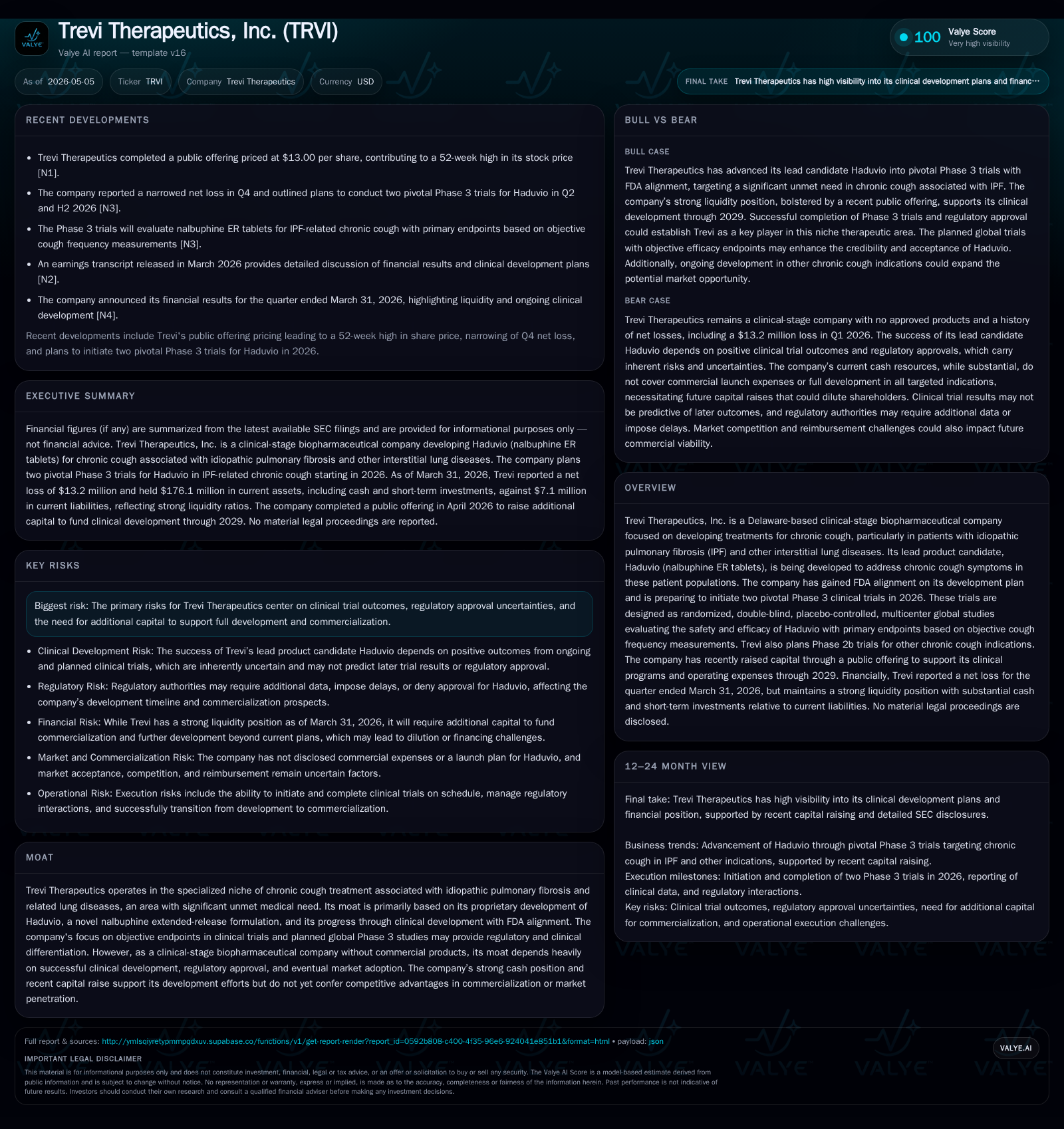
Trevi Therapeutics is on the cusp of launching two pivotal Phase 3 clinical trials in 2026 for Haduvio, targeting chronic cough associated with idiopathic pulmonary fibrosis (IPF). The company recently secured capital through a public offering, bolstering its financial footing to support these late-stage development programs potentially through regulatory approval. Trevi’s business model centers on developing treatments for high-unmet-need chronic cough indications using its proprietary nalbuphine extended-release formulation. While progression into Phase 3 trials marks a critical growth catalyst, significant binary clinical and regulatory risks remain. Monitoring trial initiations, interim data releases, and milestone achievements will be essential to assess execution trajectory.
Latest Quarterly Update: Clinical Progress and Development Plans
Trevi Therapeutics’ May 5, 2026, Form 10-Q filing [S2] and accompanying Form 8-K [S3] provide an important operating snapshot ahead of substantial clinical catalysts. The company confirmed it is preparing to initiate two pivotal Phase 3 clinical trials of its lead product candidate Haduvio (nalbuphine ER tablets) for treating chronic cough in patients with idiopathic pulmonary fibrosis (IPF). The first trial is expected to begin in the second quarter of 2026 with approximately 300 patients enrolled over a year-long treatment period; the second trial will start later in the year enrolling around 130 patients over a shorter fixed dosing window. Both trials employ randomized, double-blind, placebo-controlled designs with primary efficacy endpoints based on objective, quantified cough frequency using validated monitors.
This dual-trial approach reflects an FDA-aligned clinical development plan designed to substantiate safety and efficacy rigorously. In parallel, Trevi is advancing adaptive Phase 2b trials targeting non-IPF interstitial lung disease (ILD)-related chronic cough and refractory chronic cough (RCC), aiming to expand Haduvio’s therapeutic reach across distinct high-unmet-need respiratory conditions. These programs remain contingent upon final FDA protocol review but underscore an ambitious multi-indication pipeline strategy.
Trevi recently closed a public equity offering in April 2026 [N1][S7], raising crucial capital that supports clinical activities through pivotal program completion and potential U.S. regulatory submission timelines. The company's forward-looking commentary emphasizes confidence that available funds—comprising existing cash plus offering proceeds—should suffice through at least 2029 for completed clinical programs related to IPF, while noting that further financing will be necessary for expanded indications or commercialization efforts.
Business Model and Core Product Pipeline
As a clinical-stage biopharmaceutical entity headquartered in Delaware, Trevi Therapeutics generates value primarily through progressing its lead candidate Haduvio—a proprietary extended-release nalbuphine tablet formulation—through late-stage clinical development toward potential regulatory approval [S1]. The therapy targets chronic cough in patient populations burdened by idiopathic pulmonary fibrosis and other interstitial lung diseases where current treatment options are limited or ineffective.
Revenue generation prospects depend heavily on eventual U.S. Food and Drug Administration (FDA) approval alongside commercial adoption of Haduvio within specialized pulmonology markets. Pricing power could benefit from addressing an under-addressed symptom with meaningful quality-of-life improvements validated by objective measures—a distinct differentiation versus off-label or symptomatic alternatives. However, as no products are commercialized yet, revenue visibility remains conditional on positive pivotal trial results accompanied by regulatory milestones.
The company operates within a focused niche rather than broad pharmaceutical categories, necessitating efficient allocation of development resources constrained by clinical costs and complex trial designs tailored around sensitive objective cough monitoring technology. Additionally, the absence of late-stage pipeline diversification amplifies reliance on Haduvio's success but concentrates management focus.
Chronic Cough Market Dynamics and Competitive Positioning
Chronic cough linked to IPF and related ILDs represents a specialized submarket characterized by limited approved therapies globally. Trevi occupies this niche by leveraging a mechanism of action grounded in nalbuphine's pharmacodynamics paired with an extended-release platform optimized for symptom control over sustained periods [S1].
Competitors are few but include investigational agents targeting central neural pathways or symptomatic relief in RCC populations; however, Trevi's advancement into Phase 3 settings with robust endpoint alignment may establish competitive barriers via intellectual property protection on formulation and clinically validated endpoints such as objective cough frequency reduction—endorsed increasingly by regulatory bodies seeking quantifiable measures over subjective scoring.
Nonetheless, evolving understanding of ILD pathophysiology and potential introduction of novel antifibrotic or immunomodulatory therapeutics could alter treatment paradigms indirectly impacting market size or reimbursement dynamics. Off-label use of existing agents remains a background risk confounding near-term demand predictability.
Growth Catalysts: Clinical Data Milestones and Market Expansion Potential
The principal growth lever is initiation and successful execution of the two planned pivotal Phase 3 studies starting mid-2026 [S2][S7], providing critical data sets intended to support FDA marketing approval for IPF-related chronic cough indication—a step-change event transitioning Trevi into potential commercial viability.
Secondary drivers include topline data from Phase 2b adaptive studies in non-IPF ILD cough populations expected post-2026 initiation, expanding addressable markets if positive efficacy signals emerge. The refractory chronic cough Phase 2b program similarly aims to unlock distinct patient subsets with significant unmet needs enhancing long-term commercial scalability.
Capital raised in April provides financial runway fostering uninterrupted trial startups and maintenance through anticipated key inflection points around mid-to-late decade timelines [N1][S7]. Sustained investor interest likely hinges on demonstration of robust safety/tolerability alongside convincing efficacy measures tied to objective endpoints such as cough counts per hour monitored digitally.
Realization of these catalysts depends fundamentally on the timing adherence of trial initiations, enrollment rates, data quality overseen under global multicenter infrastructure, and regulatory acceptance—variables requiring precise operational execution.
Risk Factors and Developmental Challenges
Trevi faces high binary risk typical for clinical-stage biotech players: unfavorable outcomes in pivotal Phase 3 trials could materially undermine valuation amid delayed development timelines [S10]. Regulatory uncertainty persists despite prior alignment since final approvals hinge on convincing benefit-risk demonstration particularly given novelty of endpoint methodologies.
Additional financing beyond current runway appears inevitable for scale-up toward commercialization activities including manufacturing expansion, sales force development, market access strategies, and post-approval studies as outlined by management disclosures [S7]. Reliance on external capital markets exposes Trevi to funding availability volatility influenced by broader biotech investment appetites.
Competitive pressures include potential entry of alternative neuromodulators or novel pharmacotherapies addressing similar chronic cough mechanisms; while Trevi’s proprietary ER nalbuphine formulation is differentiated, patent lifespans and freedom-to-operate considerations merit ongoing surveillance.
Operational risks tied to multicenter trial coordination, patient recruitment challenges inherent in rare respiratory diseases, compliance with evolving regulatory guidance on progressive endpoint validation all present execution complexities influencing probability of success.
Next Steps: Key Upcoming Events to Monitor
- Initiation of first pivotal Phase 3 trial focusing on IPF-related chronic cough scheduled for Q2 2026.
- Commencement of second parallel Phase 3 study later in calendar year targeting similar patient group.
- Adaptive design Phase 2b study launches for non-IPF ILD indication targeted for second half of 2026 pending FDA approval & protocol negotiation.
- Start of Phase 2b refractory chronic cough trial projected early Q2 2026 across UK, Canada & Poland sites with sample size re-estimation analysis expected end-2026.
- Anticipated topline readouts from Phase 2b trials slated for second half of 2027 timeframe; first pivotal trial data expected during first half calendar year 2028 [S2][S3][S7].
- Ongoing regulatory interactions including FDA meetings reviewing protocol amendments or data presentations remain critical forward milestones.
- Monitoring cash burn trajectory consistent with clinical progression against stated runway assumptions will indicate financial health amid developmental scale-up.
Financial Snapshot: Capital Resources Highlighting Runway
Latest financial snapshot
| Metric | Value | Period |
|---|---|---|
| Cash & equivalents | $19mm | |
| 2026-03-31 | ||
| Current assets | $176mm | |
| 2026-03-31 | ||
| Current liabilities | $7mm | |
| 2026-03-31 | ||
| Current ratio | 24.75x | |
| 2026-03-31 |
Source: SEC companyfacts cache [F1].
Trevi reported $19.4 million cash & equivalents at quarter-end March 31, 2026 alongside $176.1 million in current assets versus $7.1 million current liabilities yielding an exceptionally strong current ratio near ~24.75 — signaling robust short-term liquidity [F1]. This snapshot reflects augmented balances complemented by net proceeds from an April public equity offering underpinning operational capacity through projected late-stage programs [S7].
Operating losses remain sizable reflective of costly advanced clinical activity typical among specialty biopharmas at this stage; recent operating income was negative $49.3 million trailing calendar year-end figures [F1]. Sustained capital consumption aligns logically with non-revenue generating R&D focus ahead of product commercial launch preparations.
While available funds currently secure core trials potentially through PDUFA reviews circa ~2029 horizon management warns additional funding rounds will be needed beyond this window to cover expanded development pathways or commercial infrastructure build-out phases [S7]. Therefore liquidity metrics emphasize medium-term strength balanced against longer-term financing imperatives inherent to pioneering therapies addressing orphan/niche respiratory conditions.
This analysis utilizes public SEC filings including the May quarter Form 10-Q/8-K statements alongside recent press releases detailing financing transactions. It integrates company-disclosed strategic priorities paired with industry-specific insights about nascent chronic cough therapeutics landscape without speculating beyond documented evidence or projecting financial outcomes absent explicit disclosures.
Disclaimer: This is research-only, informational analysis and not investment advice. It may include AI-generated interpretation and general industry context. Always verify important details using primary sources.

Comments