
SOBR Safe Restructures with Merger as Compliance Software Market Evolves
SOBR Safe’s recent merger agreement with Clean World Ventures signals a pivotal restructuring amid ongoing Nasdaq compliance challenges and evolving substance compliance software demands.
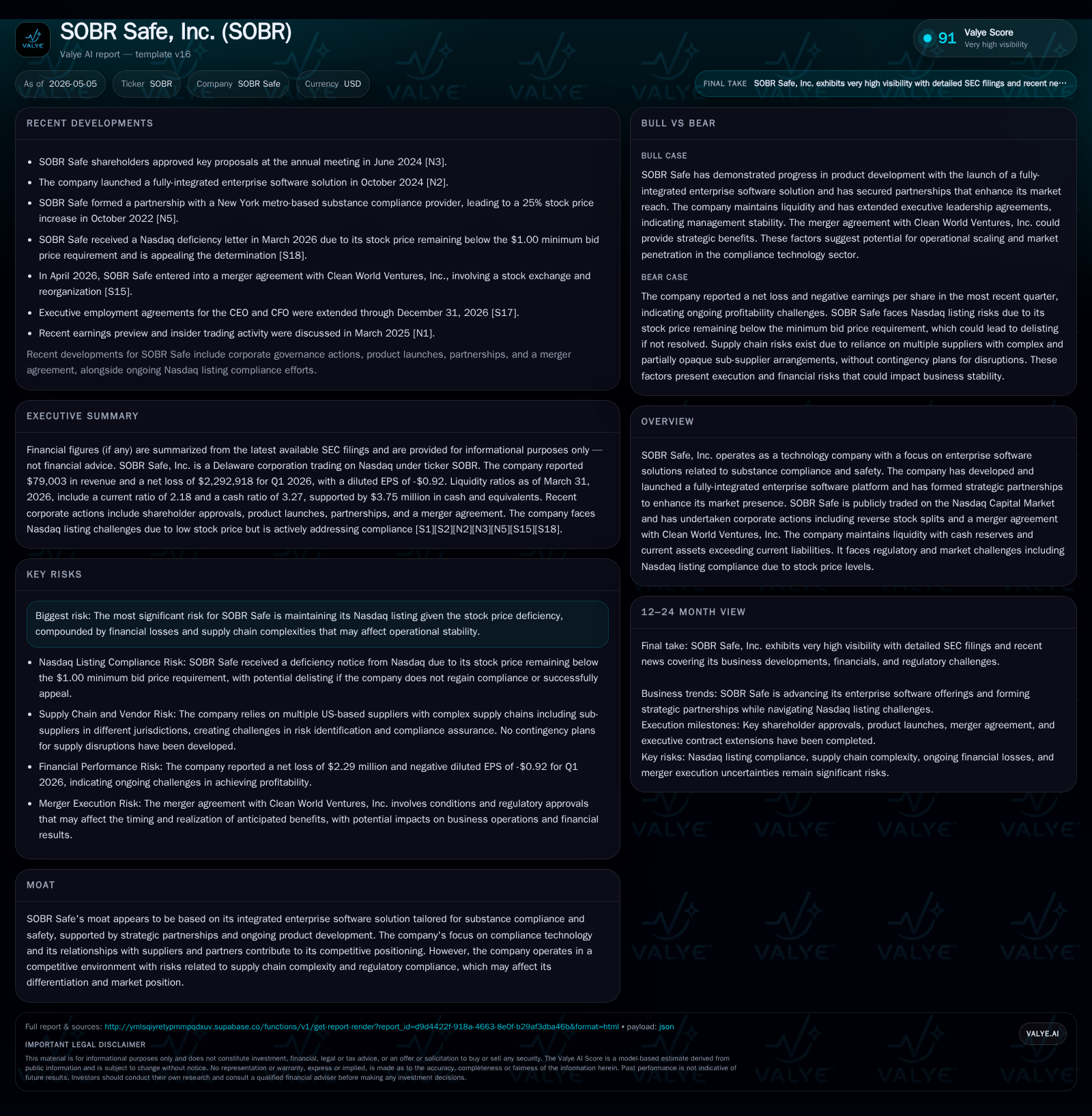
In its April 2026 quarterly 10-Q, SOBR Safe disclosed a merger agreement with Clean World Ventures designed to reposition the company strategically amid regulatory and market pressures. The transaction, which requires stockholder and Nasdaq approvals alongside other customary conditions, points to a material shift in capital structure and ownership. SOBR Safe’s business centers on an integrated enterprise software platform focused on substance compliance backed by patented hardware solutions. The company operates in a competitive landscape marked by supply chain and regulatory risks but is leveraging patent protections and strategic partnerships to drive growth. Maintaining Nasdaq listing compliance and managing financial losses remain significant operational challenges.
Latest Quarterly Update and Merger Announcement
In the most recent quarterly report filed April 30, 2026 (Form 10-Q), SOBR Safe announced a definitive Agreement and Plan of Merger with Clean World Ventures, Inc. (CWV), marking a material corporate restructuring event [S2][S3][S26]. Under the terms, SOBR Safe’s wholly owned subsidiary will merge into CWV, with CWV surviving as a wholly owned subsidiary, in a transaction intended to qualify as a tax-free reorganization under IRS Section 368(a) [S26].
The merger’s consummation is contingent upon multiple key conditions: approval by SOBR Safe’s stockholders for several matters including share issuance exceeding 20% of pre-merger shares (per Nasdaq rules), reverse stock split authorization aimed at meeting minimum bid price requirements ($1.00 per share), amendments to equity incentive plans, requisite approvals by CWV shareholders, and notably approval by Nasdaq for listing the combined entity's common stock post-merger [S26][S27].
Preliminary pro forma ownership math projects CWV shareholders will own approximately 98.3% of the combined company with incumbent SOBR Safe shareholders retaining about 1.7%, indicating a decisive control shift [S27]. This realignment reflects both capital structure rationalization ambitions and a strategic pivot given prevailing operational headwinds.
The company simultaneously disclosed that efforts continue to maintain compliance with Nasdaq listing standards amid ongoing concerns about share price levels—the reverse split vote is framed as a preemptive measure to secure continued listing eligibility during the merger transition period [S26][S27]. Importantly, additional SEC filings including the Form S-4 registration statement are expected to furnish detailed proxy materials requisite for shareholder voting.
SOBR Safe’s Business Model and Product Differentiation
Operating primarily as a technology provider specializing in enterprise-level substance compliance solutions, SOBR Safe builds revenue around software licensing coupled with proprietary hardware integration. Its flagship offering blends an enterprise software platform tailored for compliance monitoring with patented devices such as the SOBRcheck™ breathalyzer system that integrates real-time data capture into reporting workflows [S1]. This integrated approach targets enterprises facing stringent workplace safety regulations requiring adherence to substance use policies.
Revenue mechanics hinge on contracts with mid-to-large regulated companies who depend on continuous monitoring solutions for risk mitigation. Customers pay for service subscriptions tied to usage intensity along with possible device procurements under binding agreements that foster switching costs, given the regulatory nature of these systems [S1]. The company strengthens its product moat through active patent filings globally—the recent grant of a European Patent underscores efforts to protect its unique value proposition against competitors [S5].
Strategic partnerships allow SOBR Safe to extend its platform integration capabilities or navigate distribution channels more effectively. This ecosystem positioning supports customer retention while enhancing entry barriers based on proprietary technology and contracted footprints.
Competitive Environment and Industry Dynamics
The enterprise substance compliance sector is characterized by rising regulatory enforcement coupled with technological convergence—software platforms must marry accuracy in biological sampling devices with robust data management systems subject to privacy laws. SOBR Safe faces competition from specialized compliance solution providers as well as larger software entities extending into adjacent regulatory tech markets.
Supply chain complexities impart operational risks; procuring new device hardware or upgrading software modules faces delays given global component shortages noted in recent disclosures [S2]. Pricing power appears moderate—demand is influenced heavily by regulations mandating compliance but constrained by budget limitations within target customers.
Nasdaq listing pressures mirror stock price volatility arising from limited liquidity and sustained operating losses reported historically. This market constraint limits capital raising capacity thereby necessitating alternative strategic moves such as the disclosed merger [S2][F1].
Key Growth Catalysts and Market Expansion Opportunities
Patents like the recently granted European Patent enhance SOBR Safe's defensibility facilitating expansion into international markets where regulatory frameworks echo U.S. standards [S5]. Adoption rates among heavily regulated industries such as transportation, manufacturing, and municipal safety agencies provide structural demand uplift fueled by evolving legislation.
The pending merger functionally aims at accelerating scale either through cross-selling opportunities or pooled R&D resources. New contractual wins tracked via bookings metrics will serve as tangible indicators of momentum post-combination. Additionally, enhancements in product-suite functionality promised in annual disclosures suggest planned launches targeting broader use cases within workplace safety management [S1][S5].
Risk Factors and Operational Challenges
Foremost among risks is sustaining Nasdaq listing status given persistently low trading prices—a situation exacerbated by thin trading volumes limiting price stability [S2]. Financial performance remains challenged; recent periods reflect sizeable operating losses undermining free cash flow generation capacity while necessitating careful cost management.
Supply chain bottlenecks constrain timely deployment of device components integral to the core hardware-software bundle, potentially delaying revenue recognition or straining fulfillment commitments [S2]. Regulatory uncertainty also adds buying hesitancy or elongated decision cycles amongst customers adapting procurement forecasts amidst shifting laws.
Capital structure sensitivities related to dilution risk are notable since financing through equity issuance remains limited by valuation constraints; hence transaction-tailored issuances (in conjunction with the merger) dilute existing holders significantly per disclosed ownership rebalancing [S27].
Upcoming Milestones and What to Monitor Next
Investors should track imminent shareholder meetings scheduled for voting on merger approvals including reverse stock splits, equity plan amendments, and share issuance parameters—these votes constitute gating steps for closing [S3][S4][S26].
SEC clearance timelines for Form S‑4 registration statement filings are critical milestones signaling progress towards consummation.
Nasdaq’s response regarding continued listing pre- and post-merger will materially affect capital access avenues.
Subsequent quarterly filings will reveal execution pace integrating the merged entities along with top-line traction signals if growth initiatives bear out.
Current Financial Snapshot and Liquidity Position
Latest financial snapshot
| Metric | Value | Period |
|---|---|---|
| Current assets | $2mm | |
| 2026-03-31 | ||
| Current liabilities | $1146136 | |
| 2026-03-31 | ||
| Current ratio | 2.18x | |
| 2026-03-31 |
Source: SEC companyfacts cache [F1].
| Metric | Value (USD) | Period End |
|---|---|---|
| Current Assets | $2,495,008 | |
| 2026-03-31 | ||
| Current Liabilities | $1,146,136 | |
| 2026-03-31 | ||
| Current Ratio | 2.18 | |
| 2026-03-31 | ||
| Cash & Equivalents | $3,751,391 | |
| 2022-06-30 | ||
| Total Debt | $439,881 | |
| 2021-09-30 | ||
| Net Debt* | -$3,311,510 | ~Latest Est. |
| *Net Debt = Total Debt minus Cash & Equivalents [F1] |
As of the latest quarter ending March 31, 2026, SOBR Safe reports a comfortable current ratio of 2.18 reflecting adequate short-term liquidity coverage over obligations [F1]. A net cash position estimated at over $3 million after accounting for outstanding debt indicates access to working capital buffers despite historical losses amounting nearly -$9 million annually reported at fiscal year-end December 31, 2025 [F1]. Capital management remains vital given continuing operating deficits documented in prior filings.
This analysis synthesizes sobering challenges faced alongside strategic repositioning undertaken by SOBR Safe as it seeks renewed footing through its merger transaction amid tightening industry regulation and operational volatility. Continued monitoring of governance milestones and execution clarity post-merger will be essential to assess trajectory shifts.
Disclosure: This report is an informational analysis based solely on publicly available SEC filings without any investment advice or recommendation.
Disclaimer: This is research-only, informational analysis and not investment advice. It may include AI-generated interpretation and general industry context. Always verify important details using primary sources.

Comments