
River Financial Corp's Q1 2026: Stabilizing Growth through Conservative Banking
River Financial demonstrated stable profitability in Q1 2026, reinforcing its deposit-led, conservative banking model amid competitive regional dynamics.
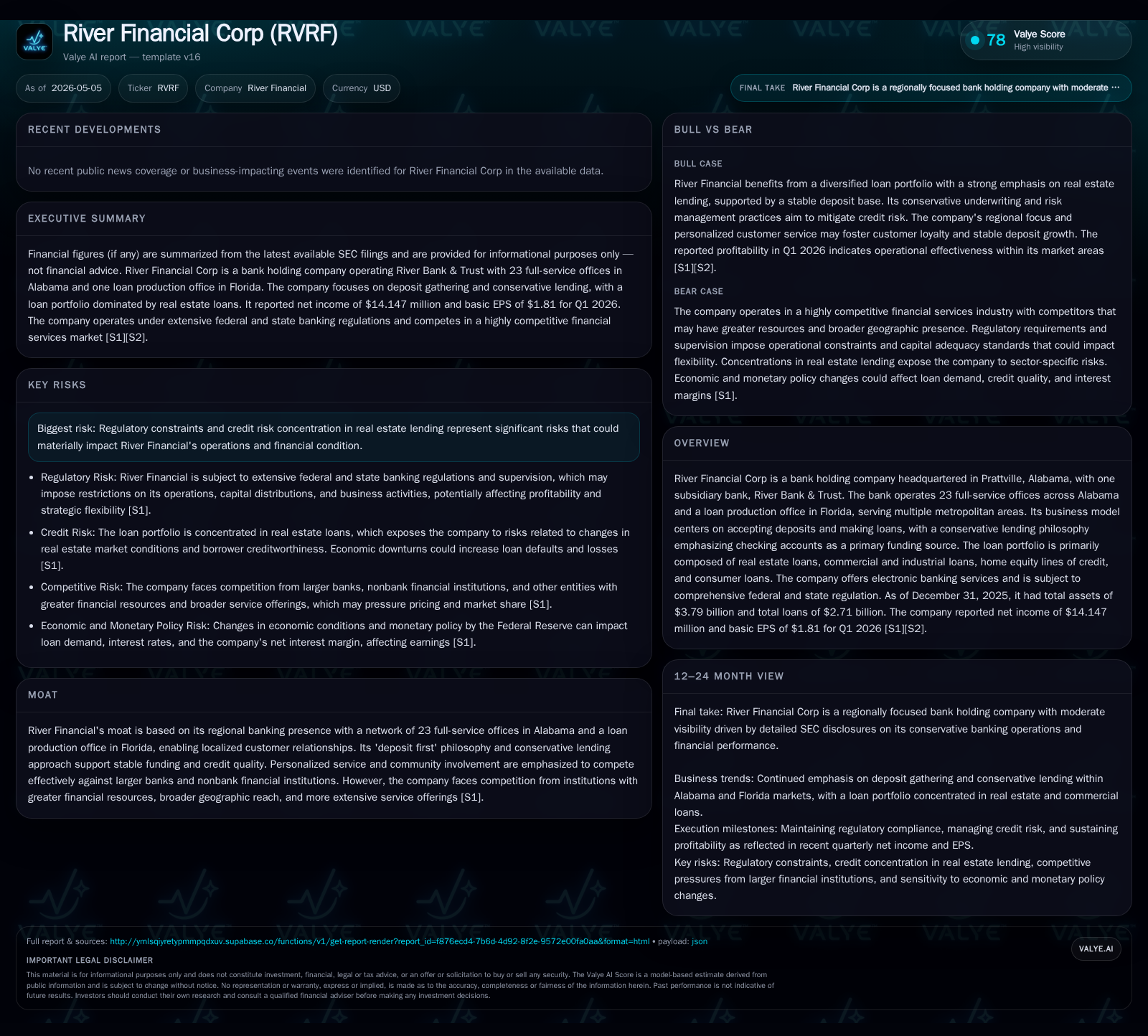
River Financial Corp reported net income of $14.147 million and EPS of $1.81 for Q1 2026, reflecting steady profitability consistent with its conservative lending and deposit-first funding philosophy. The company operates a focused regional bank network across Alabama and Florida, emphasizing real estate and commercial loans funded mainly by core deposits. While personalized service and localized relationships support competitive positioning, growth faces headwinds from regulatory constraints and credit concentration in real estate loans. Key growth drivers include market penetration in existing regions, loan production office expansion, and broadening electronic banking services. Monitoring deposit growth trends, non-performing assets, and regulatory developments will be critical for near-term execution.
Q1 2026 Operating Highlights and Recent Developments
River Financial Corporation’s Q1 2026 results reaffirm the company’s stable earnings grounded in its conservative banking approach. The May 5, 2026 Form 10-Q disclosed net income of $14.147 million and basic EPS of $1.81 [S2]. These results reflect continuity in generating steady returns through a disciplined loan portfolio underpinned by a stable core deposit base. This quarter’s operational disclosures indicate no significant deviations from the company’s conservative funding strategy or loan performance trends, underscoring effective risk management despite a competitive market backdrop.
Recent event filings dated April 14, 2026 confirmed ongoing execution around loan origination efforts out of full-service offices and loan production sites [S3]. Although no major structural changes were announced, the communication emphasizes consistency with prior quarters' focus on maintaining strong local customer engagement alongside controlled portfolio growth.
These updates are pivotal as they validate River Financial’s operating model during a period marked by tightening regulatory scrutiny in banking and fluctuating economic conditions affecting real estate lending.
River Financial’s Business Model and Deposit-First Philosophy
River Financial operates principally through its subsidiary River Bank & Trust, headquartered in Prattville, Alabama [S1]. The bank maintains a network of 23 full-service offices distributed across key metropolitan areas in Alabama plus a loan production office in Destin, Florida. This footprint enables deeply localized relationships which form the foundation for customer acquisition and retention.
The company’s business model revolves around accepting various deposits—dominantly core deposits including demand deposits (NOW accounts)—which it uses as primary funding sources for its diversified loan portfolio [S1][S20]. This "deposit first" philosophy prioritizes low-cost, stable funding over wholesale borrowing to better manage liquidity risk.
On the lending side, River pursues a conservative underwriting approach focusing heavily on real estate loans that constitute about 77% of total loans ($2.1 billion of $2.71 billion total loans as of year-end 2025) [S1][S11]. The portfolio includes residential mortgages (fixed or adjustable), commercial real estate loans (term loans with amortization up to 25 years), construction & land development loans (variable-rate, short-term), alongside commercial & industrial loans secured primarily by borrower cash flows or collateral [S4][S11]. The balance further incorporates home equity lines of credit (HELOC) at roughly 5.9% of the portfolio and consumer installment loans.
Revenue is generated predominantly through interest earned on these loans plus fees related to mortgage origination and ancillary services like electronic banking options that enhance customer convenience [S20]. Expenses are primarily interest paid on deposits along with compensation and operational overheads.
Competitive Positioning within Regional Banking Ecosystem
Within the broader regional financial services landscape, River Financial occupies a mid-sized niche characterized by localized service delivery versus larger national or super-regional banks [S1][S8]. Its competitive differentiators hinge on personalized customer interactions enabled by branch density throughout Alabama’s prominent MSAs such as Montgomery, Birmingham, Huntsville, Auburn-Opelika, Mobile, among others.
However, this focused geographic footprint subjects the bank to intense competition from institutions possessing more extensive networks or innovative digital platforms capable of capturing younger demographics or fee-based revenue streams. Nonbank financial providers and fintech entrants also place competitive pressure on traditional deposit and lending volumes.
Pricing power appears constrained due to these factors; hence River relies more on relationship depth rather than rate leadership to retain deposits or originate quality loans [S8]. Community involvement initiatives underpin brand trust but do not fully offset resource limitations compared to larger rivals.
Key Growth Drivers: Market Penetration and Loan Portfolio Expansion
Growth at River Financial is principally driven by expanding core depositor relationships alongside measured loan portfolio increases within existing markets [S1][S3]. The recent establishment of full-service branches in Tuscaloosa, Alabama and Florida Panhandle’s Destin as well as associated loan production activities signal incremental geographic diversification efforts.
Product-wise, sustained emphasis is placed on commercial loans bolstered by small business demand within these regions plus residential mortgage originations benefiting from home buying cycles [S3][S11]. Adoption of electronic banking products—such as mobile platforms and remote deposit capture—is enhancing client convenience while potentially broadening reach beyond physical branch constraints.
The interplay between deposit growth rates (especially NOW accounts) and new loan originations will remain vital KPIs for assessing volume momentum. While organic expansion dominates near-term plans, regulatory approval will limit material M&A or branch acquisition maneuvers for now given capital adequacy requirements [S1][S22].
Risks and Challenges: Regulatory and Credit Concentration Exposures
A critical headwind facing River Financial arises from heightened regulatory scrutiny under federal mandates including Dodd-Frank Act provisions enforced via CFPB rules impacting mortgage underwriting diligence [S1][S23]. Compliance expenses related to personnel training and process enhancements have increased operational costs marginally.
Credit risk concentration is another notable concern due to the heavy skew towards real estate lending constituting over three quarters of total loans [S16]. Although the bank does not currently meet regulators’ defined thresholds for “concentration” in commercial real estate portfolios requiring heightened risk controls (less than specified % thresholds relative to capital), vigilance is warranted given potential economic volatility impacting property values or borrower cash flows.
Moreover, competition from fintech firms offering alternative credit solutions threatens disintermediation risks especially for consumer or small business segments. Regulatory cost creep combined with uneven economic cycles could constrain profit margins absent careful reserve provisioning.
Outlook: Upcoming Milestones and Market Signals to Monitor
Looking ahead, several operational touchpoints warrant close attention:
- Deposit growth velocity during Q2 versus Q1 will signal stability of low-cost funding amid competing offers [S2][S3].
- Monitoring any shift in asset quality metrics such as non-performing asset ratios or allowance for credit losses could presage emerging credit stress [S2].
- Progress related to opening additional full-service branches or elevating loan production office activities—particularly in Florida—will reflect strategic expansion success.
- Regulatory developments concerning capital adequacy frameworks or lending regulation amendments remain visible risks that may alter compliance burdens or permissible activities [S23].
- Management commentary embedded within forthcoming periodic filings or press releases should offer insights into management’s outlook on macroeconomic factors impacting loan demand or competitive positioning.
Financial Overview: Latest Quarterly Snapshot in Context
At December 31, 2025 the company reported total assets nearing $3.79 billion with $2.71 billion in loans outstanding supported by approximately $3.33 billion in total deposits [S1]. This implies a relatively conservative loan-to-deposit ratio near 81%, consistent with stable liquidity management practices typical for community-focused banks.
This financial posture supports River’s conservative "deposit first" approach facilitating modest but steady earnings generation without aggressive leverage deployment [F1][S2].
This analysis leverages River Financial's most recent SEC filings through May 2026 to examine operational stability anchored by its localized banking model and conservative funding philosophy. While competitive pressures persist alongside regulatory overlay complexities, River sustains a clear strategic path prioritizing credit quality preservation with measured growth opportunities balanced against identifiable concentration risks.
Readers should monitor forthcoming quarterly disclosures around core deposit trends, asset quality shifts, regulatory changes impacting lending practices, and expansion initiatives to gauge evolving execution dynamics within this mid-sized regional bank context.
Disclaimer: This report is for informational purposes only. It does not constitute investment advice or a recommendation regarding securities of River Financial Corp.
Disclaimer: This is research-only, informational analysis and not investment advice. It may include AI-generated interpretation and general industry context. Always verify important details using primary sources.

Comments