
JELD-WEN's Restructuring and Market Challenges Define Q1 2026 Operating Dynamics
Recent restructuring initiatives, segment performance, and macro pressures shape JELD-WEN's near-term outlook.
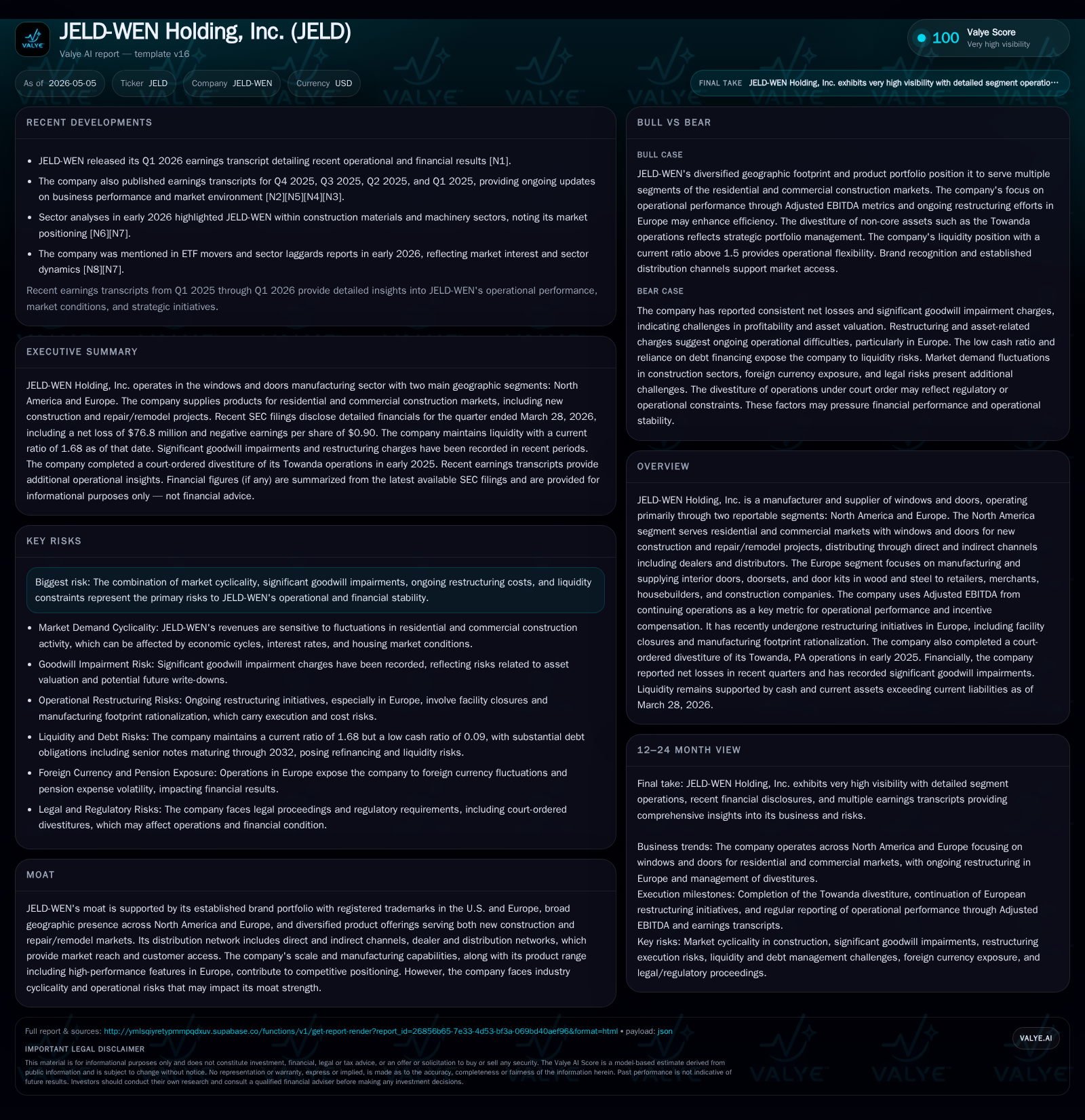
In the first quarter of 2026, JELD-WEN Holding, Inc. grappled with ongoing restructuring efforts primarily in Europe and persistent market cyclicality impacting revenues and margins. The company's North America segment, focused on windows and doors for residential and commercial markets, delivers through a diversified dealer and distributor network, while the Europe segment remains challenged by restructuring including plant closures. Despite operational headwinds, JELD-WEN’s broad product portfolio and strategic footprint support competitive positioning amid an industry marked by economic sensitivity. Watchpoints center on execution of restructuring plans, backlog development, pricing environment, and debt management given sizeable leverage.
Recent Operating Update
JELD-WEN reported Q1 2026 results on May 4-5, revealing that its operational performance remains challenged by ongoing restructuring efforts in Europe alongside cyclical softness in North American markets [S2][S3][N1]. Revenues for the quarter declined relative to prior periods impacted by subdued new construction activity and mix effects. The company highlighted progress on its rationalization initiatives, specifically plant closures and manufacturing consolidation within its European segment designed to improve long-term cost competitiveness [S2].
Management emphasized that Adjusted EBITDA from continuing operations remains the focal measure of operating performance — tying directly into executive incentive plans — underscoring the strategic priority placed on operational efficiency amid the transient market pressures [S2][S9]. This quarter’s operating results also reflect legacy challenges including goodwill impairments recognized in prior periods and restructuring charges that continue to weigh on near-term profitability.
Business Model Overview
JELD-WEN operates primarily through two geographic segments: North America and Europe. Its North American business supplies a broad range of windows and doors targeting both residential and commercial sectors. This includes products used in new construction as well as repair & remodel projects. Customers encompass homebuilders, contractors specializing in replacement, architects, and dealers/distributors who facilitate extensive market reach through both direct sales channels and indirect distribution networks [S1][S9].
The European segment is more specialized towards interior doorsets, door kits, and related wood and steel products sold to retailers, merchants, housebuilders, and construction companies. The offering includes standard categories as well as high-performance variants tailored for regulatory or energy efficiency requirements common in region-specific building codes [S1][S9].
Revenue generation depends heavily on volume sold across these channels alongside pricing that can be influenced by raw material cost fluctuations, competitive dynamics, and regional demand drivers. The repair & remodel market provides some stability due to recurring replacement cycles whereas new construction is more volatile reflecting broader economic cycles. Margins are sensitive to product mix shifts between premium versus commodity lines as well as operational efficiencies achieved at manufacturing plants.
Industry Structure and Competitive Position
Within the highly fragmented windows and doors industry spanning North America and Europe, JELD-WEN occupies a significant position buttressed by several competitive advantages. Its substantial manufacturing scale allows for sourcing efficiencies amidst raw-material cost pressures. Moreover, a registered brand portfolio shields it from pure commoditization particularly in North America where brand trust supports dealer relationships [S1].
Distribution breadth — combining direct sales to large homebuilders with indirect access via dealer networks — enhances customer reach while creating switching costs notably in specialist product lines requiring technical support or customization options. However, the sector remains highly cyclical given exposure to residential housing starts which fluctuate materially due to interest rate environments, consumer confidence changes, and broader macroeconomic conditions.
In Europe, competition is intense with numerous specialized manufacturers targeting differentiated products such as fire-rated doors or acoustic solutions necessary for commercial real estate or multi-family housing projects. JELD-WEN’s ongoing restructuring aims to streamline the footprint here to regain competitive cost positioning though it may face margin pressure during implementation phases.
Growth Drivers
Structural growth levers include:
- Residential construction recovery: The primary driver is underlying new housing starts coupled with repair/remodel spending cycles which tend to be less volatile but sensitive to economic fundamentals.
- Product innovation: Expanding high-performance product lines (energy efficient windows/doors) can command premium pricing particularly in Europe where green building policies are stringent.
- Channel expansion: Deepening penetration via dealer/distributor networks especially in underpenetrated regional markets can incrementally grow volume.
- Operational improvements: Restructuring aimed at footprint optimization intends to lower fixed costs thereby improving margins as volumes stabilize.
Each driver ties closely to measurable metrics such as bookings volume growth trends (indicating pipeline strength), backlog figures signaling future revenue visibility, price/mix changes reflecting product portfolio shifts or inflation passes-through, manufacturing capacity utilization rates indicating efficiency gains from cost-reduction efforts.
Risks / Watchpoints / Growth Constraints
Key risks remain:
- Cyclicality: Prolonged downturns in housing markets could depress demand significantly; repair/remodel activity only partially mitigates this risk.
- Restructuring execution risk: Facility closures provide long-term benefit but cause near-term disruptions including severance costs impacting earnings stability.
- Litigation exposure: Although major class-action settlements concluded recently related to alleged anti-competitive practices,[S11] residual risks from appellate processes around court-mandated divestitures persist.[S19]
- Leverage burden: Substantial net debt (~$1.7 billion) constrains financial flexibility particularly if cash flow generation weakens due to margin pressures or slower sales growth.[F1]
- Raw material volatility: Lumber prices and steel costs heavily influence input expenses affecting gross margin variability.
What to Watch Next
Investors should monitor upcoming quarterly disclosures for:
- Updates on European restructuring progress including plant closure status and related charges.
- Trends in bookings/backlog figures indicating demand momentum or deceleration.
- Pricing environment updates capturing inflationary impacts or competitive price pressures especially within key segments.
- Operational efficiency gains post-restructuring reflected through margin improvements or reduced fixed costs.
- Balance sheet developments covering debt refinancing activities or covenant compliance given large outstanding leverage.[S2][N1]
Additionally, paying attention to macroeconomic signals affecting housing starts—such as mortgage rate trends—will provide external context influencing future near-term volumes.
Financial Profile Snapshot
Latest financial snapshot
| Metric | Value | Period |
|---|---|---|
| Cash & equivalents | $50mm | |
| 2026-03-28 | ||
| Current assets | $996mm | |
| 2026-03-28 | ||
| Current liabilities | $592mm | |
| 2026-03-28 | ||
| Current ratio | 1.68x | |
| 2026-03-28 |
Source: SEC companyfacts cache [F1].
| Metric | Value | Period Ending |
|---|---|---|
| Cash & Equivalents | $50.36 million | |
| 2026-03-28 | ||
| Current Assets | $995.7 million | |
| 2026-03-28 | ||
| Current Liabilities | $592.07 million | |
| 2026-03-28 | ||
| Current Ratio | 1.68 | |
| 2026-03-28 |
This liquidity profile indicates moderate working capital adequacy considering size of liabilities.[F1] The company’s total reported debt figures remain dated but historically have been in excess of $1 billion levels highlighting leverage intensity that must be managed closely.[F1]
This analysis is based solely on publicly disclosed SEC filings up through May 5th, 2026.
Disclaimer: This is research-only, informational analysis and not investment advice. It may include AI-generated interpretation and general industry context. Always verify important details using primary sources.

Comments