
SBA Communications Elevates Tower Leasing Revenue with Strategic Growth Initiatives
The company reported Q1 2026 revenue and FFO beats driven by robust leasing growth and raised full-year guidance, underscoring sustained demand amid evolving wireless infrastructure needs.
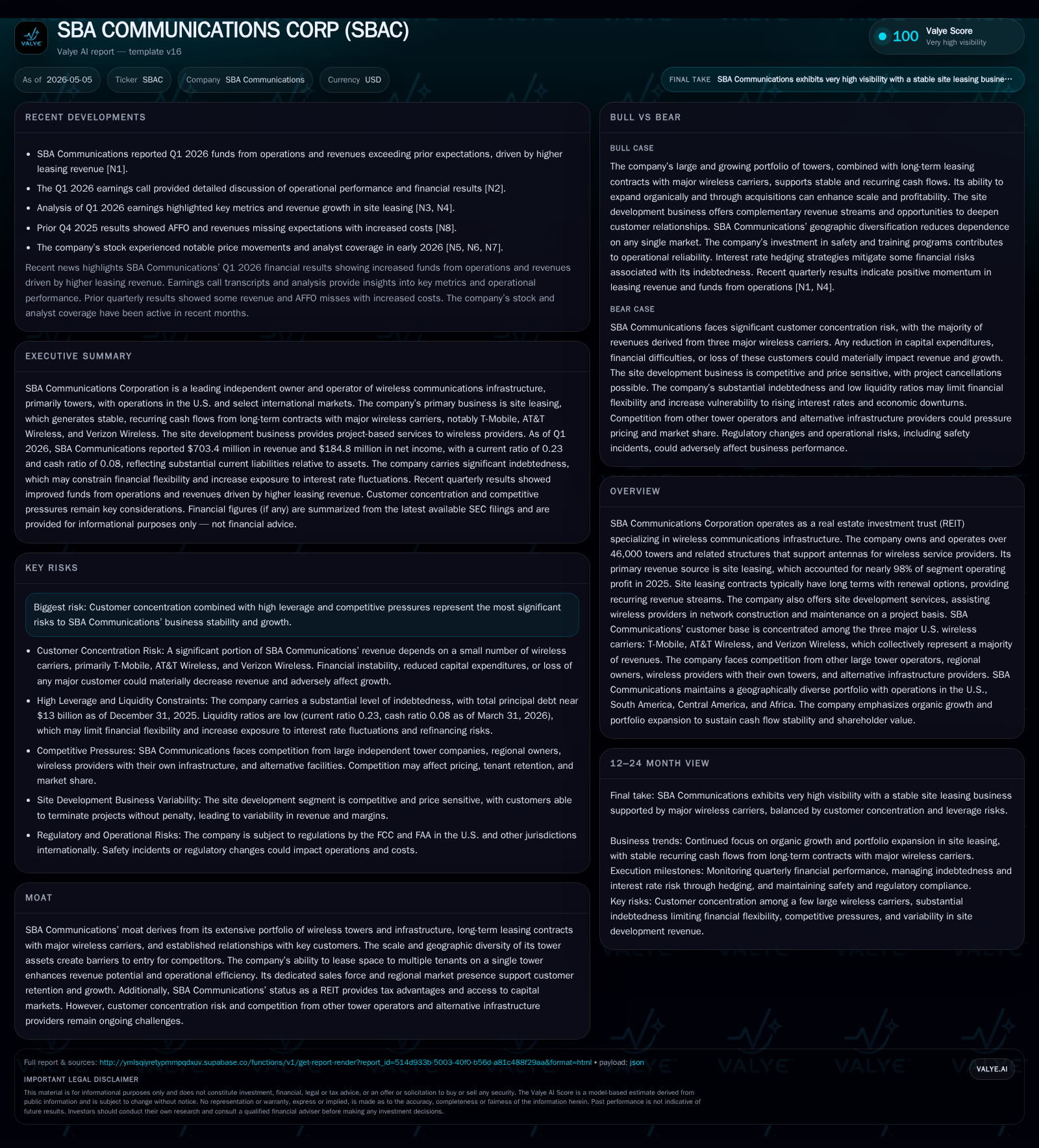
SBA Communications’ Q1 2026 results reveal strength in its core tower leasing business, supported by long-term contracts with major U.S. carriers. The company’s strategic expansion through new builds and co-location opportunities drives organic growth and enhances recurring revenue streams. Despite customer concentration and leverage risks, SBA’s scale and industry expertise maintain its competitive edge in a consolidating wireless infrastructure market.
First Quarter 2026 Operating Highlights and Guidance Update
SBA Communications Corporation’s latest quarterly filing as of May 5, 2026 [S2], combined with the April 29 corporate update [S3], reveals a solid operational performance in Q1 2026 that materially exceeds market expectations. The company reported higher-than-forecasted revenues driven predominantly by continued strength in site leasing activity. This durable revenue line reflects the firm’s ability to monetize its extensive portfolio of over 46,000 wireless towers [S1]. Funds from operations (FFO) also beat estimates, signaling healthy cash flow generation aligned with the business’ recurring lease model [N1]. These operational gains have prompted management to raise full-year 2026 guidance for both revenues and FFO, reinforcing investor confidence in near-term resilience.
Crucially, the company declared its quarterly dividend alongside this earnings release [S3], reflecting sustained cash flow adequacy despite ongoing investments into portfolio expansion. This dividend signal is consistent with SBA Communications’ REIT status that prioritizes distributions tied to stable leasing income.
SBA Communications’ Business Model: Tower Leasing at Scale
SBA’s business model centers around owning and operating a wide network of wireless communication towers leased primarily to large mobile network operators (MNOs). As disclosed in the annual report [S1], site leasing contracts encompass long terms—typically five to fifteen years—with multiple renewal options that underpin recurring revenue streams. Nearly all segment operating profit derives from site leasing activities (~98% in 2025), highlighting high-margin stability rooted in contractual lease payments.
These leases are typically paid by wireless carriers such as T-Mobile (31.1% of total revenue in 2025), AT&T Wireless (20.3%), and Verizon Wireless (15.1%) [S17][S28]. SBA also provides site development services involving network construction and maintenance on a project basis; however, these represent a smaller portion of overall revenue and are less predictable due to their project-based nature [S1].
A key strength comes from optimizing tower capacity via multi-tenant stacking—placing multiple customers’ antennas on a single tower structure—which increases lease revenue without proportional capital expenditure. As of the end of 2025, SBA averaged approximately 1.8 tenants per tower [S18]. This strategy not only boosts revenue but also dilutes fixed infrastructure costs across several lessees.
Embedded within SBA’s REIT classification is favorable tax treatment that enhances after-tax cash flows and provides access to capital markets for funding acquisitions or build-to-suit projects [S1]. The company leverages deep industry knowledge accumulated since it started developing towers in 1989 and maintains an experienced sales force organized regionally to engage with wireless service providers effectively.
Competitive Position within the Wireless Infrastructure Industry
The wireless infrastructure sector remains concentrated among a handful of national tower owners versus numerous regional players. SBA Communications benefits from scale advantages that create high entry barriers for smaller competitors—its broad geographic footprint reduces customer “dead zones” where alternatives might be viable [S1].
Pricing power appears relatively stable, fostered by long-term lease agreements backed by critical locations optimized for carrier network design needs. Customer switching costs are elevated given logistical challenges of relocating antennas or deploying new towers without service disruption. Furthermore, multi-tenant towers enable SBA’s assets to command premium pricing through volume.
Nonetheless, competitive pressures persist from other large tower operators seeking portfolio consolidation and from alternative infrastructure providers such as small cell networks or distributed antenna systems (DAS), which can undercut traditional tower demand particularly in urban areas. Regulatory factors remain manageable but warrant monitoring as zoning or environmental constraints can delay new developments or extensions.
Overall, SBA's entrenched relationships with the 'big three' carriers coupled with its status as a preferred vendor sustain its dominant market position vis-à-vis peers.
Key Growth Drivers: Portfolio Expansion, Co-locations, and Market Dynamics
Future growth hinges on expanding the tower base organically via new build initiatives while opportunistically acquiring existing assets at accretive valuations [S1]. The filed documents emphasize disciplined capital deployment targeting locations with anticipated multi-tenant demand based on carrier network evolution [S3].
Co-location leases drive incremental site margin expansion at relatively low incremental cost since existing towers provide substantial unused capacity; management highlights intensifying use given ongoing 5G densification needing more antenna placements per site [N2][S18]. Technological upgrades spur higher bandwidth demands prompting carriers to add new equipment layers — directly benefiting leasing revenue.
International expansion remains selective due to more competitive environments abroad that have restrained overseas site leasing growth in recent years [S1]. Nonetheless, targeted moves into select emerging markets complemented by localized expertise support mid-term penetration efforts.
Site development services complement leasing strategies by allowing SBA to engage customers earlier during network rollout phases while building goodwill that can convert into longer-term site tenancy agreements.
Risks and Constraints: Customer Concentration, Leverage, and Competitive Threats
A pronounced vulnerability lies in SBA’s reliance on three primary tenants accounting for roughly two-thirds of revenues — T-Mobile alone contributes over 30%, followed by AT&T Wireless and Verizon Wireless at approximately 20% and 15%, respectively [S17][S28]. This customer concentration exposes SBA to contract renewals risk; should any carrier reduce capital expenditures or shift toward owning infrastructure internally, it would materially impact revenues.
Financially, SBA operates with substantive leverage reflective of capital-intensive infrastructure investments. The current ratio stands at a low approximate level of 0.23 (current assets ~$767 million vs. current liabilities ~$3.35 billion) as of March 31, 2026 [F1], indicating working capital constraints typical for REITs but warranting close refinancing management amid rising interest rate environments [S2][F1]. Total debt figures predate latest quarter but net debt remains near $10 billion considering available cash balances [F1]. The firm is subject to restrictive covenants which may limit operational flexibility especially if industry turbulence or macroeconomic volatility elevate credit risk.
Competition remains intense from other tower owners aggressively pursuing tenancy stacking along with emergent technologies potentially reducing demand for traditional macro-cell sites.
Looking Ahead: Milestones, Demand Signals, and Execution Focus
Market participants should observe upcoming earnings releases for quarterly updates on tenant additions per tower—a key proxy for margin leverage—and renewal rate trends that could signal retention strength or erosion risks [N2][N8][S3]. Progress on tower buildouts including timelines met or delayed will illuminate SBA’s execution capability vis-à-vis guided expansion targets.
International footprint developments require monitoring given inherent complexities impacting broader growth objectives.
Dividend sustainability remains a focal point given the dividend announcement accompanying Q1 results; stable payout ratios relative to FFO reflect operational health.
Innovations around leveraging data analytics for optimized site placement or enhanced contract structuring may emerge as additional differentiation avenues.
Latest Financial Snapshot: Balance Sheet and Cash Flow Metrics
Latest financial snapshot
| Metric | Value | Period |
|---|---|---|
| Cash & equivalents | $269mm | |
| 2026-03-31 | ||
| Current assets | $767mm | |
| 2026-03-31 | ||
| Current liabilities | $3.3bn | |
| 2026-03-31 | ||
| Current ratio | 0.23x | |
| 2026-03-31 |
Source: SEC companyfacts cache [F1].
*Note: Latest total debt figure timestamp not fully current per available data.[F1]
As of the latest quarter-end filing [S2], SBA Communications holds just over $269 million in cash equivalents against current liabilities exceeding $3.3 billion reflecting working capital shortfalls common in capital-intensive REIT operations but manageable given access to capital lines. Historical total debt runs approximately $10.14 billion with net debt around $10.15 billion after adjusting for cash holdings per companyfacts data [F1]. Maintaining leverage discipline will be critical amid uncertain credit markets given the interest obligations implicit in such indebtedness levels.
This analysis synthesizes recent SEC filings alongside industry context without providing investment recommendations or forecasts. Readers should interpret findings as an informational snapshot reflecting company fundamentals anchored on verifiable disclosures up to May 2026.
Disclaimer: This is research-only, informational analysis and not investment advice. It may include AI-generated interpretation and general industry context. Always verify important details using primary sources.

Comments