
National Storage Affiliates Trust Advances Operational Integration Amid Pending Merger and Liquidity Management
NSA focuses on portfolio management and liquidity while navigating merger uncertainties.
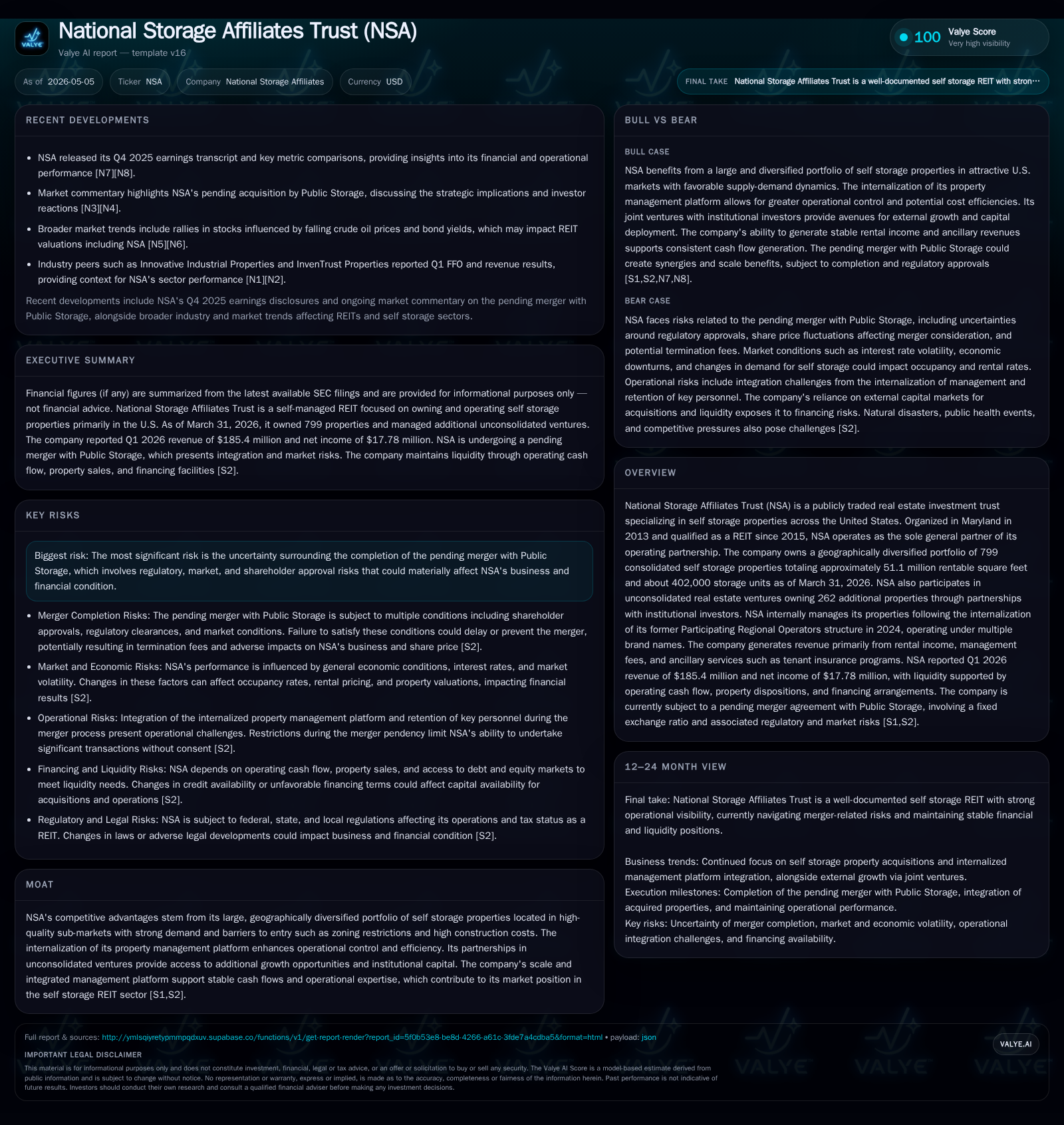
National Storage Affiliates Trust (NSA) reported steady operating cash flows in Q1 2026 with strategic emphasis on liquidity and internal property management. The company continues to operate its large, diversified self storage portfolio while managing the internalization of its former PRO structure. Its pending merger with Public Storage remains a key uncertainty affecting near-term outlook. NSA's scale, geographic breadth, and integrated operations underpin a resilient competitive position despite pressures on ancillary revenue streams such as tenant insurance fees.
Recent Operating Update
National Storage Affiliates Trust’s latest quarterly filing dated May 5, 2026 [S2] reveals continued focus on liquidity management and operational integration ahead of its pending mergers with Public Storage [S3]. For the three months ended March 31, 2026, NSA reported stable operating cash flow of $87.4 million compared to $85.6 million a year earlier despite a slight decrease in rental revenue. This reflects efficient cost controls including lower personnel and maintenance expenses. The company’s other property-related revenue dropped by $1.2 million (17.2%) year-over-year, attributed primarily to a decrease in tenant insurance-related access fees [S2]. Distributions remained steady with $44 million paid to common shareholders during the quarter.
Short-term liquidity is expected to be met through operating cash flow supplemented by $27.6 million in cash and equivalents at quarter-end alongside available capacity under its credit facility [S2]. Long-term liquidity needs focus on debt repayment, property acquisitions, and capital expenditures funded via operating cash flow, equity issuances, and secured/unsecured debt [S2].
The company emphasized the full internalization of its property management platform following the discontinuation of the Participating Regional Operators (PRO) model in 2024—a move aimed at operational control and integration efficiencies [S2]. Meanwhile, the looming merger with Public Storage is highlighted as a material uncertainty involving regulatory approvals, shareholder consent, and fixed exchange ratio risks that could affect investor value [S2][S3].
Business Model Overview
NSA operates as a real estate investment trust (REIT) specializing in self storage properties across the United States [S1]. Organized in Maryland in 2013 with subsequent REIT qualification in 2015, it serves as the sole general partner of its operating partnership that consolidates ownership of self storage assets.
Revenue primarily derives from rental income paid by individual or commercial tenants for storage unit leasing within a geographically diversified portfolio comprising 799 consolidated properties with approximately 51.1 million rentable square feet and roughly 402,000 units as of March 31, 2026 [S1]. Ancillary income streams include management fees from unconsolidated joint venture partnerships contributing an additional 262 properties under institutionally backed ventures.
Retention and occupancy are influenced by localized market dynamics including demand driven by residential mobility trends, downsizing behaviors, e-commerce inventory overflow needs, and cyclical urban housing pressures.
The company's internalization of property management functions enables standardized operational practices, marketing strategies, pricing controls, enhanced customer service platforms utilizing digital leasing tools, and cost-saving synergies previously fragmented under the PRO structure [S2][S1]. Large-scale asset ownership allows bulk purchasing power for supplies and technology investments promoting consistent customer experience.
Revenue Mechanics
Customers—mainly individuals requiring flexible storage solutions—pay recurring monthly rental fees varying by unit size, location quality, seasonality, and competitive local supply constraints. Pricing power is supported by substantial barriers to new construction such as restrictive zoning laws and high capital requirements which limit supply responsiveness.
Ancillary products including tenant insurance policies generate supplementary revenue but have shown volatility declining recently due to pricing or participation changes per the latest quarter [S2]. Management fees from affiliated ventures align earnings to partnership performance rather than direct operations.
Margins benefit from economies of scale over fixed property taxation and maintenance costs spread across a broad unit base. Cash conversion remains relatively stable given lease terms are typically month-to-month with prompt payment schedules.
Industry Structure and Competitive Position
The U.S. self storage sector is highly fragmented yet dominated financially by national REITs like NSA, Public Storage, CubeSmart (CUBE), and Extra Space Storage (EXR). National players benefit from scale advantages including centralized technology platforms, brand recognition across multiple markets, capital market access for acquisitions/development funding, plus enhanced operational expertise.
NSA’s competitive moat arises from:
- Geographic Diversification: A broad footprint reduces exposure to localized economic downturns or natural disasters.
- High-Quality Sub-Markets: Focus on urban/suburban locations exhibiting robust population growth or density supports sustained occupancy rates.
- Barriers to Entry: Zoning restrictions along with significant required upfront capital disincentivize new entrants or rapid supply increase.
- Integrated Management Platform: Internalized operations post-PRO enhance agility in pricing/marketing while improving cost structures compared to historically outsourced models.
- Joint Venture Partnerships: Access to institutional capital expands growth opportunities beyond wholly-owned assets.
Against these factors NSA maintains a strong position but competes closely with entities like Public Storage that have superior brand scale and liquidity resources.
Growth Drivers
Acquisition Pipeline Execution
NSA continues pursuing accretive acquisitions targeting properties that complement existing regional clusters or provide entry into high-growth markets [S2][S1]. Judicious deployment of capital is critical given valuation sensitivity across the sector amidst rising interest rates impacting cap rate spreads.
Organic Growth Through Operational Levers
Enhanced yield management via premium pricing on newer/larger units alongside ancillary upsell opportunities remain focal points. Cost efficiencies from ongoing integration of formerly independent operators promote margin expansion potential.
Structural Demand Trends
Persistent demographic shifts favoring smaller households, urban living constraints leading to limited personal space availability, increasing online retail contributing to warehousing needs for smaller entities all structurally support demand for self storage.
Innovation Adoption
Investments in technology-enabled customer acquisition funnels—including AI-driven marketing analytics—and automated gate access systems improve tenant satisfaction and reduce churn risks.
Risks / Watchpoints / Growth Constraints
- Merger Uncertainty: Completion risks tied to Public Storage acquisition approval processes could create operational distractions or stock price volatility [S2][S3].
- Interest Rate Sensitivity: Rising financing costs could pressure acquisition returns or refinancing terms given NSA's leverage profile, with total debt approximated at $873 million as of December 31, 2016 [F1], and cash and equivalents of $27.6 million as of March 31, 2026 [S2][F1].
- Ancillary Revenue Declines: Further erosion in tenant insurance participation could dampen incremental revenue generation potential as witnessed in recent quarter declines [S2].
- Regulatory & Zoning Variability: Local government policies can unpredictably alter development feasibility affecting long-term supply/demand balance.
- Economic Cyclicality: While demand drivers often reflect structural factors there remain cyclical sensitivities related to consumer spending patterns impacting move rates or discretionary storage usage.
- Integration Risk: Full benefits realization from internalizing formerly independent operators requires sustained execution excellence; missteps could lead to inefficiencies or customer dissatisfaction.
What to Watch Next
Key forthcoming milestones include:
- Progress updates regarding shareholder votes and regulatory approvals integral to completing the Public Storage merger transaction [S3].
- Quarterly operational metrics focusing on rental rate increases relative to inflationary environment adjustments plus occupancy levels signaling demand resilience or softness [S26].
- Acquisition announcement cadence reflecting ability to deploy capital accretively amid capital market conditions.
- Impact analysis of any further shifts in tenant ancillary product usage patterns affecting non-rental revenues [S2].
- Management commentary on continued integration synergy captures especially with respect to cost savings versus incremental investments required.
Financial Profile (Brief Context)
As of March 31, 2026 NSA held approximately $27.6 million of cash and equivalents supporting operational reserves [S2][F1]. Operating cash flow generation remains solid at about $87 million per quarter supporting routine distribution payments approximating $44 million during Q1 along with preferred dividends totaling about $5.2 million [S2]. The firm maintains compliance under credit facility covenants while preserving borrowing availability enabling tactical deal-making flexibility.
Overall NSA exhibits disciplined balance sheet stewardship balancing growth aspirations against prudent leverage constraints amid evolving macroeconomic headwinds challenging pricing power consistency across certain ancillary revenue lines.
Disclaimer: This analysis is based solely on disclosed SEC filings as referenced without any investment recommendation or prediction about National Storage Affiliates Trust’s future stock performance or financial outcomes.
Disclaimer: This is research-only, informational analysis and not investment advice. It may include AI-generated interpretation and general industry context. Always verify important details using primary sources.

Comments