
Digital Brands Group Strengthens NIL Apparel Partnerships and Capital Structure
Recent capital market initiatives and exclusive NIL apparel agreements frame Digital Brands Group’s growth amidst structural financial challenges.
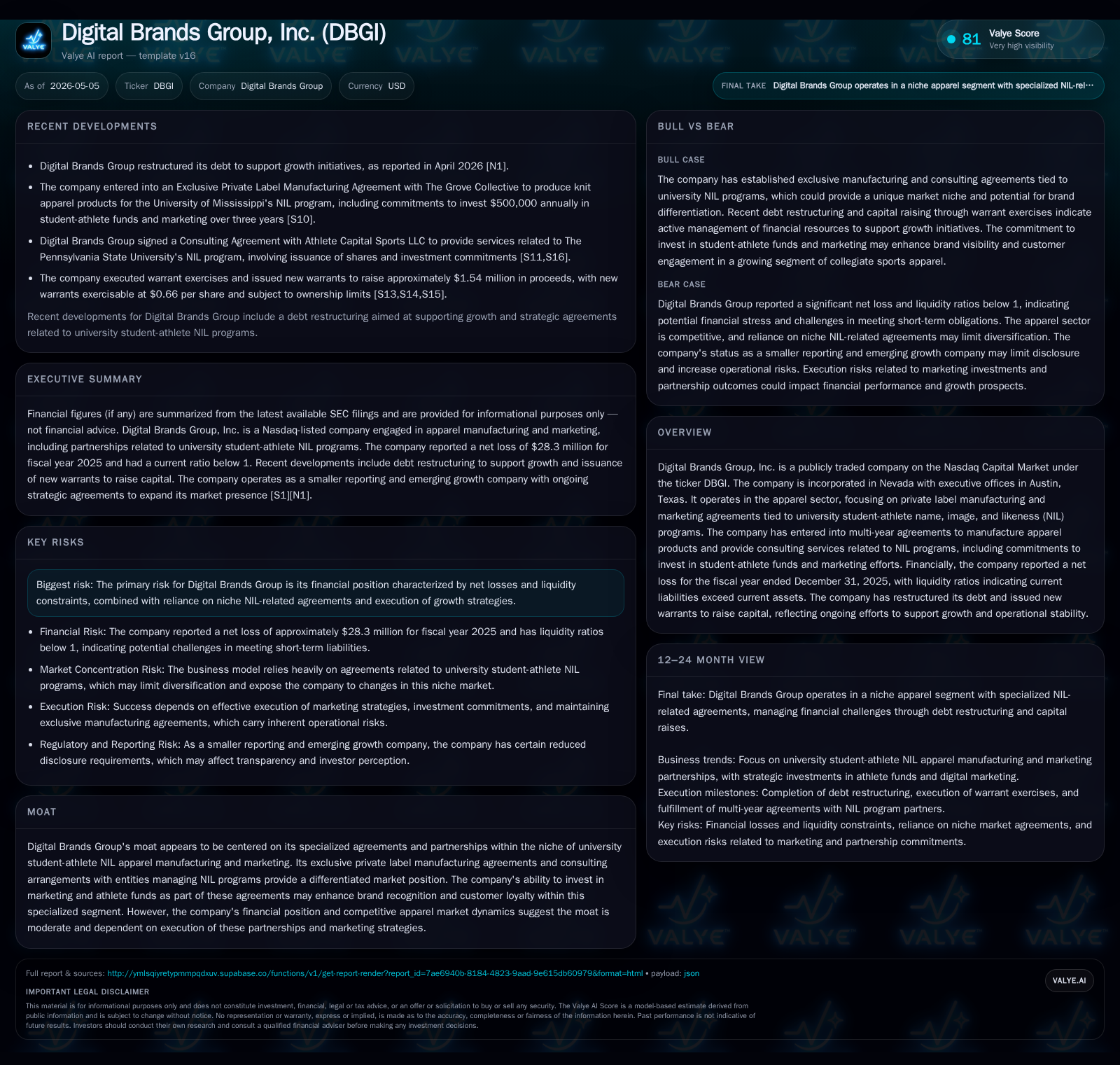
Digital Brands Group, Inc. (DBGI) has solidified its position in the niche university student-athlete NIL apparel market through exclusive multi-year manufacturing and marketing agreements. The latest quarterly update confirmed ongoing net losses but was punctuated by an April 2026 at-the-market (ATM) sales agreement aimed at enhancing liquidity and funding growth initiatives. DBGI operates a private label business model tightly integrated with NIL program marketing, relying on multi-year deals that include commitments to athlete funds and digital marketing to build brand equity. While competitive positioning benefits from specialized NIL partnerships, the company faces liquidity constraints and execution risks tied to its financial health and evolving collegiate sports commercialization landscape. Investors should monitor capital raise execution, contract renewals, and traction in NIL-driven apparel sales as key milestones.
Recent Operating Update: Quarter and Event Highlights
Digital Brands Group’s November 14, 2025 quarterly filing ([S2]) laid bare a continued operating environment marked by net losses without fundamental shifts in core operations or revenue mix. The company confirmed ongoing investment in branding and athlete-related initiatives aligned with its NIL apparel focus but underscored persistent negative profitability.
In a material development reported on April 21, 2026 ([S3]), DBGI entered into an At-the-Market Issuance Sales Agreement with Aegis Capital Corp., granting it flexibility to issue shares incrementally up to $100 million aggregate value under an effective shelf registration statement. This transaction mechanism enables opportunistic capital raising consistent with market windows while adhering to regulatory limits on offering volumes relative to public float. Though no guaranteed sales volume was stipulated, this arrangement materially bolsters DBGI's financing toolkit.
Together these filings illustrate an elevated focus on shoring up liquidity via modern equity financing tools while maintaining operational continuity within their specialized apparel niche.
Business Model and Product Offering Focused on NIL Apparel
Digital Brands Group operates primarily as a private label manufacturer specializing in apparel tied to university student-athlete name, image, and likeness (NIL) programs—a newly emergent segment within collegiate sports merchandising. Their contracts typically involve exclusive multi-year manufacturing agreements for knit apparel products under clients acting as NIL marketing agents for specific universities ([S1], [S19]).
Distinctly, DBGI’s model integrates product manufacturing with consulting services that encompass managing NIL marketing strategies surrounding athletic endorsements. The company commits annually significant funds—around $500,000—to directed student-athlete funds as specified by its partners plus an equivalent amount toward digital advertising and influencer campaigns orchestrated by DBGI itself ([S19]).
Revenue is driven by production volume under these long-term engagements and pricing arrangements negotiated under private label terms rather than direct consumer retailing. The contractual nature generally ensures a base order flow while enabling upside via expanded marketing success that stimulates brand recognition across athlete fanbases.
This positioning leverages DBGI’s expertise not only in technical apparel production but also navigating the complex legal and promotional landscapes around NIL rights—a capability not readily replicable by generic apparel manufacturers.
Industry Position: Niche Partnerships and Competitive Dynamics
Within the broader athletic/apparel sector—which includes major brands competing on endorsement deals across professional and college leagues—DBGI occupies a specialized subset focused exclusively on bridging newly commercialized collegiate NIL initiatives with apparel production.
Their strategic advantage lies in securing exclusive private label manufacturing rights linked directly to NIL marketing agencies representing university athletes. These locks on certain university-related product lines effectively limit competitive encroachment through higher switching costs given the intertwined marketing fund commitments and unique partnership structures ([S1]).
However, DBGI’s moat is moderate; their scale remains modest when compared to national sportswear giants who dominate standard collegiate team jerseys or mass-market sportswear. Furthermore, pricing pressure endemic to the general printing/knit textile industry coupled with the nascent status of the NIL commercialization framework implies volatility both in demand predictability and margin sustainability.
Execution in digital marketing spend effectiveness—often measured by return on influencer engagement—and maintaining strong ties with key university programs are critical for defending position against potential entrants seeking footholds via similar athlete network platforms.
Key Growth Drivers in the Student-Athlete NIL Market
The burgeoning acceptance of name-image-likeness rights among U.S. universities has catalyzed demand for licensed merchandise that reflects student-athlete identities beyond traditional team logos. This market evolution structurally expands potential demand for tailored apparel intersecting official athletics departments and independent NIL-focused agencies.
DBGI’s growth prospects partly rest on increasing penetration into additional universities implementing or expanding NIL frameworks. Multi-year contract wins such as their agreement with The Grove Collective LLC tied to University of Mississippi athletes illustrate recent successful new client acquisitions ([S19]).
Further upside derives from amplified commercialization efforts within existing partnerships: sustained digital marketing spends targeted at athlete fanbases may drive volume growth through online retail channels controlled by partners. Also notable is DBGI's commitment to invest annually substantial sums into athlete funds fostering goodwill and indirect consumer pull-through ([S19], [N1]).
Simultaneously, recent debt restructuring actions coupled with warrant exercises have improved financial flexibility allowing potential scaling of marketing budgets or capacity enhancements that otherwise might be constrained by cash flow limitations ([S3], [N1]).
Risks and Constraints: Financial Position and Execution Challenges
Despite strategic footholds, DBGI faces meaningful financial headwinds underscored by net operating income losses exceeding $29 million for fiscal year 2025 coupled with net losses nearing $28 million ([F1]). Total debt surpasses $6 million against cash reserves below $2 million resulting in a current ratio of approximately 0.79 ([F1]), signaling short-term liquidity strain.
Such deficits necessitate continuous equity or warrant-based capital raises as evidenced by the recent ATM sales agreement which carries inherent dilution risks yet is vital to sustaining operations ([S3]). The company’s reliance on a relatively small number of niche contracts linked to volatile collegiate programs presents concentration risk should key agreements lapse or fail to renew.
Execution-wise, translating committed marketing expenditures into measurable revenue growth demands effective campaign management amidst shifting social media trends affecting athlete endorsement potency. Additionally, supply chain disruptions affecting textile costs or delivery timeliness could further pressure margins given limited scale advantages.
What to Watch Next: Capital Raises, Partnership Execution, and Market Adoption
Investors should prioritize monitoring capital inflows originating from share issuances under the ATM facility granted April 2026 ([S3])—noting that although no minimum sale requirement exists, actual proceeds will influence balance sheet stability.
Equally important is tracking renewal status of marquee multi-year contracts such as those with The Grove Collective and Buffalo Sports Properties LLC which serve as key demand indicators for the firm’s product pipeline ([S19], [S23]). Forward-looking commentary within quarterly disclosures regarding digital ad spend effectiveness or expansion into new university markets would provide signals about scalable growth execution.
Lastly, progress on registrations enabling resale of shares underlying warrants issued during prior debt restructurings will impact shareholder composition dynamics alongside immediate liquidity provisions ([S17], [N1]).
Financial Snapshot: Balance Sheet and Profitability Overview
Latest financial snapshot
| Metric | Value | Period |
|---|---|---|
| Cash & equivalents | $1934831 | |
| 2025-12-31 | ||
| Total debt | $6mm | |
| 2025-12-31 | ||
| Net debt | $4mm | |
| 2025-12-31 | ||
| Current assets | $21mm | |
| 2025-12-31 | ||
| Current liabilities | $26mm | |
| 2025-12-31 | ||
| Current ratio | 0.79x | |
| 2025-12-31 |
Source: SEC companyfacts cache [F1].
The company's financial position reflects ongoing negative profitability alongside leverage surpassing cash reserves by roughly $4.2 million ([F1]). Current liabilities exceed current assets indicating short-term solvency pressure necessitating continued access to capital markets measures such as the recently executed ATM arrangement ([S3]). While these metrics underscore the tight financial footing DBGI operates within currently, they also contextualize the importance of strategic partnerships driving predictable revenue inflows.
This analysis synthesizes Digital Brands Group's publicly available SEC filings and corporate disclosures without providing investment advice or forecasts. Any forward-looking developments require closer scrutiny against market realities as new data emerges.
Disclaimer: This is research-only, informational analysis and not investment advice. It may include AI-generated interpretation and general industry context. Always verify important details using primary sources.

Comments