
ACRO BIOMEDICAL’s Struggle to Reignite Revenue Highlights Financial and Operational Challenges
ACRO BIOMEDICAL faces acute liquidity pressures and a stalled product pipeline amid an absence of revenue since 2022.
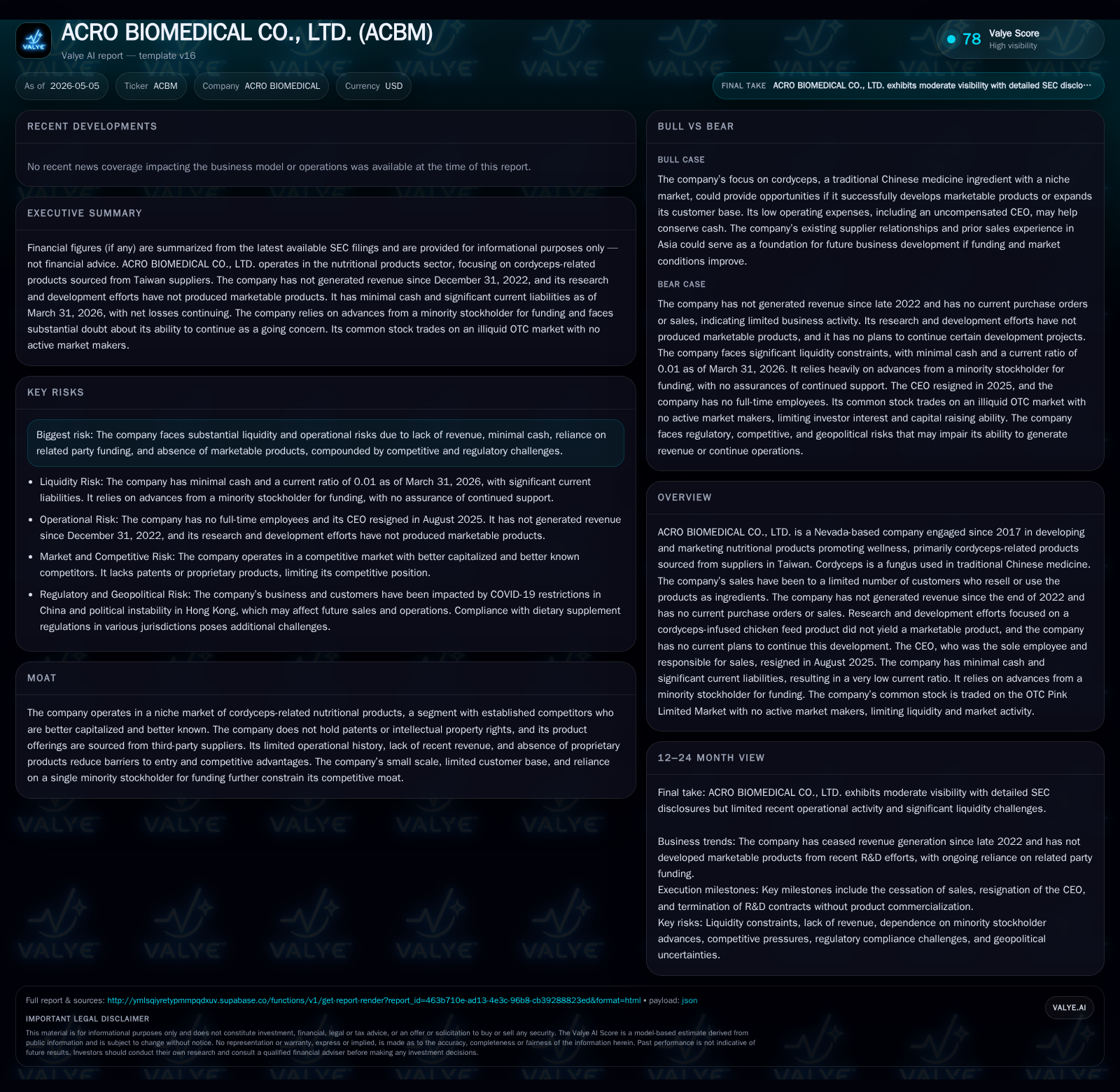
The latest Q1 2026 filing reveals ACRO BIOMEDICAL has not generated revenue since the end of 2022, with cash reserves dwindling and key personnel departures deepening operational risk. Its core business of cordyceps-related nutritional products is challenged by limited customer reach, no proprietary advances, and a failed R&D stint in cordyceps-infused chicken feed. The firm depends heavily on a minority stockholder for advances without formal agreements, sustaining a razor-thin current ratio near 0.01. Going concern warnings from auditors underscore the urgency of securing capital or reviving product innovation to stave off business discontinuity.
Q1 2026 Operating Review: Plunging Liquidity and Absent Revenues
ACRO BIOMEDICAL CO., LTD.’s latest quarterly report dated May 5, 2026 ([S2]) paints a stark picture of ongoing financial distress and halted business operations. The company disclosed zero revenue for the first quarter ended March 31, 2026—continuing a trend dating back to the end of 2022 with no active purchase orders or sales arrangements reported since then. Notably, its CEO and sole employee resigned in August 2025, leaving the company without operational leadership and staff.
Liquidity is critically impaired; current assets stood at just $3,873 compared to $431,108 in current liabilities as of March 31, 2026 ([S2],[F1]), yielding an alarmingly low current ratio near 0.01. This gap widened slightly over the prior quarter as liabilities increased by approximately $30k while assets contracted by over $10k. The company incurred a net loss of $43,774 in Q1 alone ([S2]) despite recording a non-recurring gain of $20,000 from liability extinguishment—highlighting an underlying cash burn exacerbated by operational expenses related primarily to public company compliance and professional fees. Interest expense paid to a minority stockholder was $3,503 during this period ([S2]).
Critically, ACRO continues to depend almost solely on advances totaling about $375k from a minority shareholder—advances that are non-interest-bearing and payable on demand without formal contractual repayment terms ([S2]). This funding reliance underscores precariousness in its capital structure amid an absence of independent liquidity or viable financing sources.
Business Model and Product Offering: The Niche Cordyceps Focus
Since the change in control in early 2017 ([S1]), ACRO has targeted nutritional products centered on cordyceps fungi—an ingredient rooted in traditional Chinese medicine purported for wellness benefits. Their product portfolio comprises third-party sourced cordyceps wellness items purchased from three suppliers based in Taiwan ([S1]). Sales have been routed through a very narrow customer base (fewer than five), mainly resellers who either directly retail these products or use them as ingredients ([S1]).
A notable deviation was the company's experimental R&D on a cordyceps-infused chicken feed initiated between mid-2021 and mid-2023 aimed at expanding into novel applications ([S16],[S19]). However, this program failed to yield any marketable product and was formally discontinued with no current plans for reinitiation ([S1],[S19]). Such R&D setbacks coupled with the resignation of the CEO-cum-sale operator have left ACRO without active product innovation or marketing momentum.
The business model relies purely on margin spread between third-party procurement costs and resale pricing without proprietary formulations or patents—resulting in low differentiation and minimal pricing power. Given the limited supplier base concentration (one supplier accounted for all purchases through 2022) and concentrated wholesale customers primarily linked to the China market segment ([S1]), the company faces structural risks tied to customer solvency and geopolitical factors.
Competitive and Industry Context: Barriers Absent in a Fragmented Nutraceutical Segment
ACRO operates within the broader traditional medicine nutraceutical realm specializing in cordyceps products—a niche but competitive segment populated by better-capitalized players with stronger branding and scale economies. Regulatory scrutiny for Chinese medicinal ingredients entering Western markets further complicates potential expansion paths ([S1]).
The industry is characterized by low switching costs due to commoditized sourcing; buyers can readily substitute among suppliers given similar product qualities. Inflationary pressures in Asia have aggravated supply chain costs leading to inventory delays and cost sensitivity among downstream customers ([S1],[S8]). Moreover, market disruption caused by China's stringent COVID-19 containment policies until late 2022 significantly dented demand from their major customer geographies ([S1],[S19]). Political tensions in Hong Kong further cloud customer stability given that early significant sales involved Hong Kong-based resellers who exited beginning circa 2018 ([S1],[S19]).
Taken together, ACRO’s lack of intellectual property protection or differentiated distribution advantages virtually nullifies competitive moats. Existing incumbents benefit from entrenched customer relationships and greater resource capacity for marketing and product development—advantages an undercapitalized ACRO cannot currently match.
Strategic Growth Drivers: Limited Prospects Without Product Innovation or Market Expansion
Potential growth levers would theoretically include reviving credible R&D initiatives akin to their failed chicken feed project; broadening the small customer base beyond four principal buyers; penetrating new geographic markets particularly Western territories; or forming strategic partnerships for distribution scaling. However, none are actively underway as per recent disclosures ([S1],[S2]).
The company explicitly states it has no plans presently to recommence research efforts following consultant contract expirations last year ([S19]). Meanwhile, critical sales channels remain inactive with no purchase orders outstanding as of Q1 2026 ([S2]). The combination of management vacancy post-CEO resignation with tight cash constraints constrains any swift business plan execution.
Risks and Constraints: Liquidity Pressures, Management Void, and Market Realities
ACRO BIOMEDICAL’s risks are deeply rooted in its prolonged revenue drought compounded by severe liquidity shortfalls. With scant cash resources ($3,873) juxtaposed against outsized current liabilities ($431,108) as March-end Q1 shows ([F1],[S2]), working capital deficits undermine ongoing operational sustainability.
The departure of its sole full-time executive leaves governance and execution responsibility vacant unless promptly resolved ([S2]). Internal controls weaknesses flagged by management weaken reliable financial reporting capabilities amid reliance on external consultants for accounting duties ([S16]).
Their common stock’s listing status on the OTC Pink Limited Market results in no active market makers or proprietary broker quotes for shares—translating into illiquidity risk for shareholders and reducing attractiveness for fresh equity investment ([S8],[S18]). Advances from minority stockholders driving liquidity have neither contractually binding terms nor interest incentives beyond imputed accounting rates—further accentuating dependence vulnerabilities ([S5],[S21]).
Additionally, political dynamics impacting core Chinese customer bases (post-pandemic recovery unevenness plus Hong Kong instability) limit organic demand resurgence prospects given historical client ties concentrated there ([S19]).
Going concern flags issued both internally by management and externally via auditor reports underline serious doubt about the firm's ability to continue absent immediate financing or fundamental operational transformation ([S3],[S6]).
Pointers for Investors: Key Milestones and Funding Triggers to Monitor
Given ACRO's precarious state, key upcoming indicators include any announcements regarding new fundraising rounds whether debt placement or equity issuance that could stabilize cash flows ([S2],[S5]). Effective recruitment of senior management could suggest an intent toward revitalizing commercial activities or business planning.
Reactivation signs might come from signed contracts reflecting resumed orders from customers or strategic partnerships expanding distribution reach. Additionally, any revived R&D engagements yielding promising prototype progress would be pivotal milestones.
From a financial perspective monitoring shifts in working capital ratios alongside changes in related party advances provides insight into evolving liquidity dynamics. Enhanced transparency around structured funding arrangements would also mitigate current opacity concerning solvency avenues.
Absent such positive signals within forthcoming quarters remains illustrative of continuing existential risks.
Latest Financial Snapshot: Cash Position, Liabilities, and Capital Structure
Latest financial snapshot
| Metric | Value | Period |
|---|---|---|
| Current assets | $3,873 | |
| 2026-03-31 | ||
| Current liabilities | $431,108 | |
| 2026-03-31 | ||
| Current ratio | 0.01x | |
| 2026-03-31 |
Source: SEC companyfacts cache [F1].
This snapshot succinctly encapsulates ACRO's severe working capital deficit driven largely by sizeable related party indebtedness with minimal liquid assets available—illustrating the capital constraints dominating operational decisions. The net loss figure reflects ongoing expenses linked primarily to overheads rather than productive business activity.
This analysis is grounded exclusively on SEC filings as recent as May 5th, 2026 including detailed quarterly disclosures [S2]–[S26] alongside companyfact snapshots [F1]. It omits speculative assumptions beyond confirmable facts provided therein.
No investment advice is provided herein; this report serves solely as an informed evaluation of ACRO BIOMEDICAL CO., LTD.’s financial condition and operating environment based on publicly available documents.
Disclaimer: This is research-only, informational analysis and not investment advice. It may include AI-generated interpretation and general industry context. Always verify important details using primary sources.

Comments