
Ball Corporation’s Scale and Innovation Underpin Q1 Performance and Growth Outlook
Ball Corp’s Q1 results highlight resilience amid input cost pressures, leveraging a strong aluminum packaging franchise and targeted growth initiatives.
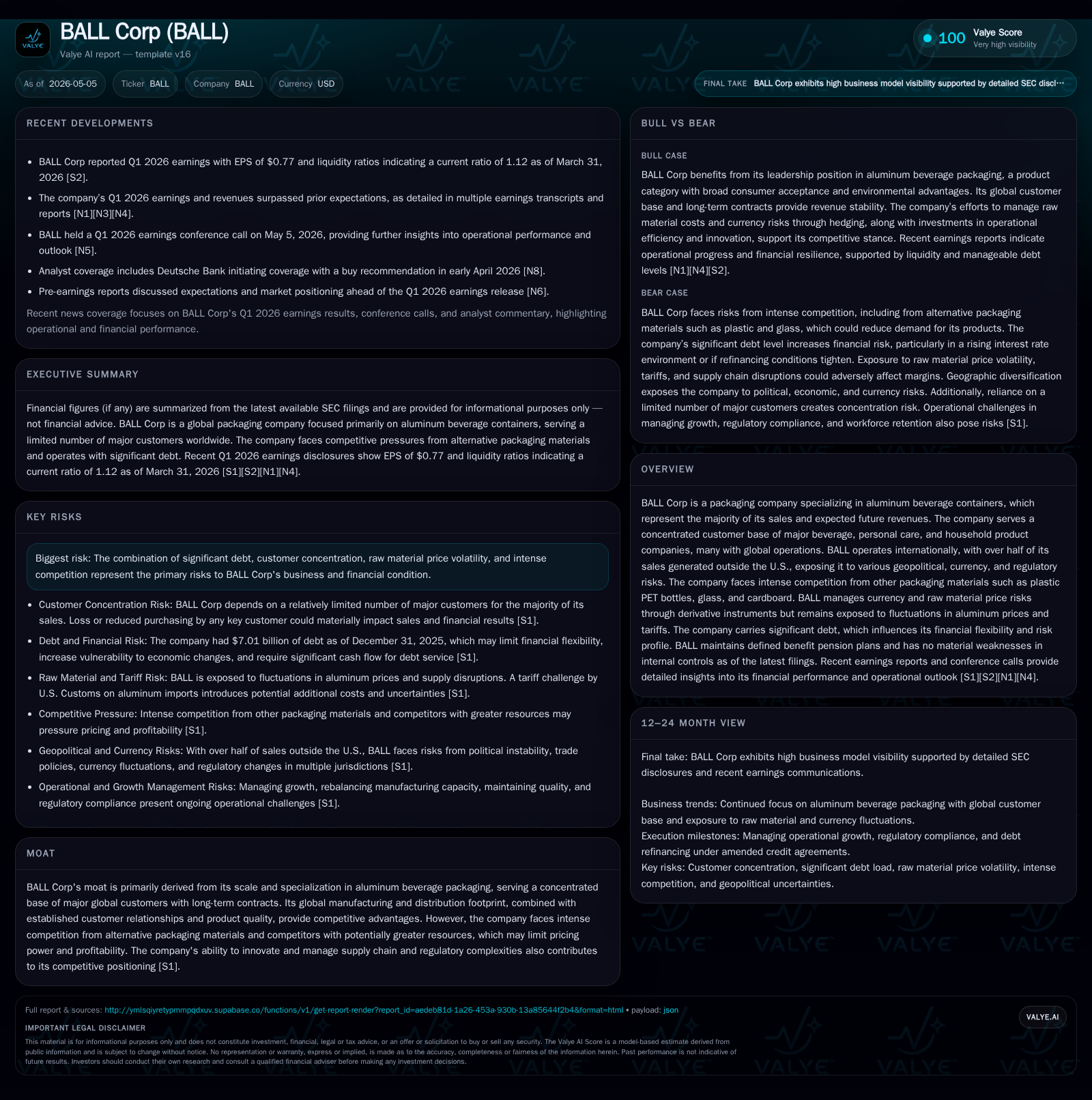
In its latest quarterly report dated May 5, 2026, Ball Corporation demonstrated solid operational performance despite margin headwinds from volatile aluminum prices. The company's core business of aluminum beverage packaging remains strategically advantaged due to long-term customer contracts and global manufacturing reach. Facing a competitive landscape with alternatives like PET and glass, Ball continues to drive growth through innovation, capacity optimization, and geographic expansion. Key risks include raw material price fluctuations and heavy debt load. Forward-looking milestones center on capacity projects and contract renewals with major beverage customers.
First Quarter Operating Update: Resilience Amid Cost Challenges
Ball Corporation’s 10-Q filing on May 5, 2026 ([S2]) alongside its concurrent 8-K event update ([S3]) shows the company navigating volatile aluminum prices that pressured margins yet still delivering top-line growth that modestly outperformed market expectations ([N1],[N5]). While gross margins contracted year-over-year due to raw material inflation, Ball's established long-term contracts with major customers helped offset some input cost swings through pass-through pricing mechanisms. Currency exchange fluctuations were managed via hedging programs without significant adverse impact reported. Volume growth in key beverage segments remained stable to slightly positive, supporting revenue resilience in the quarter.
No material changes were reported to risk factors in this filing period ([S2]), indicating steady strategic posture entering the mid-2026 fiscal year.
Business Model and Product Quality: The Aluminum Packaging Advantage
Ball Corp is structurally focused on the production of aluminum beverage containers which constitute over 70% of its sales ([S24]), a category where it holds leading scale advantages. The company serves a concentrated roster of large beverage firms globally under predominantly long-term contracts ([S12]). These contracts embed volume commitments backed by quality standards that create switching costs for customers reluctant to move to alternative packaging types due to supply chain complexity or brand positioning needs.
Aluminum cans appeal environmentally compared to plastics (PET) or glass alternatives, bolstered by global sustainability pressures favoring recyclable metal packaging ([S1]). Ball's product quality and consistencies across a broad international footprint—generating approximately 53% of sales outside the U.S.—further supports its market position while exposing the business to multifaceted regulatory and geopolitical risks in various jurisdictions ([S24]).
Competitive Landscape and Industry Dynamics: Navigating a Crowded Market
The global packaging industry remains fragmented with intense competition from PET bottles, glass containers, and emerging sustainable materials ([S1], [N2]). Although Ball’s scale enables cost efficiencies, pricing power is constrained by oversupply cycles evident in some regions as well as by competitors potentially wielding greater resource pools ([S1], [S4]).
Currency exposure is managed through active derivative use given significant non-U.S. dollar operations primarily denominated in euros and other emerging market currencies ([S24]). Regulatory frameworks targeting raw materials—such as PFAS-free coating mandates—require ongoing adaptation investments without guaranteed immediate returns ([S13]). As markets evolve toward ESG-compliant packaging solutions, agility in new technology development remains key for competitiveness.
Growth Drivers: Innovation, Capacity Optimization, and Global Footprint
Ball’s near-term growth strategy emphasizes expanding manufacturing capacity to meet rising customer demand aligned with global beverage trends ([N2], [S1]). Innovations like PFAS-free coatings demonstrate responsiveness to environmental regulations while enhancing product relevance.
Operational efforts focus on rebalancing regional production footprints to optimize logistics costs amid shifting demand patterns across North America, Europe, and emerging markets. Investments also support scaling automation technologies improving throughput efficiency and potential margin enhancement over time.
These initiatives aim to generate moderate volume increases complemented by mix improvements through specialty products offering premium features or sustainability credentials ([N2]).
Risks and Constraints: Debt, Customer Concentration, and Raw Material Volatility
Ball carries substantial leverage with total debt around $7.05 billion as of December 31, 2025 ([F1]) resulting in an approximate net debt position of $6.32 billion after considering cash reserves ([F1]). This capital structure constrains financial flexibility especially amid interest rate variability.
Customer concentration represents a crucial vulnerability; top beverage clients purchasing under long-term agreements account for a majority of sales but those contracts carry renewal risks contingent on pricing competitiveness and service delivery ([S12]).
Raw material price volatility—particularly aluminum—poses ongoing operational risks despite partial hedging strategies implemented by the company. Tariffs or trade policy shifts could exacerbate input cost unpredictability further impacting margins ([S1], [S13]).
Outlook and Key Milestones: What Investors Should Monitor Next
Going forward, investor focus should be on quarterly volume trends relative to customer demand signals alongside margin trajectory influenced by commodity price movements and contract escalators ([S3], [N2]).
Execution progress on announced capacity expansions will be pivotal in meeting medium-term growth targets; delays or cost overruns here could pressure operating leverage.
Contract renewal cycles with major customers will serve as critical inflection points for sustaining revenue visibility given concentration risk dynamics.
Innovations around environmentally compliant coatings rollout also warrant close monitoring as indicators of adaptation success against evolving regulatory landscapes ([N2], [S13]).
Financial Snapshot: Capital Structure and Liquidity Overview
Latest financial snapshot
| Metric | Value | Period |
|---|---|---|
| Cash & equivalents | $730mm | |
| 2026-03-31 | ||
| Total debt | $7.05bn | |
| 2025-12-31 | ||
| Net debt | $6.32bn | |
| 2025-12-31 | ||
| Current assets | $6.22bn | |
| 2026-03-31 | ||
| Current liabilities | $5.56bn | |
| 2026-03-31 | ||
| Current ratio | 1.12x | |
| 2026-03-31 |
Source: SEC companyfacts cache [F1].
At quarter-end March 31, 2026, Ball reported cash and equivalents totaling $730 million alongside current assets of approximately $6.22 billion against current liabilities near $5.56 billion yielding a current ratio of about 1.12 — indicative of adequate short-term liquidity positions amid a sizable working capital base ([F1]).
Total debt stood at approximately $7.05 billion as per year-end December 31, 2025 figures; no covenant breaches or refinancing concerns were disclosed in recent filings ([F1], [S2]).
| Metric | Value |
|---|---|
| Cash & Equivalents | $730 million |
| Total Debt | $7.05 billion |
| Current Assets | $6.22 billion |
| Current Liabilities | $5.56 billion |
| Current Ratio | 1.12 |
| Net Debt (approx.) | $6.32 billion |
This analysis reflects information available as of May 5, 2026 based on latest SEC filings (notably Form 10-Q and accompanying reports) combined with recent earnings call insights sourced from public transcripts. It aims to present an objective assessment rooted strictly in disclosed data without speculative forecasts or investment recommendations.
Disclaimer: This is research-only, informational analysis and not investment advice. It may include AI-generated interpretation and general industry context. Always verify important details using primary sources.

Comments