
Voyager Technologies Advances Starlab and Defense Capabilities Despite Near-Term Losses
Voyager's Q1 2026 update highlights progress on the Starlab commercial space station and key defense contracts amid operating losses and ongoing investments.
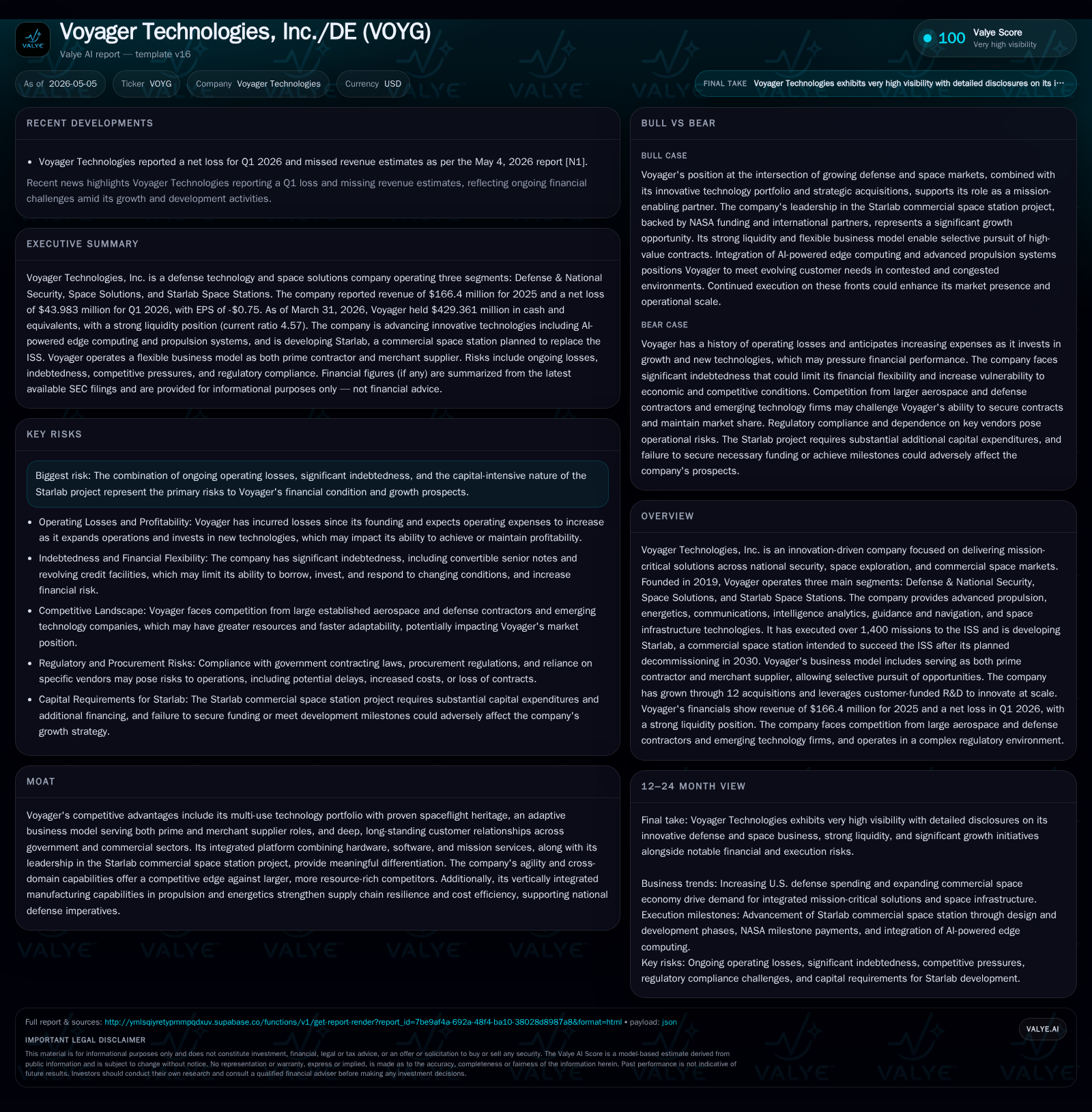
Voyager Technologies, Inc. reported Q1 2026 results reflecting continued investment in its flagship Starlab commercial space station and expansion of its defense and national security technology portfolio. The company remains focused on executing a dual-role business model as prime contractor and merchant supplier, leveraging recent acquisitions to broaden capabilities in propulsion, energetics, and AI-driven intelligence analytics. Although operating losses persisted, Voyager maintains a robust liquidity position supported by strong cash reserves and no reported debt as of late 2025. Key growth drivers include government budget increases in national security, NASA's development grant for Starlab, and the growing commercial space economy. Risks center on capital intensity of Starlab, evolving space industry dynamics, execution challenges scaling manufacturing, and regulatory complexities. Stakeholders should monitor backlog conversions, progress on Starlab’s critical design review, mission service milestones, and potential contract awards.
Recent Operating Update
Voyager Technologies’ latest quarterly report filed May 5, 2026 [S2] reveals the company's continued focus on capital-intensive projects alongside operational expansion across its three core segments: Defense & National Security, Space Solutions, and the flagship Starlab Space Stations initiative. Though the firm reported an operating loss through end-2025 with operating income at -$108 million [F1], it retains a healthy liquidity profile with cash and equivalents at approximately $429 million as of March 31, 2026 [F1]. Notably, Voyager carries no reported outstanding debt since September 2025 [F1], underscoring a conservative balance-sheet stance amidst heavy R&D and infrastructure commitments.
The company highlighted continued progression on the NASA-sponsored commercial space station project — Starlab — which aims to provide a successor orbital platform for low-Earth orbit research after ISS retirement around 2030 [S1]. As of December 31, 2025, $34.3 million remained available from the $217.5 million NASA development grant for Starlab [S1]. Multi-national partnerships under the Voyager-led global joint venture include Airbus and Mitsubishi among others [S1], signaling strategic collaboration to broaden market reach.
Business Model
Voyager Technologies operates a hybrid business model combining prime contracting roles with merchant supplier engagements or subcontracting depending on opportunity profile [S1]. This dual approach allows it to balance program risk exposure with capital efficiency while targeting long-term government budgets as well as nascent commercial space market demand.
Revenue largely derives from government contracts supporting national security missions — spanning communications technologies, missile-defense enabling propulsions systems — alongside commercial space infrastructure services including over 1,400 executed missions to the ISS involving scientific payloads [S1]. The company’s portfolio integrates hardware such as advanced propulsion (solid-propulsion subsystems for Lockheed Martin's Next Generation Interceptor) and energetics materials (via Estes Energetics acquisition), software solutions like AI-powered signal intelligence analytics (through EMSI), combined with mission service support [S1][S26].
This approach underpins steady expansion across proprietary technology platforms that meld physical systems engineering with advanced sensor analytics — emphasizing lives-on-the-line applications that require resilient performance in contested domains. Vertical integration was notably reinforced by recent acquisitions that expand domestic capabilities in propulsion materials critical for missile defense programs crucial under U.S. strategic imperatives [S1][S26].
Industry Structure and Competitive Position
The defense technology industry remains characterized by large prime contractors with entrenched government relationships; however, Voyager differentiates itself through agility enabled by innovation at scale across intersecting domains — defense electronics, propulsion systems manufacturing, in-space infrastructure — which gives it an edge over both traditional primes slower to pivot into space-economy verticals and pure-play commercial entrants lacking integrated hardware-and-software depth.
The expanding role of space within national security frameworks elevates demand for adaptable technologies covering guidance/navigation controls alongside data fusion from synthetic intelligence platforms [S27]. Increasingly congested orbital environments motivate new infrastructure such as commercial stations like Starlab — creating competitive niche openings distinct from incumbent ISS reliance — though these also attract competition from large aerospace conglomerates including potentially state-backed rivals internationally.
Key to Voyager’s moat is its demonstrated flight heritage evidenced through extensive ISS mission experience combined with integration capabilities allowing seamless end-to-end solutions from component manufacture to operations services [S27]. Its stake-leading presence in the Starlab JV cements long-horizon positioning within rapidly maturing LEO markets slated for microgravity research, orbital manufacturing projects, logistics support networks plus scientific discovery expansions projected over subsequent decades.
Growth Drivers
Government Budgets & Defense Spending
Sustained bipartisan strength in U.S. Department of Defense appropriations has buoyed predictable funding flows supporting advanced missile defense interceptors where Voyager holds supply chain criticality through integrated propulsion subsystems [S28]. The fiscal year 2026 DoD budget approximated $839 billion marking steady upward trajectory reinforcing resilient military modernization priorities essential for product demand continuity.
Commercial Space Infrastructure Expansion
The planned decommissioning of ISS around 2030 creates urgency among private-public entities to field replacement platforms securing continuous LEO presence [S1]. Voyager’s development of Starlab addresses this emerging multi-sector demand ranging from academia to industrial microgravity processes likely driving future customer diversity beyond governmental baseloads.
Strategic Acquisitions & Organic Innovation
A track record of integrating twelve acquisitions since inception enables vertical/horizontal supply chain control augmenting both technological breadth—AI-enabled radar analytics—and depth—energetics chemical compound manufacture—supporting complex system offer bundles attractive to national security agencies seeking single-source vendors with proven delivery capacity [S1][S26]. This accelerates product pipeline velocity while mitigating subsystem dependency risks.
Risks / Watchpoints / Growth Constraints
Capital Intensity & Operating Losses
High fixed costs associated with next-generation space station construction alongside ongoing R&D investment contribute to near-term operating deficits (-$108 million operating income loss reported) [F1]. These expenditures expose Voyager to execution risk if timelines extend or cost overruns occur given limited historical operating scale relative to larger aerospace peers.
Manufacturing Scale & Supply Chain Complexity
As Voyager attempts to scale production of energetics materials domestically—including sensitive chemicals foundational to solid rocket motors—it faces regulatory compliance hurdles plus workforce enhancement challenges impacting schedule adherence [S24][S26]. Supply constraints may strain delivery consistency critical for missile defense programs reliant on strict operational cadence.
Contractual Uncertainties & Backlog Variability
Given many contracts contain termination-for-convenience clauses permitting customer cancellations or scope changes prior to full exercise, revenue realization is susceptible to order flow fluctuations impacted by government priorities or geopolitical developments altering funding or mission requirements [S23].
Regulatory Environment & Export Controls
Strict U.S. export controls governing advanced defense-related technologies may restrict ability to leverage international partnerships fully or quickly adapt supply lines amid shifting geopolitics affecting foreign collaborations embedded within the Starlab JV structure [S25].
What To Watch Next
Critical milestones include:
- Progression through Starlab’s Critical Design Review facilitating transition toward hardware production beginning imminently following expected launch targeted for 2029-2030 timeframe [S1]
- Further contract awards under missile defense interceptor propulsion programs validating newly integrated vertically aligned manufacturing capabilities [S26]
- Expansion of AI-enabled signals intelligence deployments through EMSI platform integration confirming sortie volumes or governmental renewals
- Backlog conversion rates quarter-over-quarter signaling health of upcoming revenue streams given order timing sensitivities inherent in spacecraft mission schedules
- Updates on multi-cloud infrastructure deployments in orbit extending software service offerings embedded onboard customer missions now underway post-September 2025 launch release [S27]
Financial Profile Summary
Latest financial snapshot
| Metric | Value | Period |
|---|---|---|
| Cash & equivalents | $429mm | |
| 2026-03-31 | ||
| Current assets | $509mm | |
| 2026-03-31 | ||
| Current liabilities | $111mm | |
| 2026-03-31 | ||
| Current ratio | 4.57x | |
| 2026-03-31 |
Source: SEC companyfacts cache [F1].
Despite operating losses reflecting ongoing investment phases fundamental to future growth initiatives like Starlab deployment and new product ramp-up in defense sectors, Voyager preserves ample liquidity with strong current assets relative to liabilities supporting near-term operational continuity without debt burden pressures [F1]. This provides financial flexibility critical amid evolving industry dynamics.
This analysis reflects information currently available from Voyager Technologies’ SEC filings through Q1 2026 alongside relevant industry context without forecasting or investment guidance. It emphasizes operational shifts observed recently as well as longer-term structural positioning within national security and commercial space domains.
Disclaimer: This is research-only, informational analysis and not investment advice. It may include AI-generated interpretation and general industry context. Always verify important details using primary sources.

Comments