
PSQ Holdings Unveils New Leadership and Growth Strategy as GMV Surges
PSQ Holdings’ recent executive appointments and operational milestones reflect a pivotal phase in scaling its fintech payment and credit platform amidst industry pressures.
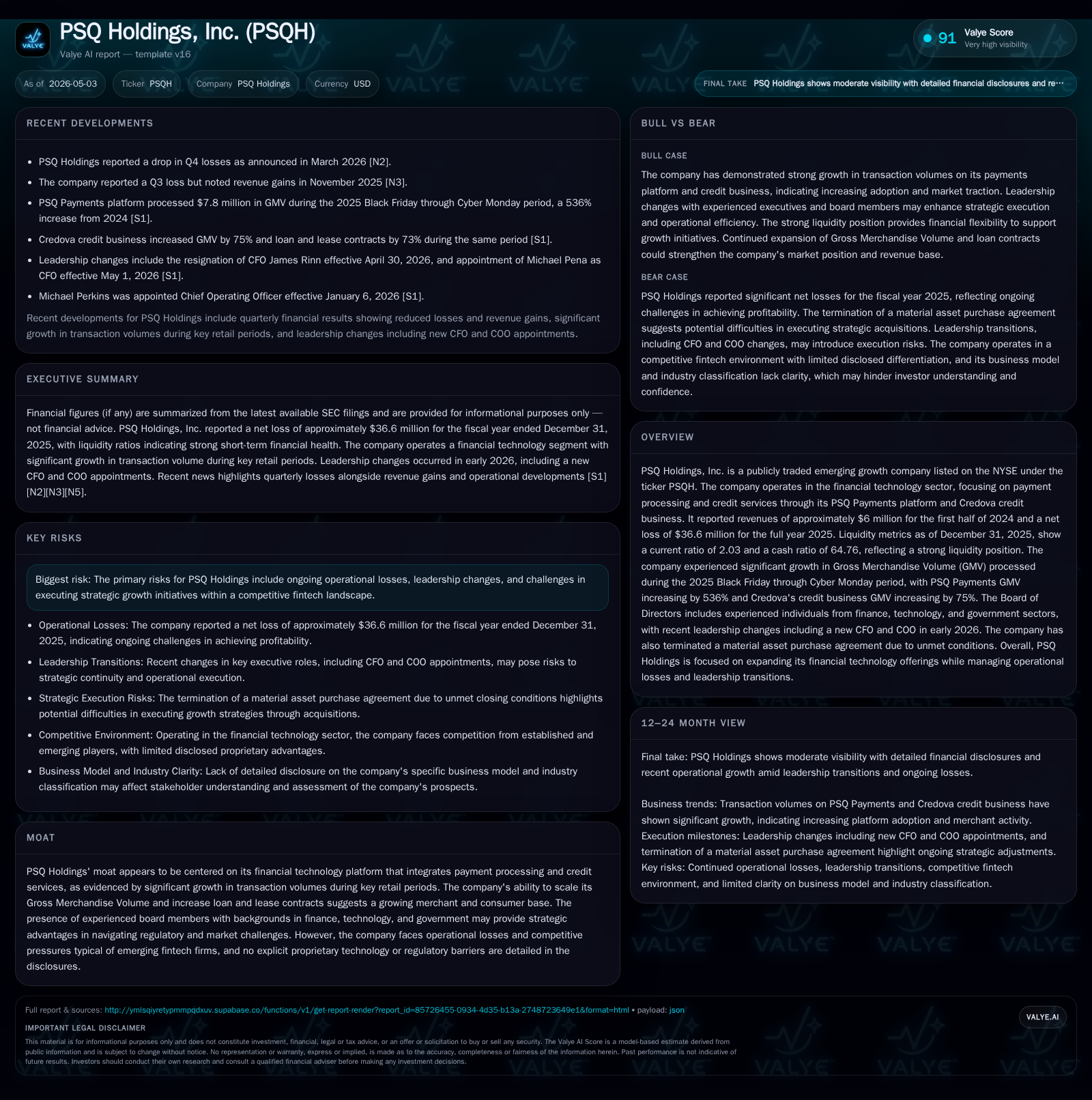
In April 2026, PSQ Holdings appointed Krista Wenzel as Senior Vice President of Finance & Accounting, signaling enhanced financial stewardship amid ongoing strategic shifts. Supported by robust growth in Gross Merchandise Volume (GMV) during the 2025 holiday period, PSQ is leveraging its integrated payment processing and credit services to expand merchant and consumer adoption. However, persistent operational losses and competitive challenges highlight the need for disciplined execution and capital management. Close monitoring of GMV trajectory, credit portfolio quality, and further leadership developments will be critical near-term indicators of PSQ’s path toward profitability.
Recent Leadership and Operating Developments
PSQ Holdings marked a significant leadership milestone with the appointment of Krista Wenzel as Senior Vice President of Finance & Accounting in November 2025 [S3]. Ms. Wenzel comes with a strong record in public company finance operations and capital markets leadership across infrastructure investments exceeding $1 billion in capital structuring—experience likely to bolster PSQ’s financial discipline amid a complex growth trajectory. Her prior roles include CFO positions at Meridiam infrastructure platforms and founding a financial advisory firm [S29]. This leadership addition comes alongside restructuring within the board including changes that lower quorum requirements for shareholder meetings to improve governance flexibility [S3].
These moves align with ongoing strategic shifts as PSQ scales its merchant base and expands operational processes driven by momentum from late-2025 sales cycles.
Business Model Architecture and Platform Economics
PSQ Holdings operates a two-pronged fintech platform combining payment processing through PSQ Payments with embedded consumer credit via its Credova business [S1]. The company monetizes primarily from transaction fees on gross merchandise volume processed and interest income or fee-based revenue from originating consumer credit contracts. This model benefits from volume sensitivity where increases in GMV directly boost revenue potential; however, it also carries operating leverage risk—fixed platform costs can pressure margins until scale thresholds are achieved.
The integration of credit services allows deeper merchant stickiness as consumers leverage financing options at point-of-sale. Credova functions by underwriting loans that then drive repeat usage from both merchants seeking higher conversion rates and consumers preferring credit-enabled purchases.
However, operating losses reported in full year 2025 (-$31.9 million operating income) reflect both ramp-related investments in technology/platform expansion and underwriting capabilities alongside market development costs [F1]. The net loss of $36.6 million signals the continuing challenge of balancing growth investment with progression toward profitability.
Competitive Environment and Industry Dynamics
Operating within the fintech payments and embedded lending space places PSQ Holdings amidst intense competition from established payment processors and newer embedded finance providers. Competitors often possess scale advantages enabling pricing pressure on transaction fees or advantages in underwriting sophistication aided by proprietary data models.
Additionally, regulatory scrutiny around consumer credit practices adds complexity to compliance functions, requiring robust risk management frameworks—an area PSQ is actively evolving given its expanding loan portfolio [S1]. Switching costs for merchants remain relatively moderate given alternative fintech solutions abound; hence PSQ’s dual offering aims to create higher barriers by embedding payments tightly coupled with credit capabilities.
Technology demands necessitate continuous enhancements to API integrations, data security protocols, real-time authorization processing speed, all crucial for merchant retention in high-volume e-commerce ecosystems.
Key Growth Catalysts and Market Penetration Opportunities
Demand drivers for PSQ stem notably from e-commerce growth patterns exacerbated by increasingly digital consumer payment preferences. The dramatic GMV increase—536% growth for PSQ Payments processing volume during the 2025 Black Friday through Cyber Monday period (from $1.2M to $7.8M) along with a substantial 75% rise in GMV attributable to Credova’s credit business—underscores this secular tailwind [S16] [F1].
Cross-selling potential between payment processing clients and credit offerings provides an important platform scalability lever as merchants seek bundled fintech solutions to maximize sales conversion.
Geographic expansion opportunities remain available provided regulatory pathways are navigated effectively; however, current filings do not detail multi-regional rollouts explicitly.
Overall, product innovation centered on enhancing user experience—such as instant loan approval or more seamless checkout workflows—could materially increase merchant adoption rates.
Risks, Constraints, and Execution Challenges
PSQ faces material risks including sustained negative earnings trends with full year 2025 net loss at $36.6 million despite GMV acceleration [F1]. Continued loss trajectories necessitate further capital infusion or stringent cost controls to sustain growth investments without deteriorating liquidity.
Credit risk inherent in consumer financing portfolios may lead to elevated write-offs if underwriting algorithms do not adapt rapidly to market conditions or rising default rates—a common challenge in embedded lending sectors.
Leadership transitions pose execution risks especially if key personnel churn occurs during critical product scaling phases [S3]. Regulatory compliance costs could intensify amid evolving consumer protection statutes targeting fintech lenders.
Competitive pressures may limit pricing power or prolong customer acquisition cycles requiring additional marketing spend.
Lastly, recent NYSE notice regarding non-compliance with listing standards remote but possible delisting raises capital market reputational concerns [S23].
Upcoming Catalysts and Performance Milestones
Near-term indicators relevant for tracking PSQ’s path forward include quarterly disclosures focused on GMV progression beyond the amplified holiday season peak [S7]. Monitoring loan origination volumes within Credova’s vertical will provide signals on credit portfolio scaling and associated risk metrics.
Boardroom developments or additional executive appointments will reveal corporate governance prioritization particularly around financial discipline areas now under Ms. Wenzel’s purview.
Partnership announcements expanding the merchant network or integrating third-party technologies could provide tangible validation of product-market fit strategies.
Finally, explicit guidance or commentary on breakeven timelines will be crucial for external stakeholders reflecting confidence in sustainable operating leverage attainment.
Financial Profile: Liquidity, Losses, and Capital Position
Latest financial snapshot
| Metric | Value | Period |
|---|---|---|
| Cash & equivalents | $15mm | |
| 2025-12-31 | ||
| Current assets | $32mm | |
| 2025-12-31 | ||
| Current liabilities | $16mm | |
| 2025-12-31 | ||
| Current ratio | 2.03x | |
| 2025-12-31 |
Source: SEC companyfacts cache [F1].
At fiscal year-end December 31, 2025, PSQ Holdings exhibited a current ratio of approximately 2.03x supported by $14.64 million cash & equivalents on hand against current liabilities nearing $15.67 million—indicating reasonable short-term liquidity coverage [F1]. Current assets totaled roughly $31.77 million supporting operational stability amidst net losses.
Nevertheless, an accumulated net loss amounting to $36.6 million reflects significant ongoing investment lagging immediate returns as the company scales infrastructure underpinning its payment processing network and embedded financing products [F1].
Managing cash burn alongside incremental revenue gains will be essential going forward to avoid dilutive capital raises or renegotiations of financing arrangements.
This analysis relies solely on disclosed SEC filings dated up to April 2026 ([S1],[S3]) and corresponding companyfacts snapshots ([F1]). Forward-looking statements pertaining to future performance should be interpreted cautiously due to evolving market dynamics inherent in emerging fintech companies such as PSQ Holdings.
Disclaimer: This is research-only, informational analysis and not investment advice. It may include AI-generated interpretation and general industry context. Always verify important details using primary sources.

Comments