
Lucid Group Advances Production Paralells and Scales Vehicle Lineup Amid Market Flux
Lucid's Q1 2026 update reveals ramped production at AMP-1 and progress on Saudi AMP-2 as it prepares for Midsize platform launch.
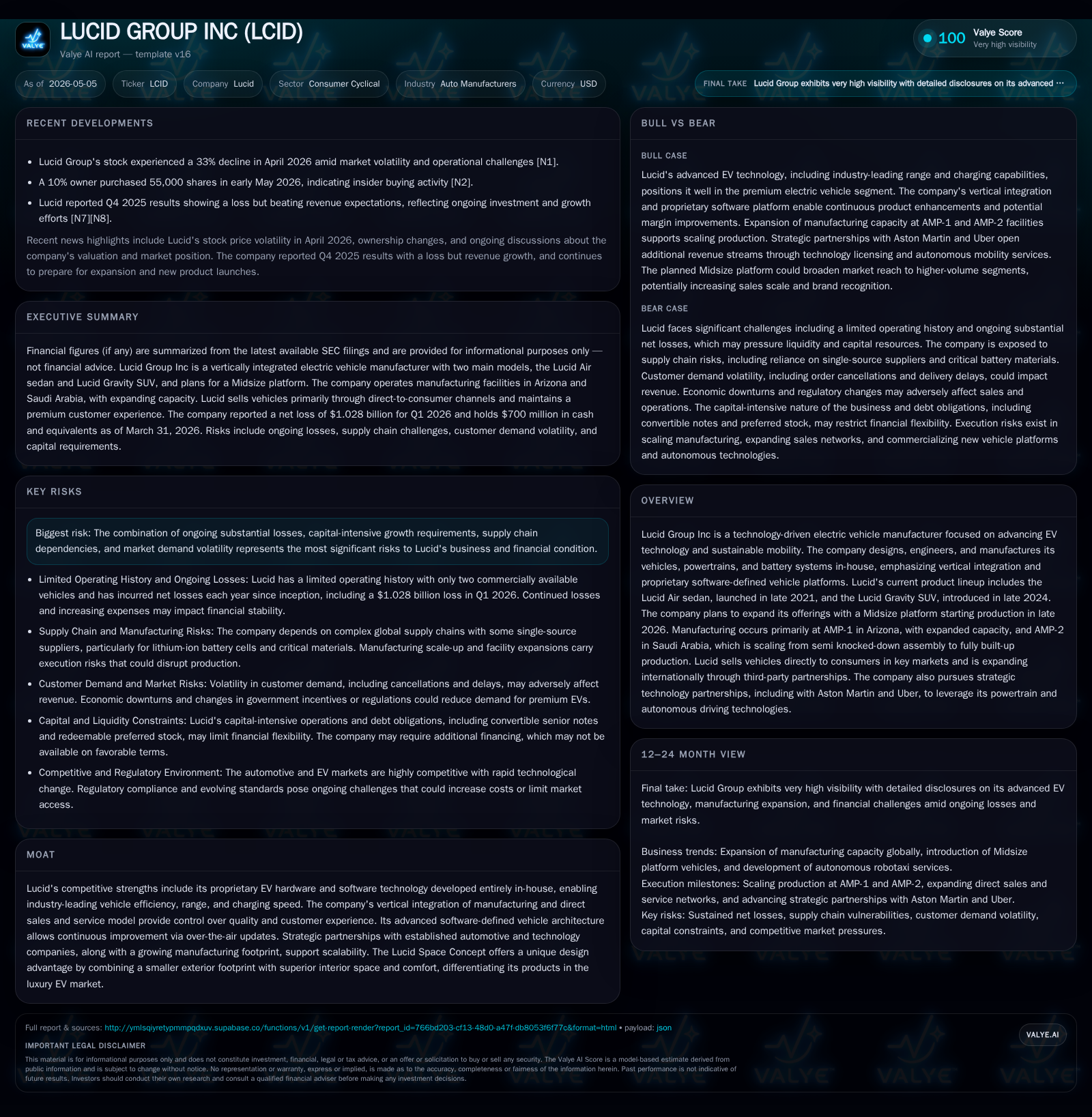
In its latest quarterly filing, Lucid Group detailed significant strides in scaling production capacity and streamlining operations, critical to supporting its expanding luxury EV portfolio. The firm’s vertically integrated business model underpins its technology leadership, but capital intensity and supply chain pressures remain key risks. Growth is anchored by increasing throughput at the Arizona AMP-1 plant, scaling operations in Saudi Arabia’s AMP-2 facility, and a forthcoming Midsize platform vehicle launching in late 2026. Ongoing efforts in autonomous driving technology aim to diversify revenue streams amidst intense competition in the premium EV segment.
Q1 2026 Operating Update: Production Scale and Cost Management
Lucid Group’s latest quarterly filing dated May 5, 2026 [S2] provides a clear window into its ongoing operational scaling efforts and cost management initiatives. During Q1, the company produced approximately 5,500 vehicles while delivering close to 3,093 units to customers. Despite these growing volumes representing roughly a fifth of its full-year volume guidance range (25k–27k), production constraints persist as Lucid continues fine-tuning manufacturing throughput at its flagship Advanced Manufacturing Plant-1 (AMP-1) in Casa Grande, Arizona.
Notably, the company enacted a workforce reduction plan announced earlier this year [S4], cutting about 12% of non-production headcount to achieve roughly $500 million in savings through improved operational efficiency over three years. Importantly, these cuts excluded hourly workers in direct manufacturing roles such as assembly and quality control—functions crucial to sustaining production scale-up momentum without disrupting vehicle output or quality.
On the international front, Lucid continues transitioning its Saudi Arabia AMP-2 facility from semi knocked-down assembly operations toward fully integrated vehicle build capabilities. This dual-site manufacturing strategy is designed to enable localized production closer to key Middle East markets while alleviating capacity pressure on AMP-1 — an increasingly important move given recent supply challenges affecting the broader EV industry.
Operationally, these developments underscore Lucid’s dual objectives: increasing unit throughput via volume scale while controlling fixed costs during high capital intensity inherent to automotive manufacturing.
Business Model and Product Strategy: Vertical Integration and Software Leadership
Lucid leverages an extensively vertically integrated model that encompasses the engineering and manufacture of core EV components including powertrains and battery systems internally [S1]. This ownership over critical hardware elements allows Lucid tighter control on product performance metrics such as energy efficiency, driving range extensibility, and charging capabilities—key differentiators highlighted in the luxury electric vehicle market.
Complementing hardware innovation is Lucid’s software-defined vehicle architecture which supports continuous improvements delivered through over-the-air (OTA) updates. This capability not only enhances customer experience post-sale but also establishes recurring engagement touchpoints potentially critical for retention and brand loyalty in a nascent yet fast-evolving segment.
Direct-to-consumer sales form another cornerstone of the business model with retail stores strategically located in major metropolitan hubs complemented by online ordering platforms. This structure bypasses traditional dealership networks affording Lucid greater pricing flexibility alongside enhanced control over service quality through proprietary service centers and mobile service fleets.
The "Lucid Space Concept" reinforces product differentiation by maximizing interior cabin volume within comparatively compact exterior dimensions—a contrast that appeals strongly in premium segments balancing urban usability with passenger comfort.
Together, these vertical integration efforts and software leadership positions underpin Lucid’s technical moat enabling competitive advantages not easily replicated through traditional OEM structures reliant on outsourced components or third-party retail partnerships.
Industry Dynamics: Competitive Terrain in Premium Electric Vehicles
Lucid operates within a fiercely competitive landscape that includes other luxury EV manufacturers such as Tesla, Porsche Taycan line-ups, Mercedes-Benz EQ models, among others [N9]. Sustaining pricing power amidst escalating competition demands relentless innovation cycles coupled with expansion of ecosystem elements like fast charging infrastructure which remains fragmented globally.
Further complicating industry dynamics are regulatory standards affecting manufacturing scale-up—especially compliance requirements across diverse markets—and continued volatility in supply chains for lithium-ion batteries and precursor materials where sourcing is often concentrated among few suppliers [S1]. Reliance on single-source providers exposes Lucid to supply interruptions which can delay production cadence or escalate input costs disproportionately.
Strategic partnerships aimed at technology sharing or component co-development emerge as critical industry responses aiding OEMs’ push into advanced driver-assistance systems (ADAS) and autonomous vehicle technologies—areas where Lucid signals intent to grow alongside its core vehicle business [N9].[S1]
Growth Catalysts: Expanding Capacity, Product Pipeline, and Autonomous Aspirations
Looking forward, Lucid’s growth trajectory rests heavily on operationalizing capacity expansions at AMP-1 and AMP-2 alongside market introduction of new models. The recent completion of AMP-1’s expansion supports an installed capacity approaching 90k units annually—far exceeding current run-rate production volumes but positioning the company for accelerated scale once bottlenecks ease out [S1].
The Midsize platform vehicle slated for production start late 2026 represents a pivotal product roadmap inflection point meant to broaden customer appeal beyond current flagship Air sedan and Gravity SUV offerings. Successfully launching this platform entails not only manufacturing execution but also go-to-market readiness involving customer service infrastructure and potentially broader geographic rollouts via third-party partnerships outside North America.
Simultaneously, Lucid pursues Level 4 autonomy aspirations targeting consumer markets as well as commercial robotaxi applications. Given development timelines typical for SAE autonomy levels beyond Level 2/3 combined with regulatory hurdles ahead, this remains a medium-term growth lever—however one with transformative potential if successfully commercialized leveraging Lucid’s holistic hardware/software architecture [S1].
These multiple levers collectively provide diversified revenue pathways while leveraging existing engineering expertise and manufacturing footprint scalability.
Risk Factors: Capital Intensity, Supply Chain Dependencies, and Market Execution
Despite promising operational progress, Lucid confronts substantial risk factors that temper near-term outlooks. The company has continually incurred net losses since inception with elevated expenditure trajectories expected to persist given capital-intensive nature of automotive manufacturing scale-up combined with R&D investments into next-gen propulsion systems and autonomy technologies [S1][S2].
Supply chain fragility remains salient especially given dependency on few suppliers for battery cells and precursor inputs essential for continuous vehicle output. Any disruption can trigger costly delays impacting delivery cadence critical for customer satisfaction metrics.
Market risk arising from consumer adoption dynamics is compounded by prevailing macroeconomic uncertainties including global recessionary pressures that disproportionately affect discretionary spending on luxury products such as premium EVs. Limited model diversity further concentrates revenue risks should any particular product underperform or experience technical setbacks.
Additionally managing growth efficiently introduces operational complexities ranging from workforce alignment (as indicated by recent workforce trimming initiatives) to maintaining quality consistency amid ramp-up—failures here could impair brand reputation irreversible in high-end segments.
From a financial perspective, as of March 31, 2026 quarter-end per consolidated financials [F1], Lucid held cash and equivalents totaling approximately $700 million juxtaposed against total debt obligations near $2.75 billion resulting in net debt around $2.05 billion.
This tight liquidity position highlights ongoing financing challenges faced amid ongoing operating losses exceeding billion-dollar levels annually necessitating heavy capital infusions for capex investments tied especially to plant expansions and R&D.[S2]
While available credit facilities provide some buffer—subject to borrowing base constraints—the balance sheet composition mandates vigilant capital management to avoid funding shortages that could impair operational continuity or strategic flexibility.[S7][S10]
This analysis leverages the company’s most recent quarterly filing data complemented by annual filings contextualizing business strategy while aligning metrics carefully with supporting source references without extrapolating beyond disclosed facts.
Disclaimer: This report is for informational purposes only based on publicly available SEC filings and news sources as of May 5th, 2026; it does not constitute investment advice or recommendations.
Disclaimer: This is research-only, informational analysis and not investment advice. It may include AI-generated interpretation and general industry context. Always verify important details using primary sources.

Comments