
CNS Pharmaceuticals Advances TPI 287 Trial Amid Financing and Regulatory Challenges
Clinical-stage CNS-focused biopharma progressing lead asset trial with funding runway into late 2026 but faces execution and market adoption risks.
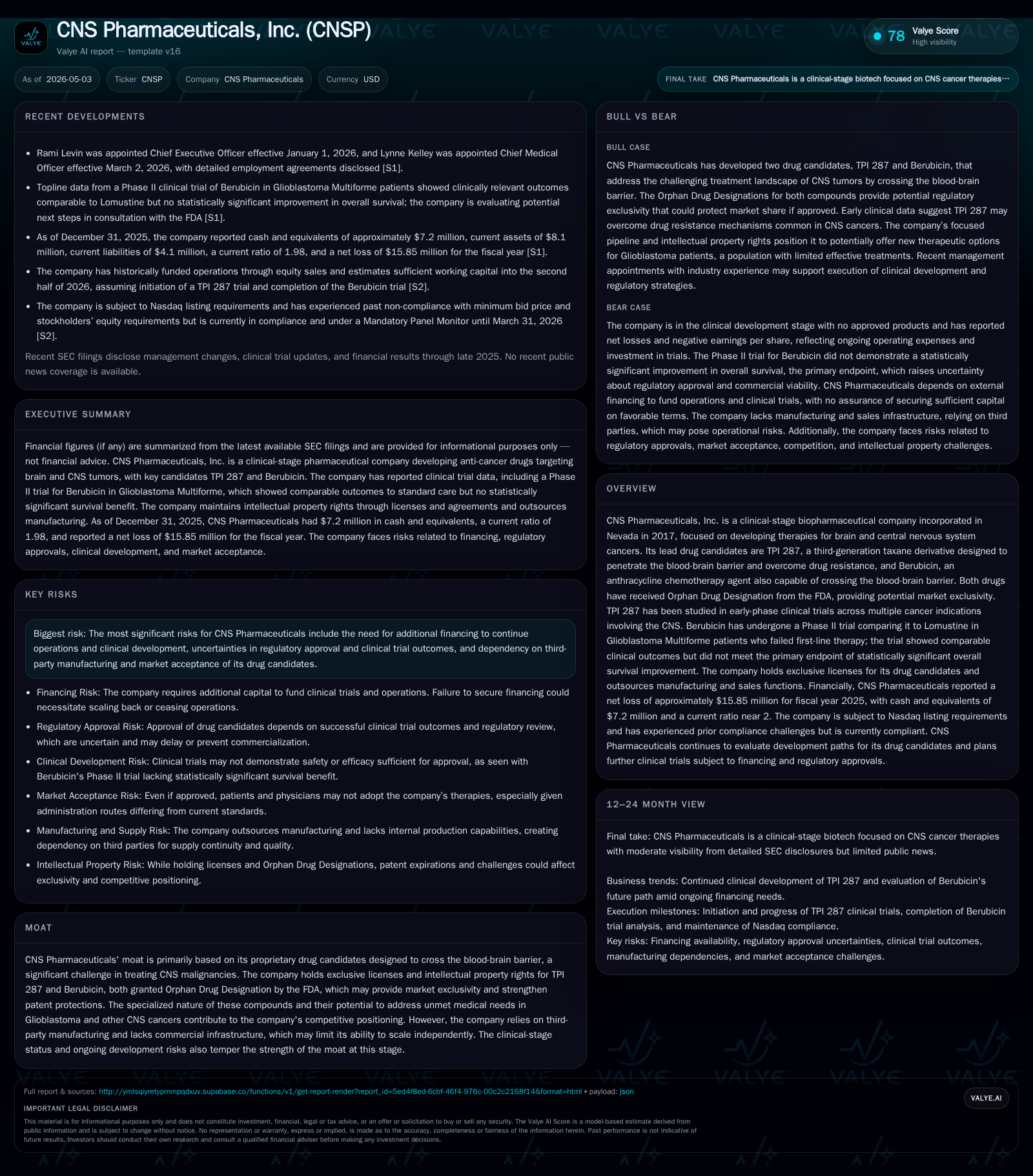
CNS Pharmaceuticals is a clinical-stage company developing therapies targeting central nervous system cancers, most notably Glioblastoma. Its recent quarterly update confirms sufficient working capital through the second half of 2026, with plans to initiate the pivotal Phase II trial for TPI 287 in Q2 2026. The company’s prior lead candidate, Berubicin, showed clinically relevant but not statistically significant survival benefits in glioblastoma patients, creating uncertainty around its regulatory path. CNS relies on licensed intellectual property and third-party manufacturing without commercial infrastructure, leaving it heavily dependent on external financing and successful trial outcomes. The blood-brain barrier–penetrating drugs position CNS in a highly specialized niche within oncology with significant unmet need.
Recent Operating Update
CNS Pharmaceuticals' latest quarterly filing dated November 14, 2025 [S2] anchors understanding of its near-term corporate trajectory. Management estimates this funding suffices to propel operations through the second half of 2026, contingent upon an annualized core expense run rate of approximately $5.5 million.
A key operational development is the planned initiation of the pivotal Phase II clinical trial for TPI 287 in Q2 2026. The company estimates this trial will cost between $12 to $15 million; however, final costs remain subject to the definitive trial design. Concurrently, CNS expects completion of its Berubicin clinical program and data analysis by mid-2026.
Importantly, CNS’s liquidity assessment predicates on no unexpected expenditure surges or significant delays in trial progression. The firm acknowledges that despite current financial sufficiency for core activities, additional substantial funding will be necessary to bring TPI 287 toward regulatory approval [S2].
The March 11, 2026 Form 8-K filing [S3] includes an investor presentation update describing ongoing strategic initiatives but does not materially alter prior disclosure contours.
Business Model
CNS Pharmaceuticals operates as a clinical-stage biopharmaceutical company specializing in novel oncologic agents targeting tumors of the central nervous system ("CNS"), particularly Glioblastoma Multiforme (GBM), a notoriously aggressive brain cancer with limited therapeutic options.
Both agents have received FDA Orphan Drug Designation, supporting potential market exclusivity periods upon approval which could enhance competitive positioning.
Operational architecture is asset-light; CNS lacks proprietary manufacturing facilities or commercial infrastructure. Instead, production is outsourced, and clinical development partnerships dominate activity. Revenue-generation remains prospective and highly contingent on future regulatory approvals and successful commercialization pathways.
Revenue mechanics hinge critically on licensing agreements (e.g., milestone payments per regulatory progress) and eventual net sales royalties—currently non-existent as drugs have not reached market stage.
In this context, CNS Pharmaceuticals' focus on molecules explicitly designed or discovered to cross this barrier provides a differentiated value proposition relative to both traditional chemotherapy agents and newer modalities such as targeted therapies or immuno-oncology approaches which often struggle with CNS penetration.
Globally, treatments for Glioblastoma are limited largely to surgery followed by radiation plus adjuvant oral chemotherapies like Lomustine or temozolomide—both marked by modest efficacy and survival benefit. Thus strides toward more efficacious systemic therapies penetrating brain parenchyma address a validated structural demand driver.
Growth Drivers
Several factors underpin potential growth should CNS Pharmaceuticals successfully bring products to market:
- Clinical Need & Patient Population: Glioblastoma incidence supports sustained demand given poor prognosis under current standards. Similar risks apply inherently to TPI 287’s upcoming studies.
- Financing Dependency: While near-term runway is adequate through H2 2026 at current burn rates [S2], substantial expenditures related to pivotal trials necessitate outside funding absent profitable operations. Market conditions or dilutionary capital raises may affect shareholder equity value.
- Regulatory Hurdles: FDA reviews are inherently uncertain; meaningful delays or adverse findings could extend timelines or require costly additional studies impacting financial resource allocation.
- Nasdaq Listing Compliance: Historically, CMS has struggled with bid price minimums though currently compliant following reverse splits; any future failure could result in delisting risk affecting liquidity [S26].
- Manufacturing Constraints: Outsourcing manufacturing limits control over supply chain continuity and cost management; disruptions would materially impact trial execution timelines.
- Market Acceptance Risk: Even if approved, patient adoption could be challenged if intravenous regimens (Berubicin) compete unfavorably with oral therapies concerning convenience or side-effect profiles.
- Intellectual Property Expirations: The original Berubicin compound patents expired by March 2020; subsequent protections rely heavily on orphan status exclusivities and new filings which carry inherent legal uncertainty [S29].
What To Watch Next
Key forthcoming developments include:
- TPI 287 Trial Initiation Timing & Design Finalization: Any delays from expected Q2 2026 start date or material changes increasing budget beyond preliminary $12-$15 million estimate will influence funding needs [S2].
- Berubicin Trial Readouts & Regulatory Discussion Outcomes: Updates regarding potential paths forward given previous trial results are crucial for visibility into whether Berubicin will advance commercially [S17].
- Capital Raising Activities: Monitoring equity issuance programs post-November 2025 ATM sales approximating $23 million net proceeds gives clues about sustaining operations [S12].
- FDA Communications & Designations: Any expedited review designations or FDA feedback shaping clinical development plans could accelerate commercialization timetables.
- Corporate Governance & Executive Leadership Changes: The appointment of Mr. Eric Faulkner as CTO in March 2026 underscores intent to bolster technical expertise during late-stage development phase [S1].
- Regulatory Compliance Regarding Nasdaq Listing Rules Through Early 2026 Monitoring Period: Any notices or breaches would pressure share liquidity metrics [S26].
Financial Profile Summary
Latest financial snapshot
| Metric | Value | Period |
|---|---|---|
| Cash & equivalents | $7.2mm | |
| 2025-12-31 | ||
| Current assets | $8.1mm | |
| 2025-12-31 | ||
| Current liabilities | $4.1mm | |
| 2025-12-31 | ||
| Current ratio | 1.98x | |
| 2025-12-31 |
Source: SEC companyfacts cache [F1].
As of December 31, 2025 [F1], CNS Pharmaceuticals held approximately $7.2 million in cash and equivalents against total debt around $450 thousand (best available data).
Operating income was negative $15.99 million reflecting sustained R&D investments typical of clinical-stage biopharma companies pursuing late-stage trials without product revenues yet realized. Net loss closely mirrored operating losses at roughly $15.85 million during this period.
Management’s disclosure highlights reliance on equity financing as well as recent ATM issuances generating over $23 million in net proceeds during nine months ending September 2025 [S12]. Despite this capital infusion capability, sizable additional fundraising will be imperative given projected total program costs for TPI 287 alone potentially exceeding initial estimates once finalized.
Disclaimer
This analysis is provided solely for informational purposes referencing publicly available disclosures up through May 2026. It does not constitute investment advice nor an endorsement of any securities discussed herein.
Disclaimer: This is research-only, informational analysis and not investment advice. It may include AI-generated interpretation and general industry context. Always verify important details using primary sources.

Comments