
Sensient Technologies Advances Natural Color Capacity Amid Steady Q1 Execution
Sensient’s latest quarter highlights incremental growth in natural color production as it navigates competitive pressures and supply challenges.
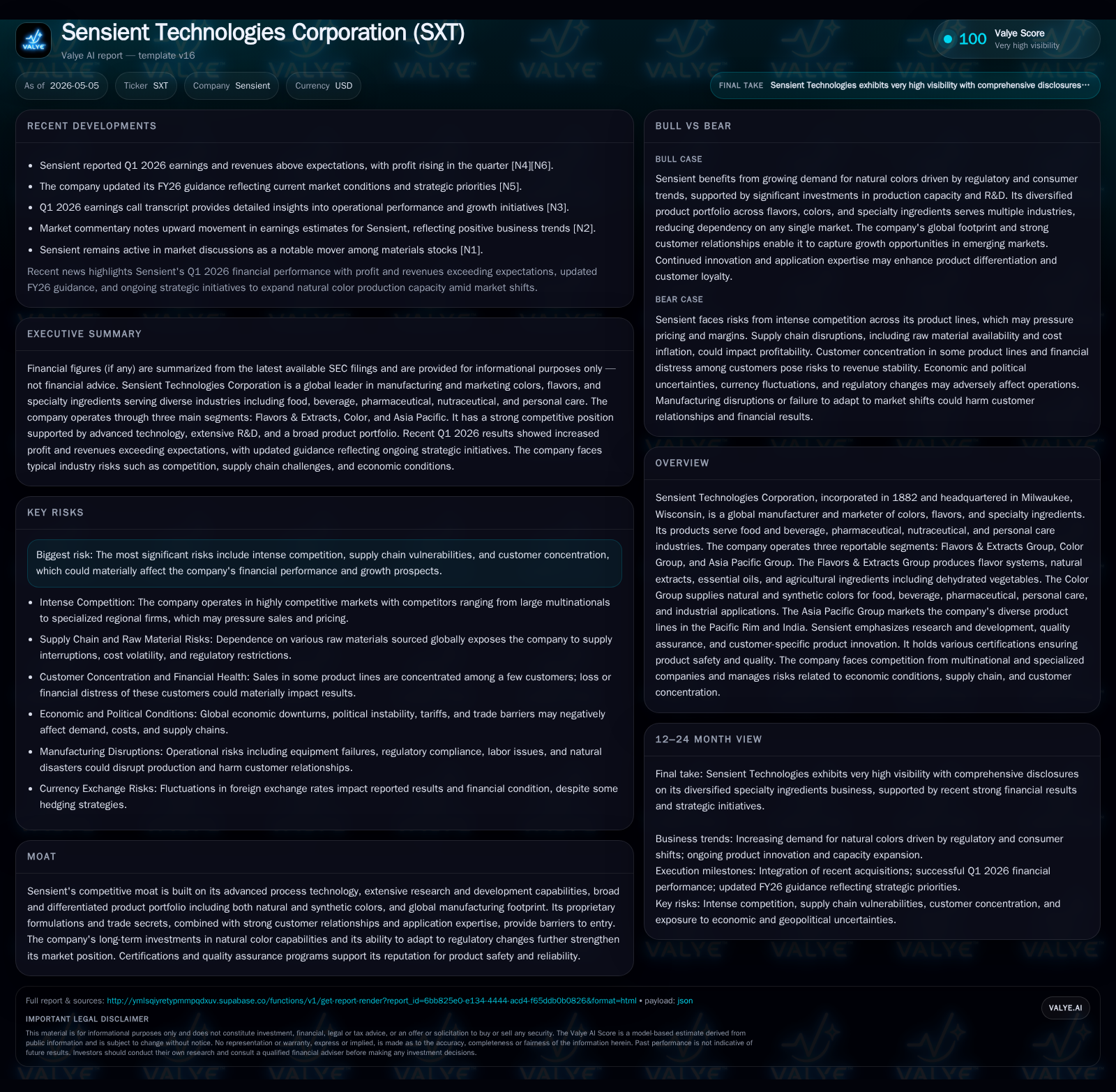
Sensient Technologies Corp reported first quarter 2026 results reflecting continued progress in expanding its natural color capabilities, a strategic pivot amid regulatory shifts away from synthetic colors. The company operates through three segments—Flavors & Extracts, Color, and Asia Pacific—leveraging proprietary technology and customer-focused innovation to maintain competitive advantage. Growth is driven by rising demand for natural ingredients across food, beverage, pharmaceutical, and personal care markets, supported by increased capacity investments. Risks include intense competition, supply chain dependencies, and regulatory complexities. Financially, Sensient maintains a strong liquidity profile with over $38 million in cash and a current ratio above 5, supporting ongoing investments.
Recent Operating Update
Sensient Technologies Corporation’s first quarter report filed on May 5, 2026, confirmed continued steady operational performance without introducing new material risks or changes to prior risk disclosures [S2]. This aligns with investor communications during the April earnings call which highlighted the company’s focus on scaling its natural color business to capture shifting consumer and regulatory trends away from synthetic alternatives [N2]. The quarter closed with firm liquidity evidenced by $38.5 million in cash and equivalents as of March 31, 2026 [F1], supporting ongoing capital expenditures aimed at enhancing production capabilities.
Business Model
Sensient operates as a globally integrated manufacturer and marketer of specialty ingredients primarily serving food & beverage, pharmaceutical/nutraceutical, personal care, and industrial sectors [S1]. Its revenues stem from sales of flavors & extracts (customized flavor systems, essential oils), colors (natural and synthetic pigments for multiple applications), and geographic marketing via its Asia Pacific group [S1][S13]. The company monetizes product innovation through proprietary formulations tailored to client-specific uses, combined with application expertise embedded in customer R&D support teams.
Revenue dynamics are influenced by contract terms that often involve batch variability driven by seasonal agricultural inputs (notably in natural colors) and volume pricing sensitive to competitive pressures [S12]. The company’s ability to command premium pricing relies on differentiation through quality certification (for safety and compliance), technical service excellence, and agility in reformulating products especially as customers shift toward natural ingredients requiring more complex blends due to higher usage quantities [S1]. Margins benefit from scale in processing technologies alongside rigorous supply chain optimization.
Industry Structure and Competitive Position
The specialty ingredient industry is fragmented yet intensely competitive. Sensient’s competitors range from large multinationals with broad portfolios to smaller niche players specializing either in flavors or colors but rarely offering the full spectrum the company does [S12]. Sensient asserts a competitive moat based on advanced process technology, deep R&D capacities including applications chemistry know-how, extensive IP protections via patents/trade secrets, well-developed global manufacturing footprint with redundancy for risk mitigation, and tightly integrated supply chains securing critical agricultural inputs [S12][S22].
Notably, the color business is uniquely positioned with a comprehensive portfolio covering both synthetic dyes/pigments and a growing array of natural colors and coloring foods—a dual offering not matched by many competitors. This dual capability positions Sensient effectively as regulatory frameworks tighten around synthetic additives in multiple jurisdictions [S26][S22]. Additionally, customer intimacy conveys switching cost advantages given the technical complexity involved in reformulations when substituting colorants or flavors.
Growth Drivers
The principal structural growth driver is the global push toward clean-label natural ingredients spanning food & beverage to pharmaceutical and personal care sectors. Legislative actions in various US states restricting synthetic food colors have accelerated customer migration toward natural substitutes that typically require higher loading rates due to formulation challenges [S22]. Sensient has responded by investing heavily over the past decade to build reliable extraction capacities for natural colorants alongside enhanced application support teams; these investments are ongoing [S22][N4].
Supplementing this are broader market wellness trends fueling demand for premiumized nutraceuticals where sensory appeal enhanced by flavors/colors is critical. Emerging markets within Asia Pacific also present sustained growth potential as local specialties incorporating Sensient’s product lines gain traction under regional technical marketing efforts [S19].
Continuous innovation in flavor compounds tailored for reformulated products supports cross-selling opportunities between segments. Lastly, the emphasis on sustainability—e.g., sourcing traceability related to agricultural inputs—supports premium positioning and justifies incremental pricing in certain product lines.
Risks / Watchpoints / Growth Constraints
Competition remains fierce with downward pressure on pricing where product commoditization occurs or where scale benefits accrue primarily to a few large competitors [S9][S12]. Customer concentration is notable in certain lines where a loss of a key account could disproportionately affect segment profitability [S14]. Supply chain risks persist due to political instability affecting sourcing regions such as Ukraine (noted supplier of sunflower oil essential for savory/beverage ingredients) and Turkey affecting crop availability [S9]. Raw material price volatility stemming from geopolitical tensions or environmental regulations can impact margins unpredictably.
Operationally, disruptions at specialized manufacturing sites can impact supply continuity since some products have limited production facility redundancy given their specialized equipment requirements [S24]. Regulatory compliance costs remain high given overlapping jurisdictional mandates governing food safety, environmental discharge limits, chemical approvals, anti-bribery laws across numerous countries which may raise operational complexity and cost structures [S28][S17]. Product liability risks involving contamination or adverse claims could impair reputation despite insurance coverage.
Macro conditions including interest rate fluctuations affect financing costs; although current liquidity is substantial enough to support investment programs without immediate refinancing needs [F1], persistent macroeconomic uncertainty could constrain buyer demand or delay capital projects.
What to Watch Next
Investors should monitor updates on Sensient's capital deployment relative to expanding natural color capacity—both announced projects' progress as well as any scaling challenges. Follow-through on securing supply chain robustness particularly diversifying raw material sources will be critical given input price volatility.
Regulatory developments impacting synthetic color bans at state/federal levels or international food safety authorities will influence demand trajectories. New product launches that concretely demonstrate efficacy in challenging formulations will serve as key adoption metrics.
Quarterly bookings growth trends especially within flavor systems reformulation contracts will indicate pace of structural transition sustaining top line expansion. Operating margins trending higher or stabilization amidst inflationary input costs would highlight successful cost management initiatives.
Furthermore, watch any shifts in customer mix signaling reduced concentration risk or expansions into adjacent specialty ingredient markets that could diversify revenue streams.
Financial Profile Snapshot
Latest financial snapshot
| Metric | Value | Period |
|---|---|---|
| Cash & equivalents | $39mm | |
| 2026-03-31 | ||
| Total debt | $710mm | |
| 2025-12-31 | ||
| Net debt | $671mm | |
| 2025-12-31 | ||
| Current assets | $1122mm | |
| 2026-03-31 | ||
| Current liabilities | $224mm | |
| 2026-03-31 | ||
| Current ratio | 5.01x | |
| 2026-03-31 |
Source: SEC companyfacts cache [F1].
| Metric | Value (USD) | Period End |
|---|---|---|
| Cash & Equivalents | 38,542,000 | |
| 2026-03-31 | ||
| Total Debt | 709,890,000 | |
| 2025-12-31 | ||
| Net Debt (approx.) | 671,348,000 | |
| 2025-12-31 | ||
| Current Assets | 1,121,538,000 | |
| 2026-03-31 | ||
| Current Liabilities | 223,713,000 | |
| 2026-03-31 | ||
| Current Ratio | 5.01 | |
| 2026-03-31 |
This financial snapshot underscores Sensient’s solid short-term liquidity position with a high current ratio indicating ample working capital coverage against liabilities [F1]. While leverage remains elevated relative to cash balances due mostly to long-term financing arrangements recorded at end-2025 balance sheet date, there was no indication of immediate refinancing concerns disclosed in the latest filings [S2][F1]. Operating income of $207 million last year reflects efficiency gains expected from process optimization paired with volume growth across core segments.
This analysis synthesizes insights drawn exclusively from public filings including the May 2026 quarterly report (10-Q) as primary anchor along with recent event reports (8-K) issued April 2026 and the most current annual filing (10-K) dated February 2026. Market commentary referenced serves contextual understanding but does not represent direct source evidence for financial metrics or material facts herein. This report provides an informed industrial perspective rather than investment advice or buy/sell recommendations.
Disclaimer: This is research-only, informational analysis and not investment advice. It may include AI-generated interpretation and general industry context. Always verify important details using primary sources.

Comments