
Edible Garden AG Pursues Strategic Growth Through Retail Expansion and Acquisitions
A recent preferred-for-common stock exchange and strategic operational developments underpin Edible Garden’s expansion in branded sustainable agriculture despite persistent liquidity challenges.
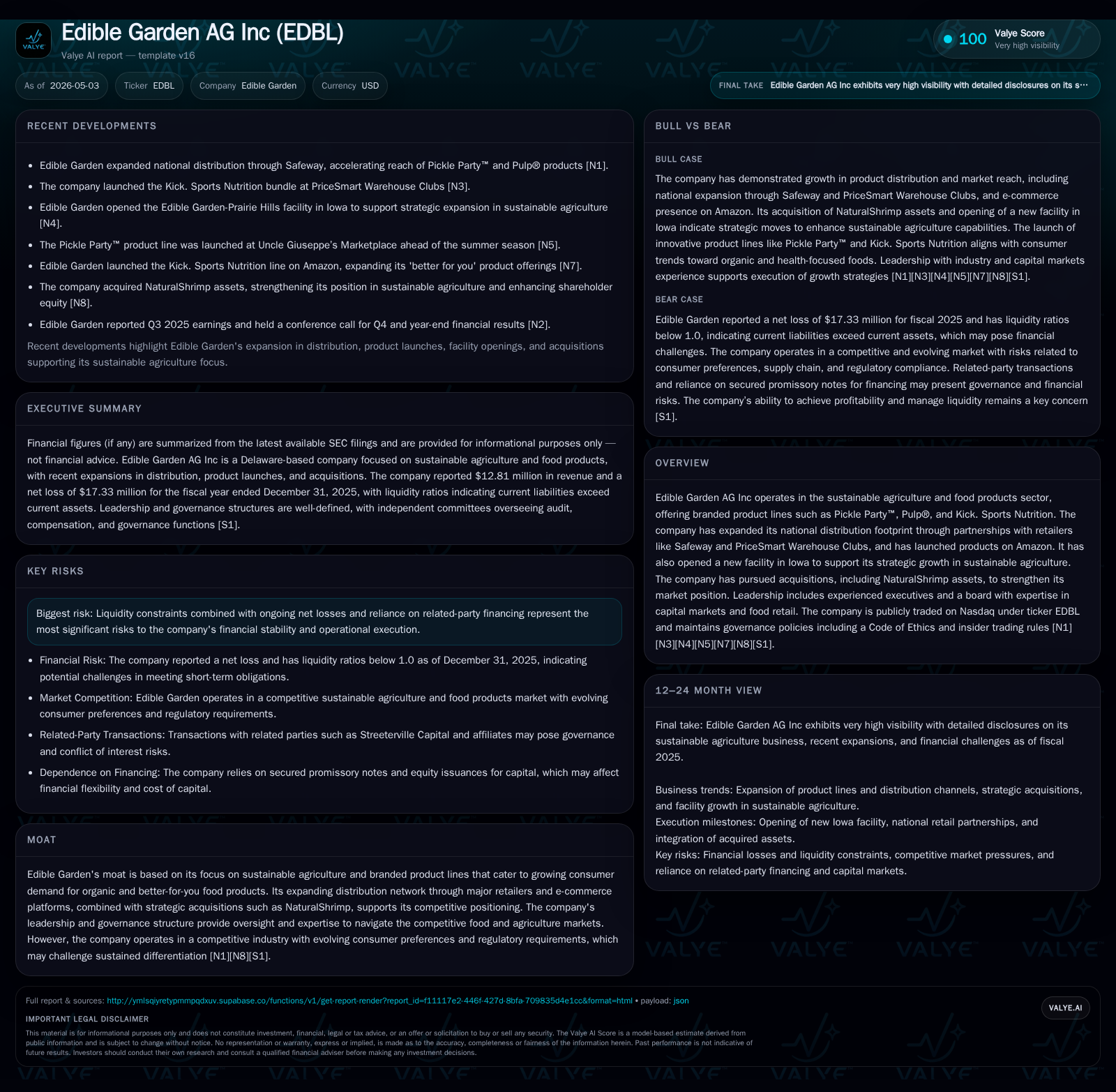
On April 21, 2026, Edible Garden AG executed an equity exchange converting $3.3 million of Series B Preferred Stock into approximately 3.6 million common shares, aiming to streamline its capital structure amid Nasdaq trading price constraints. The company operates in sustainable food products with branded lines like Pickle Party™ and has deepened retail distribution via Safeway and PriceSmart, bolstered by a new production facility in Iowa and acquisition of NaturalShrimp assets. While growth drivers include increased e-commerce penetration and retailer partnerships, liquidity pressures remain with a current ratio under 1.0 and ongoing net losses. Key milestones to watch include ramp-up of new facility capacity and integration progress on acquisitions.
Recent Capital Actions: Equity Exchange and Implications
On April 21, 2026, Edible Garden AG Incorporated entered into exchange agreements with Streeterville Capital whereby the company converted 3,301 shares of its Series B Preferred Stock—carrying an aggregate stated value of $3.301 million—into approximately 3.59 million shares of common stock [S3][S23]. The number of exchange shares was calculated by dividing the stated value by the Nasdaq minimum price effective immediately before agreement execution.
This transaction reflects a strategic move to recapitalize and potentially reduce the burdens associated with preferred stock obligations while providing Streeterville Capital significant common share ownership. Given Nasdaq's minimum price regulations influencing share issuance ratios, this restructuring may aid Edible Garden in improving market perception or liquidity profile by simplifying its capital structure and potentially avoiding delisting risks tied to low trading prices.
Business Model and Brand Portfolio Overview
Edible Garden AG operates primarily within the sustainable agriculture and food product sector offering key branded product lines including Pickle Party™, Pulp®, and Kick. Sports Nutrition [N1][S1]. These brands cater to growing consumer demand for organic, plant-based, and better-for-you food products that emphasize health and sustainability.
The company's revenue is generated through sales made predominantly via large retail partners such as Safeway Inc. supermarkets and PriceSmart warehouse clubs nationally [N1]. Additionally, Edible Garden has embraced digital transformation by launching its products on Amazon’s e-commerce platform, providing direct-to-consumer access and enhancing brand reach beyond traditional brick-and-mortar channels.
Product differentiation is anchored on sustainability credentials embedded into their processing methods, ingredient sourcing, and brand storytelling—elements increasingly valued by eco-conscious consumers [N4]. This alignment allows Edible Garden to command presence in market segments where consumers exhibit strong preferences for transparency and health-oriented foods.
Industry Context and Competitive Positioning
Within the sustainable food products industry, competition is robust among both legacy organic brands and emerging startups targeting health-conscious shoppers amidst evolving regulatory landscapes around labeling, certification, and ingredient standards [S1][N8]. Supply chains are subject to pressures from sourcing complexities inherent in sustainable agriculture practices.
Edible Garden's moat primarily draws from its combined advantages: established branded product offerings meeting sustainability standards, expanded national distribution through key retailers plus Amazon e-commerce channels, and strategic acquisitions such as the NaturalShrimp assets which add proprietary supply capabilities [N1][N8]. These assets enhance vertical integration potential critical in reducing input cost volatility common to sustainable agriculture players.
Nonetheless, the competitive environment demands continued innovation as consumer preferences shift rapidly toward novel health trends or alternative protein options. Pricing pressure can emerge from commodity substitutions or from competitors leveraging scale advantages.
Growth Opportunities and Strategic Drivers
Key growth drivers revolve around multiple operational pillars:
- Retail Footprint Expansion: Boosting penetration via additional Safeway stores nationally alongside deepening relationships with PriceSmart warehouse clubs fosters incremental volume growth [N1].
- E-Commerce Channel Development: Presence on Amazon continues to increase brand visibility direct to consumers who prefer online shopping convenience for specialty foods [N1]. This digital channel also offers richer data for demand forecasting.
- New Iowa Facility Ramp-Up: The recently opened facility aims at scaling production capacity enabling fresher product availability alongside potential cost efficiencies from consolidation of processing operations strategically located near Midwest distribution hubs [N1].
- Acquisition Integration: Incorporating NaturalShrimp asset integration paves the way for more controlled supply chains within seafood-related better-for-you offerings expanding total addressable market within sustainable proteins [N1].
Success metrics expected to correlate include same-store sales gains at partner retailers, ecommerce sales trajectory improvements measured by unique buyers or repeat purchases on Amazon, operational utilization rates at the Iowa plant post-scale-up, backlog status on acquired asset commercial launches, and margin trends influenced by production efficiencies.
Risks and Operational Constraints
Despite strategic strengths, Edible Garden faces pronounced risks:
- Liquidity Pressures: With a current ratio of approximately 0.82 (current assets $5.793M vs liabilities $7.088M) as of December 31, 2025, the company operates under tight short-term liquidity conditions highlighting potential challenges meeting near-term obligations without additional cash infusion or financing events [F1].
- Operating Losses: Sustained net losses totaling over $17 million annually (net income -$17.33M for year ended 12/31/2025), driven by negative operating income (-$15.8M), strain financial stability while limiting reinvestment capacity without dilutive capital raises or debt financing support [F1].
- Related-Party Financing Reliance: Past offerings reflect dependence on related-party entity credit facilities that may constrain flexibility or come with restrictive covenants impacting corporate strategic decisions [N1].
- Competitive Volatility: The dynamic nature of consumer preferences towards better-for-you foods requires ongoing brand innovation; lagging adaptation could erode market share. Regulatory shifts could impose higher compliance costs around claims verification or product formulations [S1]. Failure to execute marketing strategies or supply chain improvements timely may curtail anticipated growth trajectories.
Key Upcoming Milestones and Monitoring Points
Investors should focus on several pivotal operational landmarks in coming quarters:
- Facility Production Scale-Up: Observation of capacity ramp metrics at the Iowa production site will indicate ability to satisfy growing order volumes efficiently impacting margin expansion potential [S6][S20].
- Acquisition Execution: Tracking commercialization progress for NaturalShrimp-related products including integration timelines will reveal both top-line addition success as well as cost synergy realizations [N1][S1].
- Equity Structure Impact: Post-exchange dilution effects from preferred-for-common stock conversion could reshape governance dynamics given large block ownership moving from preferred holders like Streeterville Capital to common shareholder status; monitoring insider trading disclosures will help anticipate ownership shifts influencing strategic control [S23].
- Retailer Sales Volume Updates: Same-store sales information from core partners Safeway/PriceSmart alongside e-commerce channel analytics from Amazon will serve as proxy indicators for consumer demand strength.
- Liquidity Management: Any amendments to financing arrangements or public updates relating to working capital adequacy would provide visibility on addressing cash flow challenges identified as critical risk points currently.
Current Financial Snapshot
As reflected above from most recent consolidated filings ([F1]), Edible Garden is generating modest revenues yet reports significant operating losses driven largely by costs associated with scalability initiatives and market expansion efforts. The company’s current ratio of 0.82 as of December 31, 2025, indicates tight short-term liquidity conditions with current liabilities exceeding current assets [F1]. Total debt stood at approximately $4.33 million as of March 31, 2023, with cash and equivalents at $110,000 as of December 31, 2022 [F1].
Disclaimer: This analysis is based strictly on information available as of May 2026 drawn primarily from SEC filings identified above and does not constitute investment advice or recommendations.
Disclaimer: This is research-only, informational analysis and not investment advice. It may include AI-generated interpretation and general industry context. Always verify important details using primary sources.

Comments