
DuPont De Nemours Refocuses on Specialty Chemicals Amid Strategic Portfolio Changes
The company completes key divestitures and segment realignment, sharpening its emphasis on healthcare and water technologies with a solid liquidity base.
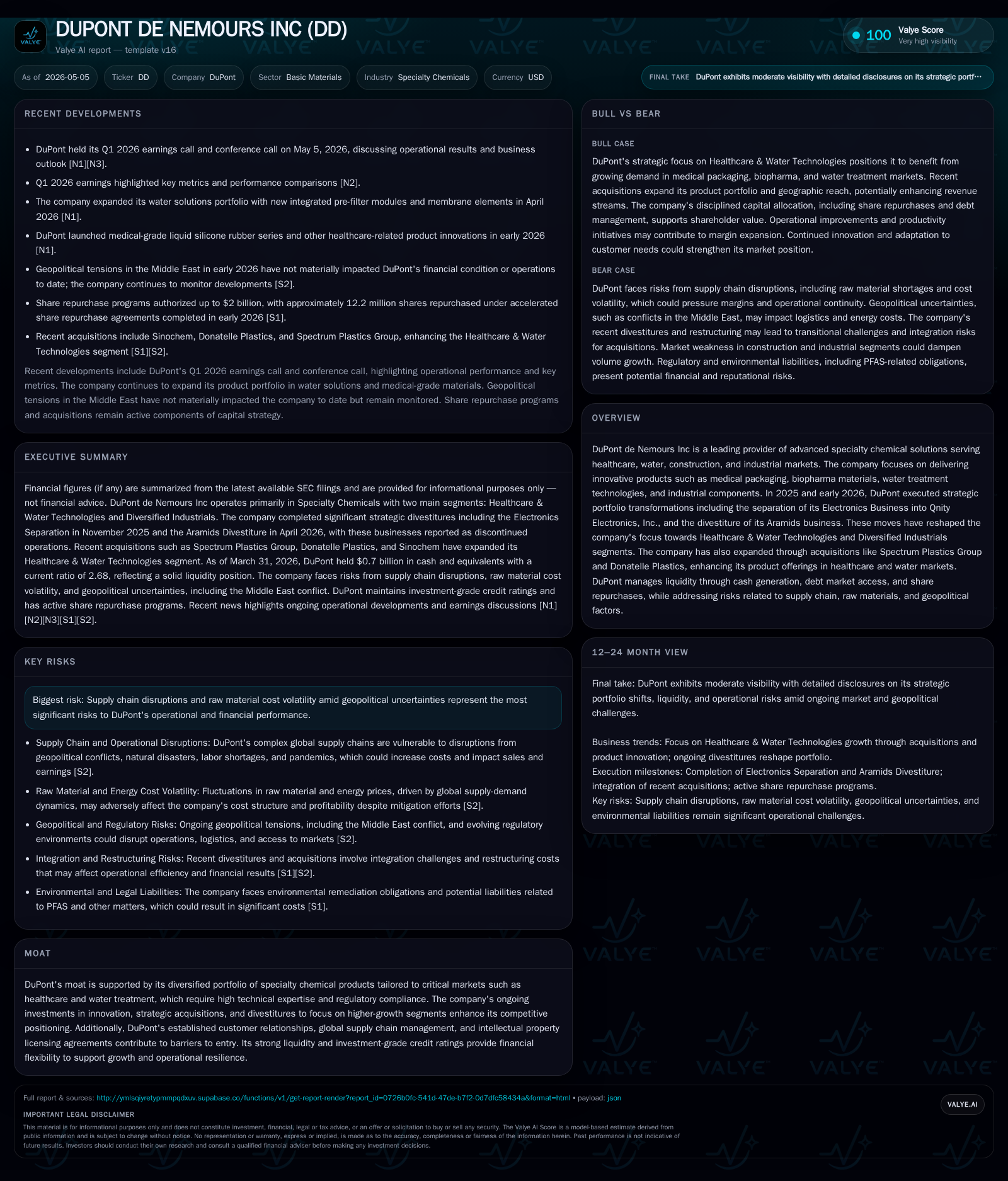
In Q1 2026, DuPont de Nemours finalized the sale of its Aramids business and completed the prior separation of its Electronics segment, segments now reported as discontinued operations. These strategic moves reposition the company to concentrate on Healthcare & Water Technologies alongside Diversified Industrials. This operational refocus follows a broader restructuring effort starting in 2025, marking a decisive pivot toward specialty chemicals tailored to critical markets requiring technical innovation and regulatory expertise. DuPont sustains a strong liquidity position supported by $2.0 billion in working capital and $0.7 billion in cash, providing financial flexibility amid geopolitical uncertainties. Growth prospects center on new product introductions and recent acquisitions aimed at expanding medical packaging and water treatment capabilities.
Strategic Transformation Anchored in Fresh Quarterly Results
DuPont's first quarter 2026 filing delivers a definitive update on its ongoing strategic transformation. The completion of the Aramids business divestiture closed April 1, 2026, transferring that unit to Arclin in exchange for approximately $1.2 billion in pre-tax cash proceeds plus additional non-cash equity interests [S2]. Combined with the earlier November 2025 spin-off of its Electronics Business into Qnity Electronics, these steps eliminate legacy commoditized or lower-growth commodity businesses from DuPont's core portfolio. Both businesses are now accounted for as discontinued operations in consolidated financials [S2][S3].
This realignment sharpens focus on two main segments — Healthcare & Water Technologies and Diversified Industrials — as formalized in a fourth-quarter 2025 segment structure update [S1][S2]. The divestitures materially adjust the revenue base but enhance margin profiles through concentrating on higher-innovation specialty chemical offerings.
Operationally, as of March 31, 2026, DuPont reported $2.0 billion in working capital alongside $0.7 billion cash equivalents, signaling ample liquidity cushion during persistent macroeconomic volatility including geopolitical tensions related to the Middle East conflict [S2]. While no material impacts have been recorded yet from these events, management identifies potential risk pathways via logistics and supply chain disruptions.
Evolving Specialty Chemicals Business Model and Portfolio Focus
Following these strategic transactions, DuPont's value creation centers on specialty chemicals engineered for demanding markets such as healthcare (medical packaging products, biopharma materials) and water technologies (reverse osmosis membranes) [S1][S2]. The company's business model relies on delivering highly customized solutions that incorporate complex chemistry knowledge combined with stringent regulatory compliance.
Customers pay primarily for specialty products differentiated by performance characteristics vital for safety or efficiency—attributes not easily replicated by generic alternatives. Volume growth drivers hinge on market expansion within clean water infrastructure investments globally and rising healthcare demands driven by demographic trends.
The distinct product complexity affords DuPont leverage in pricing power compared to commoditized chemistries divested through the Aramids sale or Electronics spin-off. Acquisitions such as Spectrum Plastics Group (flexible medical packaging), Donatelle Plastics (medical device components), and Sinochem (reverse osmosis membranes) strategically bolster this innovation-led platform by complementing existing internal R&D efforts [S8][S11]. The company’s ongoing investments build proprietary intellectual property that erects durable moat characteristics against pure-play competitors.
Competitive Positioning Within Healthcare and Water Solutions Markets
The specialty chemicals industry served by DuPont is characterized by moderate competitive intensity but significant barriers to entry stemming from regulatory approvals requirements (FDA compliance for medical products), licensing rights for patented processes, and complex global supply chains optimized over decades [S1]. These enable incumbents like DuPont to sustain relative pricing power through differentiated chemistry solutions.
Strategic acquisitions diversify product sets while expanding access within healthcare providers’ supply chains and municipal/industrial water treatment sectors. Core customers prize quality consistency alongside technological innovation that enhances throughput or safety margins—a paradigm where switching costs create stickiness.
Moreover, the company benefits from an integrated global manufacturing footprint aligned with regulatory frameworks across regions. This capability supports reliable delivery—a significant factor given ISO certifications necessary in healthcare manufacturing environments. Together with patent licenses protecting proprietary formulations, DuPont’s ecosystem offers a robust defensive posture against price erosion commonly seen in less specialized chemical markets.
Key Growth Drivers From Innovation and Targeted Acquisitions
Growth momentum is underpinned by concrete initiatives including:
- Launch of AmberChrom XT SL which simplifies biopharma workflows enhancing purification steps in drug development pipelines [N11].
- Expansion of FilmTec Fortilife portfolio introducing new membrane elements meeting increasingly stringent industrial water requirements [N12].
- Broader market penetration facilitated by recent acquisitions like Spectrum Plastics Group and Donatelle Plastics broadening addressable healthcare technology applications [S8][S11].
These innovations target measurable KPIs such as increased penetration rates within global medical packaging demand growth fueled by trends like single-use medical devices, stricter contamination controls, and sustainable packaging requirements. Similarly, scaling reverse osmosis membrane sales aligns with expanding municipal water treatment infrastructure driven both by regulation tightening and environmental concerns.
Medium-term milestones involve commercialization ramp timelines post-launchs, integration synergies from acquired entities—including cross-selling opportunities—and enhancement of go-to-market efficiency leveraging customer relationships across overlapping verticals.
Risks and Operational Constraints: Supply Chains and Geopolitical Impacts
DuPont's exposure to global supply chain disruptions remains an acute risk vector due to several factors:
- Raw material cost volatility originating from geopolitical conflicts such as the ongoing military tensions involving U.S., Israel, and Iran creating uncertainty mostly around logistics rather than direct operational impact so far [S2].
- Complex multi-tier supplier networks susceptible to capacity constraints or government-imposed trade embargoes potentially impacting feedstock availability.
- Regulatory challenges exemplified by environmental litigation notably at sites like Spruance facility subject to EPA notices [S13].
Mitigation strategies include diversification of critical raw material sourcing anchoring long-term contracts incorporating minimum purchase obligations wherever possible along with proactive pricing measures passed onto customers albeit constrained by competitive environment dynamics.
Energy dependency adds another layer where surges can compress margins despite efforts toward productivity gains or cost-cutting programs.
These operational headwinds require vigilant risk monitoring though current management disclosure signals readiness via contingency planning without near-term profit deterioration.
Upcoming Milestones and What Investors Should Monitor
Key forthcoming developments pivotal for tracking execution progress include:
- Q2 2026 earnings release expected to provide updates on revenue trajectory post-Aramids divestiture impact excluding discontinued segments from continuing operations metrics [N1][S2].
- Progress on integration plans for recent acquisitions particularly Donatelle Plastics embedding into Healthcare segment sales pipeline.
- Commercial scale-up benchmarks for AmberChrom XT SL adoption reflecting validation within pharmaceutical workflows.
- Further updates regarding geopolitical developments affecting global logistics relevant to raw materials sourcing.
- Resolution status of regulatory proceedings such as New Jersey PFAS Judicial Consent Order finalization potentially removing lingering uncertainty abroad environmental liability risks [S13].
Continuous monitoring of product backlog growth rates or signed contracts details where disclosed would serve as actionable indicators measuring sustained momentum towards specialty chemicals leadership objectives.
Latest Financial Snapshot: Liquidity, Leverage, and Capital Allocation
Latest financial snapshot
| Metric | Value | Period |
|---|---|---|
| Cash & equivalents | $710mm | |
| 2026-03-31 | ||
| Total debt | $3.1bn | |
| 2026-03-31 | ||
| Net debt | $2.4bn | |
| 2026-03-31 | ||
| Current assets | $5.6bn | |
| 2026-03-31 | ||
| Current liabilities | $2.1bn | |
| 2026-03-31 | ||
| Current ratio | 2.68x | |
| 2026-03-31 |
Source: SEC companyfacts cache [F1].
DuPont closes Q1 2026 maintaining a healthy financial profile supportive of strategic flexibility:
| Metric | Value | Period End |
|---|---|---|
| Cash & Equivalents | $710 million | |
| 2026-03-31 | ||
| Total Debt | $3.13 billion | |
| 2026-03-31 | ||
| Net Debt | $2.42 billion | |
| 2026-03-31 | ||
| Current Assets | $5.64 billion | |
| 2026-03-31 | ||
| Current Liabilities | $2.10 billion | |
| 2026-03-31 | ||
| Current Ratio | 2.68 | |
| 2026-03-31 | ||
| [F1] |
Strong working capital ($2.0 billion) combined with disciplined debt levels yield a conservative current ratio near 2.7 indicating robust short-term liquidity coverage. Total debt primarily consists of longer-dated unsecured notes complemented by revolving credit facilities ensuring ready access to capital markets if needed [S4][S20].
Share repurchase activity continues under a renewed authorization up to $2 billion supporting return of capital while balancing investment needs given acquisition focus [S7][S16]. Dividend policy maintains consistency illustrating stable free cash flow generation amidst portfolio transformation.
This report is intended solely for informational purposes regarding business operations and industrial context based on publicly filed SEC documents and recent disclosures without providing investment advice.
Disclaimer: This is research-only, informational analysis and not investment advice. It may include AI-generated interpretation and general industry context. Always verify important details using primary sources.

Comments