
MGE Energy Advances Utility Investments Amid Modest Rate Increases and Renewable Transition
Solid first-quarter results buoyed by regulatory approvals for rate base growth and ongoing renewable projects.
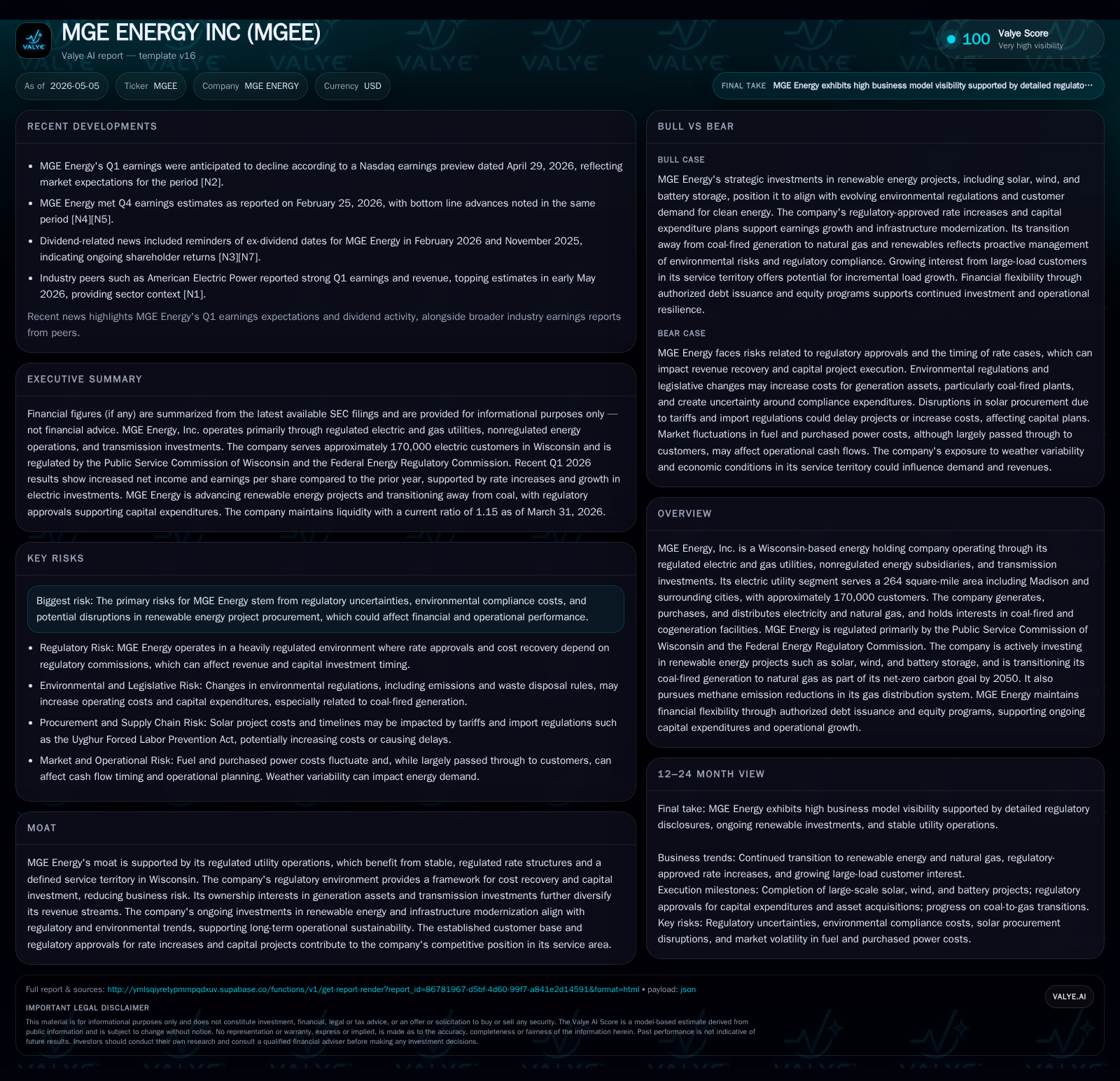
MGE Energy's latest quarterly report highlights incremental earnings growth driven by utility rate base expansions approved in recent Wisconsin Public Service Commission cases. The regulated electric and gas utility segments remain the primary revenue drivers, supported by customer growth and weather-related demand variability. The company is steadily investing in renewable solar, wind, and battery storage projects while managing deferred fuel savings within its cost-recovery framework. Its competitive moat is reinforced by stable regulatory oversight and a defined service territory focused around Madison, Wisconsin. Risks stem mainly from regulatory changes and execution of its carbon transition plans, but liquidity and capital resources appear sufficient to fund ongoing capital expenditures.
Recent Operating Update
MGE Energy's first quarter 2026 earnings reflect a continuation of steady operational performance anchored in its regulated utility businesses. Net income climbed to $48.5 million ($1.32 per share) compared with $41.6 million ($1.14 per share) the year prior [S2][S3]. The core driver was the electric utility segment’s improved earnings fueled primarily by a rise in rate base following the December 2025 Wisconsin Public Service Commission (PSCW) approval of the 2026/2027 rate settlement agreement. This agreement authorized a small 0.15% electric rate increase for 2026 with a more substantial 3.63% step-up set for 2027 alongside gas rate increases of 2.77% and 2.04% respectively [S2]. These incremental hikes underpin increasing allowed returns that support utility investment recovery.
Early-2026 continued deferral of fuel savings ($4.4 million deferred as of March 31) reflects MGE’s adherence to regulatory mechanisms aimed at smoothing fuel cost volatility impacts on rates pending PSCW’s annual fuel cost reviews scheduled for completion in 2027 [S2]. This creates transient timing differences between costs incurred and recovery via customer rates but remains common across regulated utilities.
Large-scale renewable investments remain a strategic priority despite the relatively muted near-term rate adjustments. By the end of Q1 2026, MGE had invested approximately $143 million in solar projects (down modestly from $185 million at year-end due to project phase completions), alongside continued deployments in batteries ($61.5 million) and wind generation capacity ($10.7 million). Such capital allocations support the company's transition away from coal-fired generation towards integration of cleaner energy sources consistent with its net-zero carbon target by 2050 [S2].
Business Model
MGE Energy’s revenue model centers on its wholly owned regulated subsidiaries—including Madison Gas and Electric Company (MGE)—which deliver electricity and natural gas services within a tightly defined service area spanning roughly 264 square miles encompassing Dane County and Madison, Wisconsin [S8]. Approximately 170,000 customers receive electric power under tariffs governed by the PSCW and partially overseen operationally by FERC for transmission activities.
The business earns revenue primarily through volumetric charges tied to kilowatt-hour sales for electricity and dekatherms for natural gas along with fixed charges embedded in customer bills designed to recover infrastructure investment costs plus an authorized rate of return on the utility’s regulated asset base (rate base). As new capital projects come online—be it renewable facilities or network modernization—the increased rate base allows recovery via higher authorized revenues established through periodic general rate cases [S1][S2].
Nonregulated components comprise interests in coal-fired generation assets such as the Elm Road Units and cogeneration at local campuses providing incremental earnings outside standard utility ratemaking but still linked closely with core operations [S8]. Strategic equity-method investments in regional transmission entities like American Transmission Company LLC (ATC) further broaden income streams [S6].
Regulation enforces strict reporting, environmental compliance, and cost recovery processes that limit risk exposure while constraining pricing flexibility; however, this stability forms the backbone of MGE Energy’s moat against new entrants or competitive poaching.
Industry Structure and Competitive Position
MGE operates within a defined geographic monopoly protected via state regulation—a structure typical for electric utilities within the U.S.—which ensures captive customers within service territories but demands adherence to stringent PSCW policies balancing consumer protection with utility financial health [S1][S14]. The company's competitive advantage rests on regulatory certainty regarding cost recovery and recourse allowed for incremental investments into modernized grids, renewables integration, and emission controls.
The company faces competition primarily indirectly from alternative energy suppliers or distributed generation technologies (e.g., rooftop solar) that could reduce demand over time but currently pose limited threat given scale economics favoring centralized utility operations.
Environmental regulations are another structural factor shaping industry dynamics; transitioning away from coal-fired assets—historically dominant generators—toward renewables aligns with legislation driving decarbonization [S14]. MGE’s proactive commitments here enhance reputational standing and position it well as policy frameworks tighten further.
Growth Drivers
Key growth drivers include:
- Regulatory Rate Base Growth: Periodic PSCW-approved general rate cases lead to incremental revenue authorization tied directly to capital investments.
- Customer Growth: Modest expansion in residential customers powered higher retail sales due to both usage increase per customer (weather effects) and net service additions.
- Renewable Energy Investments: Focused capital expenditure in solar parks, wind generation facilities, battery storage enhances sustainable power supply capabilities.
- Transmission Investments: Ownership stakes via subsidiaries in ATC provide access to broader transmission tariff revenues incentivized regionally.
- Energy Efficiency Programs & Net Metering: Initiatives that might initially dampen load growth but improve grid stability long term.
These growth vectors align with evolving regulatory policies that encourage decarbonization while maintaining grid reliability standards.[S1][S2]
Risks / Watchpoints / Growth Constraints
Risks include:
- Regulatory Uncertainty: Rate-setting processes expose operating results to timing risks as approvals can be delayed or adjusted adversely.
- Environmental Compliance Costs: Changing EPA or state mandates may accelerate costly retrofits or asset retirements particularly related to coal generation.
- Fuel Price Volatility: While fuel costs are generally passed through via trackers or reconciliations, unexpected swings can affect short-term margins due to regulatory lag.
- Project Execution Risk: Scaling renewable portfolio requires successful deployment amid supply chain constraints or labor market tightness.
- Technological Disruption: Increasing penetration of distributed energy resources or changing consumption patterns induced by electrification could challenge traditional load forecasts.
- Dividend Restrictions: Dividends from regulated entity MGE to holding company MGE Energy depend on maintaining prescribed equity ratios [S1].
These necessitate close monitoring of PSCW proceedings, environmental rulemaking developments, project management milestones, and evolving customer demand trends.
What To Watch Next
Investors should track:
- Completion status and commissioning timelines of ongoing renewable projects like Badger Hollow Solar expansions or High Noon Solar Center upgrades.
- Outcomes from PSCW annual fuel cost proceedings expected during the next calendar year affecting deferred fuel balance recoverability.
- Progression of future general rate cases beyond current settlement horizons impacting allowed ROEs or rate base escalations.
- Regulatory updates on methane emission standards impacting gas distribution operations.
- Capital expenditure pacing signaling sustained commitment versus potential pullbacks if market conditions shift.
- Transmission investment performances especially dividends or equity earnings from ATC related activities [S6][S9].
Financial Profile Summary
Latest financial snapshot
| Metric | Value | Period |
|---|---|---|
| Cash & equivalents | $9mm | |
| 2026-03-31 | ||
| Current assets | $211mm | |
| 2026-03-31 | ||
| Current liabilities | $183mm | |
| 2026-03-31 | ||
| Current ratio | 1.15x | |
| 2026-03-31 |
Source: SEC companyfacts cache [F1].
As of March 31, 2026, MGE Energy reported cash and cash equivalents totaling approximately $9.5 million with current assets at $211 million versus current liabilities of $183 million yielding a current ratio around 1.15—indicating acceptable near-term liquidity [F1][S2][S9]. Total debt approximates $427 million based on best available data though prior year-end figures suggest moderate leverage consistent with utility sector norms [F1].
Operating cash flows remain robust at about $80 million during Q1 which combined with access to capital markets through an active Direct Stock Purchase Plan supplying ~$2.6 million net proceeds this quarter supports financing ongoing infrastructure buildouts [S2][S4].
Operating income as reported at $170 million (year-end basis) corroborates steady profitability reflective of underlying regulated earnings strength [F1]. Dividend payouts maintain compliance with regulatory requirements tied to equity ratios ensuring balanced returns between reinvestment needs and shareholder distributions [S1][S24].
This analysis synthesizes publicly filed SEC disclosures current through early May 2026 without forecasting future outcomes or providing investment advice. Investors should refer directly to official filings and consult industry sources for additional context regarding evolving market conditions impacting MGE Energy Inc.
Disclaimer: This is research-only, informational analysis and not investment advice. It may include AI-generated interpretation and general industry context. Always verify important details using primary sources.

Comments