
Marathon Petroleum’s Q1 Surge and Strategic Midstream Integration
Marathon Petroleum's strong Q1 performance reflects operational scale, integrated logistics, and expanding renewable diesel capacity amid evolving energy market dynamics.
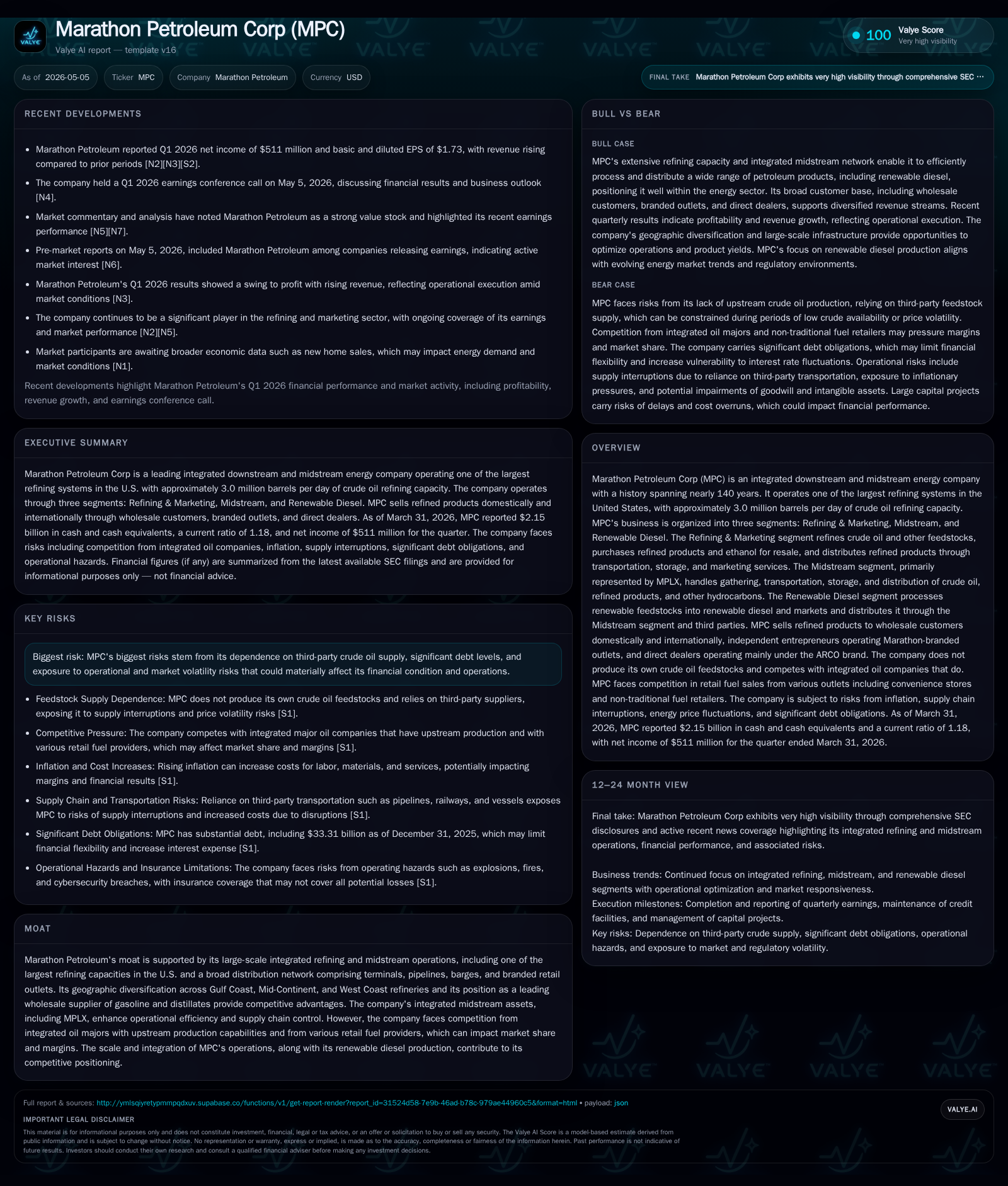
In its latest quarterly filing, Marathon Petroleum Corporation (MPC) reported a notable swing to profitability with improved revenue and margins driven by refining scale and favorable crack spreads. The company's integrated business model encompassing refining, midstream logistics via MPLX, and renewable diesel production underpins its competitive moat and operational resilience. Amid industry structural challenges including feedstock sourcing and regulatory pressures, MPC is leveraging renewable diesel growth and midstream optimization as key growth drivers. Elevated debt levels and supply chain vulnerabilities remain notable risks to monitor in the near term.
Latest Quarterly Highlights Propel MPC Forward
Marathon Petroleum's Q1 2026 earnings report filed on May 5 reveals a marked turnaround from prior quarters with a swing into profitability alongside meaningful revenue enhancement. The filing underscores refined product crack spreads improved materially, enabling enhanced refining margins which, combined with consistent throughput deployment across its large-scale facilities, drove the positive results [S2][N1][N2]. The 8-K event filing the same day confirmed continued operational efficiencies and contract expansions especially in renewable diesel sales channels [S3]. This quarter solidifies MPC’s execution under its integrated model during volatile commodity price environments.
Integrated Model and Product Mix Underpinning Business Strength
MPC’s business is segmented into Refining & Marketing, Midstream primarily through MPLX (a publicly traded MLP affiliate), and Renewable Diesel production. Boasting approximately 3 million barrels per day of U.S. refining capacity located strategically along the Gulf Coast, Mid-Continent, and West Coast corridors, MPC leverages geographic diversification for feedstock sourcing flexibility and refined product market access [S1].
Midstream operations via MPLX cover pipeline gathering, processing of natural gas liquids (NGLs), storage terminals, barge fleets for inland distribution, allowing the company to internalize significant portions of logistics costs and maintain supply chain control [S1]. Renewable Diesel has emerged as a high-growth segment where MPC processes sustainable feedstocks into low-carbon diesel products distributed through its own midstream network as well as third-party channels [S1][S2]. This vertical integration across product handling enhances operating margins by mitigating third-party fees and maximizes asset utilization.
Competitive Dynamics in U.S. Downstream and Midstream Energy
The refining sector remains intensely competitive with numerous multi-capital global players possessing upstream production advantages unavailable to pure downstream operators like MPC. Such peers benefit from proprietary crude supply that buffers against feedstock volatility which MPC must hedge through market purchases [S1]. At the retail end, MPC contends with branded gasoline outlets operated by other independents or majors, plus aggressive pricing from non-traditional fuel sellers including supermarkets and mass merchants [S1].
From an inflation standpoint, rising input costs — from labor to materials — potentially compress margins absent commensurate price pass-throughs. Moreover, reliance on lengthy third-party transportation routes via pipelines or railroads exposes MPC to disruption risk absent self-owned crude gathering systems at scale [S1][S7]. Yet MPC's large refining footprint combined with broad midstream assets positions it favorably compared to smaller regional refiners lacking similar scope or integration.
Growth Catalysts: Renewable Diesel Expansion and System Optimization
Renewable diesel stands out as a major growth lever reinforced by supportive U.S. policies targeting decarbonization in transport fuels. MPC is capitalizing on this trend by expanding processing capacity for renewable feedstocks while utilizing its midstream infrastructure for seamless product distribution—reducing costs relative to competitors without similar integration [S1][S2].
Simultaneously, initiatives to optimize refinery run rates and realize synergies from the Andeavor acquisition continue to improve throughput efficiency. Leveraging MPLX’s logistical capabilities provides operational leverage rarely accessible to pure refiners. These factors collectively underpin margin resilience amid cyclical demand fluctuations.
Risks to Watch: Supply Chain, Debt Levels, and Regulatory Pressure
Material risks persist around MPC's dependence on external suppliers for crude feedstock amid increasingly complex geopolitics impacting global oil markets. Interruptions or constraints in pipeline or rail transport infrastructure could lead to supply bottlenecks or cost escalation [S1][S7]. Corporate leverage remains elevated; net debt stood near $28.55 billion at the end of Q1 2026 — necessitating prudent capital allocation and robust cash flow generation for compliance with covenants and servicing expense burdens [F1].
Environmental regulations targeting emissions intensify compliance costs and potential litigation exposure, particularly given lifecycle assessments of fossil fuels remain under political scrutiny [S7][S16]. Labor relations also warrant monitoring given unionized employee negotiations that could disrupt operations if unresolved [S17].
Key Milestones Ahead: Production, Contracts, and Market Signals
Market watchers should focus on quarterly renewable diesel volumes as indicators of successful capacity ramp-up aligned with tangible demand uptake, particularly through contracts with branded dealers predominantly under the ARCO brand network [S2][N3]. Additionally, monitoring refiners' crack spread trends will signal market fundamentals affecting gross margin sustainability.
Contract renewals in wholesale marketing channels can reflect customer retention strength amid competitive pricing pressures. Capital project execution timelines for expansions or upgrades also serve as key operational execution barometers.
Current Financial Health at a Glance
Latest financial snapshot
| Metric | Value | Period |
|---|---|---|
| Cash & equivalents | $2.2bn | |
| 2026-03-31 | ||
| Total debt | $30.7bn | |
| 2026-03-31 | ||
| Net debt | $28.6bn | |
| 2026-03-31 | ||
| Current assets | $28.7bn | |
| 2026-03-31 | ||
| Current liabilities | $24.4bn | |
| 2026-03-31 | ||
| Current ratio | 1.18x | |
| 2026-03-31 |
Source: SEC companyfacts cache [F1].
The company maintains a current ratio above 1 reflecting reasonable short-term liquidity. However, sizeable total debt emphasizes ongoing leverage risk requiring consistent operating cash inflow to meet obligations without curtailing strategic investments [F1][S2][S3]. Recent refinancing activities underline efforts to optimize borrowing costs but cannot fully eliminate macroeconomic interest rate sensitivities.
This analysis integrates the latest quarterly disclosures supplemented by annual business context extracted from regulatory filings without speculative commentary beyond available data sources. The interplay of integrated refining scale, midstream logistics backbone via MPLX, and expanding renewable diesel platform position Marathon Petroleum uniquely among U.S.-focused downstream energy firms amidst tightening environmental policy regimes.
Disclaimer: This report is for informational purposes only and does not constitute investment advice or recommendations.
Disclaimer: This is research-only, informational analysis and not investment advice. It may include AI-generated interpretation and general industry context. Always verify important details using primary sources.

Comments