
BellRing Brands' Q2 Performance Highlights Executive Retention Efforts Amid Operational Risks
BellRing Brands reported Q2 earnings and revenue shortfalls while implementing executive retention measures during a leadership transition amid cybersecurity and market challenges.
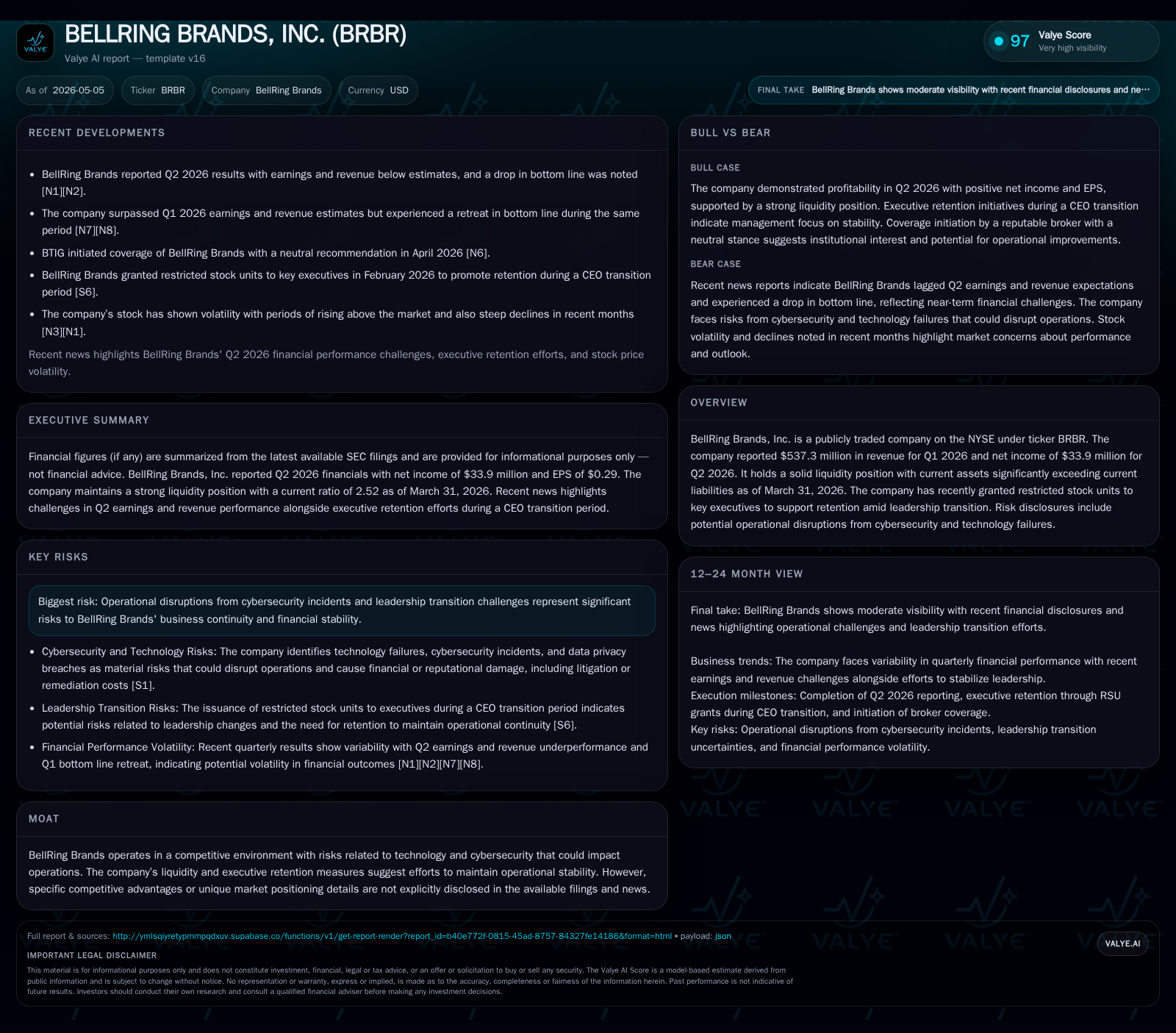
BellRing Brands' latest quarterly filing for Q2 2026 shows revenues of $537.3 million and net income of $33.9 million, both falling short of market expectations. The company is navigating operational pressures including margin compression in a competitive consumer packaged goods environment, intensified by ongoing leadership transition efforts highlighted by targeted restricted stock unit grants to key executives. Cybersecurity risk disclosures and the broader market context underscore potential headwinds. Strategic growth initiatives remain focused on product innovation and operational efficiency improvements. Monitoring upcoming quarters will be critical to assess management stabilization and margin recovery.
Q2 2026 Operating Results and What They Signal
BellRing Brands reported second-quarter fiscal results for the period ended March 31, 2026, revealing a top-line of $537.3 million alongside net income of $33.9 million [S2][F1]. While these figures demonstrate continued scale within its consumer nutrition portfolio, they fell short of consensus analyst expectations, signaling operational margin compression within a challenging cost environment and competitive retail dynamics [N1]. The earnings release dated May 5, 2026, combined with an accompanying investor presentation, underscores near-term headwinds including pressured pricing power and elevated input costs impacting profitability [S3][N4]. Notably, the company highlighted leadership transition efforts whereby restricted stock units (RSUs) were granted to key executives earlier this year to promote retention and stability during this period of management change—a strategic move that indicates BellRing is prioritizing operational continuity amidst evident challenges [S8]. This confluence of missed financial targets coupled with organizational adjustments paints a cautious picture for near-term momentum.
Business Model Overview: Consumer Packaged Foods Focus and Product Quality
BellRing Brands operates principally in the consumer packaged foods sector with a core emphasis on nutritional products designed for broad retail distribution [S1]. Revenue generation is driven primarily by sales to large grocery chains and specialty retailers where longstanding relationships support recurring demand streams. The product portfolio leverages brand heritage and perceived quality to justify premium pricing; however, margins are subject to input cost inflation—particularly raw materials linked to agricultural commodities—and supply chain volatility [S1]. Pricing strategies must balance maintaining customer loyalty while absorbing some cost pass-through given competitive constraints in shelf pricing. Production economics therefore reflect ongoing tension between fixed manufacturing capacity and variable ingredient expenses that can erode profitability if not effectively managed. Overall, the company’s offering maintains relevance in health-conscious consumer segments but faces stiff competition from larger conglomerates that exert greater scale advantages.
Competitive Landscape and Market Positioning
Within the broader fast-moving consumer goods (FMCG) landscape, BellRing competes against established players such as Kraft Heinz along with specialized nutrition-focused companies that have demonstrated superior agility or distribution reach [N2][N3][S1]. Industry consolidation among peers enhances scale benefits for those competitors limiting BellRing’s pricing power relative to larger rivals who can leverage supplier negotiations more effectively. The filings reveal no distinct competitive moat—rather a fairly commoditized product mix subject to retailer-driven terms and promotional activity pressures that compress margins over time [S1]. Channel penetration remains challenging as e-commerce growth disrupts traditional grocery patterns while consumer preferences continue evolving rapidly toward novel formats or organic/natural claims that require fresh innovation investments. Regulatory developments around labeling or ingredient standards add further complexity for maintaining product compliance at scale.
Key Growth Drivers and Strategic Initiatives
Growth initiatives pivot largely on product innovation pipelines aimed at capturing incremental consumer trends such as enhanced nutritional formulations or convenience packaging enhancements [S8]. Additionally, BellRing pursues expansion into newer distribution channels beyond core grocers—potentially including online platforms or health-centric outlets—to diversify revenue sources and mitigate concentration risk. Operationally, the company emphasizes cost containment programs targeting supply chain optimization and manufacturing efficiencies especially critical during the CEO transition phase when managerial focus may be divided [S8]. The RSU grants represent an explicit strategy to retain four senior executives including CFO Paul Rode and Chief Growth Officer Douglas Cornille—an effort designed to preserve institutional knowledge essential for executing these growth levers reliably. These steps suggest management recognizes leadership continuity as a linchpin for sustaining growth trajectories amid external pressure.
Risks and Challenges: Cybersecurity, Leadership Transition, and Market Pressure
An explicit area of concern detailed consistently across both the annual (November 2025) and recent quarterly filings is exposure to cybersecurity threats which could materially disrupt operations or compromise sensitive data resulting in financial or reputational harm [S1][S2][S9][S12]. Given the increasing reliance on digital systems for supply chain coordination and sales tracking, such vulnerabilities require continual mitigation investment. Concurrently, the ongoing CEO transition injects additional uncertainty into executive decision-making agility; reliance on retention incentives underscores potential challenges in talent stability during this phase [S8]. From a market standpoint, intensifying competition coupled with inflationary cost pressures delineate a constraining environment limiting margin expansion possibilities even as volume growth attempts continue. These factors combine into material risks that investors must weigh carefully.
Catalysts and Milestones to Monitor
Looking forward, key events will center on the release of subsequent quarterly reports which will clarify whether revenue trends stabilize or improve alongside any resurgence in operating margins as strategic cost programs advance [S2][S3]. Monitoring updates around executive tenure continuity—including effectiveness of RSU retention grants—will provide insight into management cohesion critical for sustained performance improvement [S8]. Additionally, announcements regarding new product launches or channel diversification plans could signal successful growth pivots within competitive constraints. Supply chain developments or cybersecurity controls enhancements may also emerge as important indicators informing near-term resilience.
Financial Snapshot (As of March 31, 2026)
Latest financial snapshot
| Metric | Value | Period |
|---|---|---|
| Cash & equivalents | $33mm | |
| 2026-03-31 | ||
| Total debt | $1190mm | |
| 2026-03-31 | ||
| Net debt | $1157mm | |
| 2026-03-31 | ||
| Current assets | $756mm | |
| 2026-03-31 | ||
| Current liabilities | $301mm | |
| 2026-03-31 | ||
| Current ratio | 2.52x | |
| 2026-03-31 |
Source: SEC companyfacts cache [F1].
This snapshot highlights BellRing’s strong liquidity position reflected by a current ratio above 2.5 despite carrying substantial debt load near $1.19 billion—a capital structure feature common in the sector requiring careful servicing amid margin volatility [F1]. Net cash equivalents levels remain modest relative to liabilities emphasizing dependence on operating cash flow generation.
This analysis is based solely on publicly available SEC filings dated through May 5, 2026, combined with recent reliable news reporting; it does not constitute investment advice but aims to provide an informed overview grounded in disclosed data.
Disclaimer: This is research-only, informational analysis and not investment advice. It may include AI-generated interpretation and general industry context. Always verify important details using primary sources.

Comments