
Sterling Infrastructure Shifts to Higher-Margin Projects While Managing Cyclical Risks
Q1 2026 results reflect strategic progress in risk management and segment repositioning amid economic cyclicality.
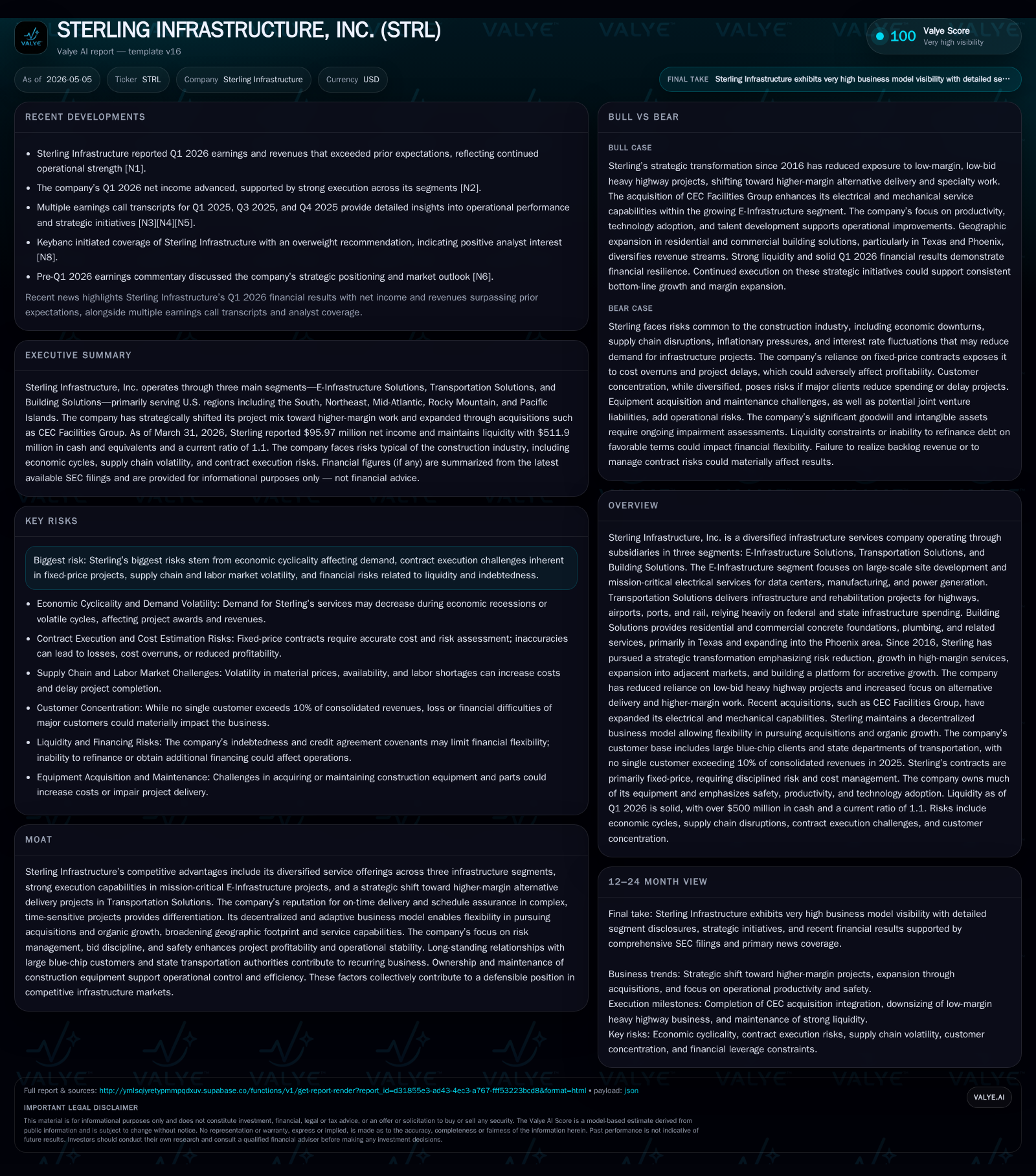
Sterling Infrastructure (STRL) reported first-quarter 2026 results highlighting continued execution on its long-term strategy to reduce risk and grow higher-margin businesses. The company’s diversified structure spanning E-Infrastructure, Transportation, and Building Solutions segments anchors growth, despite ongoing challenges from supply chain volatility and cyclical infrastructure spending. Recent operational moves, including strategic downsizing of lower-margin Texas highway operations and integration of the CEC Facilities acquisition, underscore a focus on margin improvement and platform expansion. Liquidity remains solid with a strong cash position exceeding debt, supporting flexibility for organic investments and acquisitions.
Recent Operating Update
Sterling Infrastructure announced its Q1 2026 financial results on May 4, reporting earnings and revenues that beat consensus estimates [S3][N1][N9]. The company reaffirmed full-year guidance reflecting ongoing benefits from its strategic shift away from low-margin heavy highway projects toward higher-margin alternative delivery contracts in Transportation Solutions. Operationally, the portfolio continues to rebalance with the planned completion of the Texas heavy highway downsizing initiative in 2026 [S2][S25]. Additionally, Sterling is integrating its acquisition of CEC Facilities Group, adding specialty electrical and mechanical contracting capability to its E-Infrastructure segment [S10].
The Q1 filing outlines approximately $375 million of unconsolidated joint venture work, with no current indications of partner non-performance triggering liability under joint venture agreements [S2]. The updated filings confirm no material changes in critical accounting estimates or new accounting standards impacting results this quarter.
Business Model
Sterling Infrastructure operates through three primary segments:
E-Infrastructure Solutions: Focused on large-scale site development and mission-critical electrical services essential for data centers, semiconductor fabs, manufacturing facilities, distribution centers, warehousing, power generation, etc. This segment targets blue-chip end customers requiring high reliability and schedule assurance across multifaceted projects.
Transportation Solutions: Comprises infrastructure construction and rehabilitation for highways, airports, ports, rail lines, storm drainage systems. This segment relies heavily on federal/state funding and is undergoing a transition from predominantly low-margin heavy highway bids to alternative delivery models (design-build, P3s) along with other niche infrastructure such as airports and rail.
Building Solutions: Includes residential and commercial concrete foundations, slabs, plumbing services primarily concentrated in Texas with geographic expansion into Phoenix. Customer base targets national/regional homebuilders for single-family residential homes alongside multi-family/commercial developers requiring specialized concrete work.
Revenue is generated primarily through fixed-price contracts won via competitive bidding processes across all segments. Cash flow drivers include project progress billings balanced against working capital demands such as receivables and retention payments. Margins are subject to cost control on materials/labor plus risk management related to contract scope uncertainties.
Strategically since 2016, Sterling has emphasized risk reduction by improving bid discipline to decrease loss frequency—especially moving away from historically low gross margins (~4%) on traditional heavy highway work toward alternative delivery projects yielding materially higher margins [S1][S25]. The company’s decentralized operating structure fosters agility in both organic growth initiatives and acquisitions.
Industry Structure and Competitive Position
The infrastructure construction sector remains fragmented yet intensely competitive. Sterling differentiates itself through:
- A diversified service suite catering to diverse end markets resisting single-industry cyclicality.
- Proven track record on mission-critical E-Infrastructure projects where execution reliability commands premium pricing.
- Strategic repositioning within Transportation Solutions away from commoditized low-bid contracts towards alternative delivery methods that generally feature better risk allocation and return profiles.
- Expansion of Building Solutions within booming housing markets leveraging local expertise.
- Strong safety programs, technological adoption for operational efficiency, and cultivated relationships with government agencies (DOTs) securing repeat business.
Competition includes specialized regional contractors focused narrowly on heavy highway or building trades as well as large multidisciplinary firms offering integrated design-build capabilities. Sterling’s ability to consistently meet demanding schedules with quality execution supports reputation-based advantages especially valuable among blue-chip customers seeking reliability over lowest cost.
Growth Drivers
Backlog Profile
As of December 31, 2025, Sterling reported backlog totaling approximately $3.01 billion representing signed contracts not yet earned [S26]. While backlog provides visibility into future revenue streams, it is subject to project cancellations or scope modifications inherent in construction industries.
Margin Expansion Initiatives
Ongoing growth in high-margin product mix primarily within Alternative Delivery transportation projects aligns with corporate objectives set since 2016. Completion of the Texas heavy highway downsizing is expected to further improve segment margins going forward [S25].
Geographic Expansion & Acquisitions
Expansion of Building Solutions into the Phoenix market along with complementary acquisitions such as CEC Facilities enhances service breadth and expands regional footprint [S10]. The adaptive decentralized model facilitates integration while maintaining operational focus at subsidiary levels.
Demand Tailwinds
Federal infrastructure funding allocations have trended upward given renewed emphasis on modernization of highways/transportation assets plus robust private sector investment fueling demand for data center build-outs that support E-Infrastructure growth.
Risks / Watchpoints / Growth Constraints
Cyclicality & Economic Sensitivity
Demand is inherently cyclical tied closely to public infrastructure budgets influenced by political cycles as well as private sector capex trends susceptible to macroeconomic fluctuations including interest rates affecting financing availability [S18][S13].
Contract Execution Risks
Fixed-price contract frameworks expose Sterling to risks around cost overruns arising from supply chain disruptions or labor shortages which could compress margins despite efforts to build buffer provisions during bidding [S18].
Supply Chain & Labor Market Volatility
Ongoing inflationary pressures impacting material costs (steel, concrete) alongside tight labor markets continue to represent operational headwinds impacting scheduling flexibility and profitability [S18].
Financial & Liquidity Considerations
At March 31, 2026, Sterling Infrastructure reported a strong liquidity position characterized by $511.9 million in cash & equivalents against total debt of $289.1 million resulting in a net cash position of approximately $223 million as per companyfacts [F1]. Current assets stood at $1.19 billion versus current liabilities of $1.08 billion yielding a current ratio around 1.1 which is adequate though typical given construction sector working capital requirements [F1].
Legal & Regulatory Exposure
Routine litigation related to construction claims exists but currently no significant contingent liabilities poised for material impact according to management assessments [S27]. Compliance with evolving environmental regulations may increase operating costs over time [S18].
What To Watch Next
Investors should monitor:
- Progress milestones in completing the Texas heavy highway business exit scheduled for full closure in 2026.
- Integration outcomes from CEC Facilities acquisition impacting E-Infrastructure segment performance.
- New contract awards within Transportation Solutions reflecting shift toward alternative delivery models.
- Backlog evolution particularly in response to federal/state funding cycles.
- Pricing environment trends in materials and wages shaping margin sustainability.
- Quarterly reports detailing profitability improvements from risk mitigation strategies applied since 2016 transformation launch.
- Any updates on joint venture liabilities or project performance flags related to unconsolidated entities as highlighted this quarter [S2].
Financial Profile Summary (Q1 2026)
Latest financial snapshot
| Metric | Value | Period |
|---|---|---|
| Cash & equivalents | $512mm | |
| 2026-03-31 | ||
| Total debt | $289mm | |
| 2026-03-31 | ||
| Net debt | $-223mm | |
| 2026-03-31 | ||
| Current assets | $1195mm | |
| 2026-03-31 | ||
| Current liabilities | $1084mm | |
| 2026-03-31 | ||
| Current ratio | 1.1x | |
| 2026-03-31 |
Source: SEC companyfacts cache [F1].
At March 31, 2026 Sterling Infrastructure reported a strong liquidity position characterized by $511.9 million in cash & equivalents against total debt of $289.1 million resulting in a net cash position of approximately $223 million as per companyfacts [F1]. Current assets stood at $1.19 billion versus current liabilities of $1.08 billion yielding a current ratio around 1.1 which is adequate though typical given construction sector working capital requirements [F1].
This analysis synthesizes publicly filed SEC documents including the latest quarterly Form 10-Q dated May 5, 2026 along with supporting annual Form 10-K disclosures filed February 26, 2026 supplemented by recent event filings via Forms 8-K. All financial metrics cited are derived solely from current period official disclosures or attributed news reports without forecasting or opinion-based extrapolations. The narrative aims to provide an informed overview rooted firmly in observed data points without investment recommendations or price outlooks.
Disclaimer: This is research-only, informational analysis and not investment advice. It may include AI-generated interpretation and general industry context. Always verify important details using primary sources.

Comments