
Powell Industries Updates Q2 with Backlog Resilience and Automation Expansion
Q2 results highlight sustained backlog strength and integration of Remsdaq acquisition to bolster automation capabilities amid ongoing supply chain and inflationary pressures.
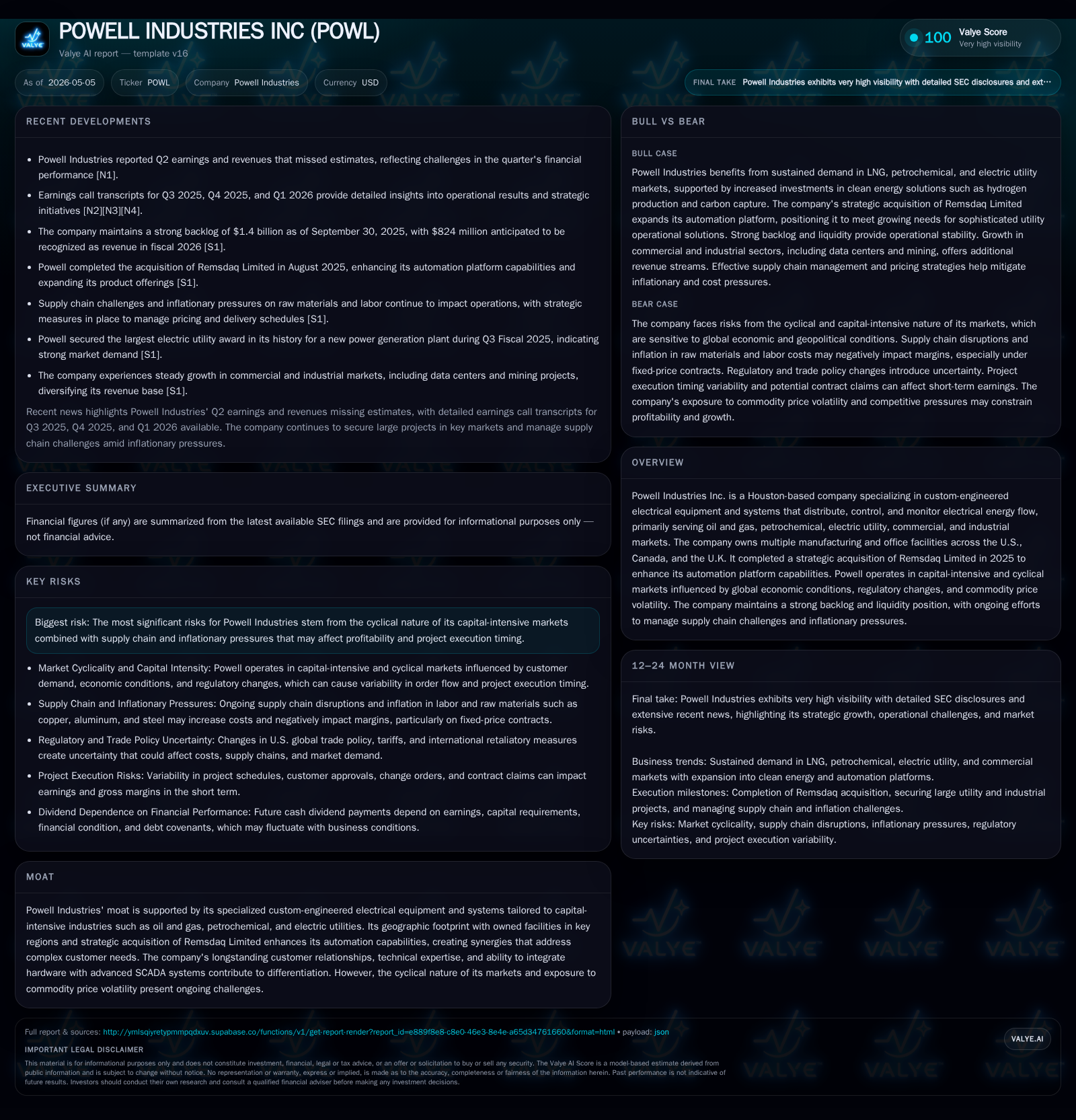
In its Q2 2026 filing, Powell Industries reported revenues missing consensus estimates due to persistent supply chain bottlenecks and inflationary cost headwinds. Despite these near-term challenges, the company’s strong backlog provides substantial revenue visibility into FY2026, supported by healthy order activity in oil & gas and electric utility markets. The strategic acquisition of Remsdaq bolsters Powell’s automation platform, integrating SCADA RTUs with its electrical hardware solutions, a key differentiator in capital-intensive industrial sectors. Solid liquidity with zero debt and a current ratio above 2 underpin operational flexibility as market cyclicality continues to pose execution and margin risks.
Latest Q2 Operating Performance and Market Reaction
Powell Industries reported its Q2 fiscal 2026 results on May 5, 2026 [S2], revealing a revenue miss relative to market expectations primarily due to ongoing global supply chain constraints and inflationary pressure that impacted project execution timelines and margins [N2][N3]. Despite these challenges, management emphasized their continued focus on backlog execution discipline and cost controls to manage margin compression.
The company declared a quarterly cash dividend of $0.09 per share payable in mid-June 2026 reaffirming its commitment to shareholder returns even as near-term earnings softness persists [S3][S12]. Investor sentiment during the earnings call reflected cautious optimism anchored by solid backlog visibility but tempered by the external headwinds constraining volume growth and margins [N1].
Supply chain issues manifest as component delays continue to restrict capacity utilization across Powell’s manufacturing footprint. Inflation is being offset through pricing adjustments where contractual allowances permit; however, fixed-price projects weigh on margin performance.
Powell Industries’ Business Model and Differentiated Product Offering
Powell operates as a custom-engineered electrical equipment manufacturer focused on systems that distribute, control, and monitor electrical energy flow tailored primarily for capital-intensive industries including oil & gas, petrochemical refining, electric utilities, commercial infrastructure, and industrial end users [S1]. The company’s product suite spans switchgear assemblies, motor control centers (MCCs), power distribution units (PDUs), automation platforms integrating Supervisory Control and Data Acquisition (SCADA) RTUs, as well as protective relays.
A pivotal expansion was the acquisition of UK-based Remsdaq Limited completed August 2025 for approximately $18.4 million [S1][S24]. Remsdaq’s SCADA RTUs provide advanced monitoring and control capabilities vital for modern substation automation across generation, transmission, and distribution sectors. This acquisition materially enhances Powell’s automation offerings by marrying hardware power distribution equipment with intelligent software-driven control – a strategic moat given rising demand for networked infrastructure solutions enhancing system reliability.
Powell’s engineering-centric approach emphasizes customizing designs to match unique customer specifications in complex projects. Its geographically diverse manufacturing operations across Houston (multiple sites), Ohio (North Canton), Illinois (Northlake), Alberta (Acheson), and U.K. locations such as Bradford provide proximity advantages to major client bases facilitating shorter lead times and logistical efficiencies [S1].
Competitive Landscape and Industry Positioning
Within the specialty electrical equipment sector serving industrial end markets, Powell competes on technical differentiation rooted in customization capability combined with integrated software-hardware platforms post-Remsdaq acquisition. This contrasts with commodity switchgear manufacturers or purely software-focused vendors.
Pricing pressure is cyclical but partly mitigated by contract structures allowing escalation clauses offsetting component cost inflation. Nevertheless, procurement complexity amid global supply constraints tempers production cadence causing some project slippage [S1][S20].
Owning major facilities rather than leasing supports operational continuity during volatile supplier markets - a strategic operational resiliency feature enhancing contract fulfillment reliability.
Long-term client relationships developed over decades support repeat business but do not immunize Powell fully against the inherent cyclicality driven chiefly by oil/gas capex cycles influenced by commodity price swings and regulatory frameworks dictating investment timing [S1][S20].
Key Growth Drivers: Backlog, Automation, and Geographic Reach
Backlog stood robust at $1.4 billion as of September 30, 2025 with approximately $824 million anticipated revenue recognition during fiscal 2026. This backlog level supplies strong near-term demand visibility essential given the unpredictability introduced by macroeconomic catalysts affecting new orders [S20].
The Remsdaq integration drives growth prospects through expanded automation platform capabilities that enable cross-selling opportunities into existing clients demanding more sophisticated monitoring solutions alongside traditional power distribution products – enhancing value proposition depth.
Powell’s footprint across multiple North American regions plus UK imbues it with exposure to diversified infrastructure spending cycles reducing concentration risk while enabling responsiveness to regionally varying market dynamics including LNG expansions in North America linked to abundant natural gas supply favoring project awards within oil & gas verticals [S20][S24].
Risks and Operational Constraints in Capital-Intensive Markets
The primary risk remains market cyclicality reflective of client capex patterns within oil & gas, petrochemical refining, utility infrastructure investment – areas sensitive to commodity pricing fluctuations and geopolitical-economic uncertainties influencing spending timing or scale [S1][S20].
Supply chain disruptions continue exerting pressure on project schedules causing delivery delays; these lead time variabilities couple with inflation impacting input costs compressing gross margins especially where contracts lack sufficient escalation provisions.
Potential liquidated damages from schedule slips are monitored; however management has not flagged any material exposures adversely affecting financial position or liquidity [S25]. Legal proceedings remain routine without expected material adverse outcomes [S1].
Financial covenant compliance under revolving credit agreements is maintained with zero drawn borrowings as of Q2 end reflecting a conservative balance-sheet posture supportive amid uncertain market conditions [F1][S14].
Investor Watchlist: Upcoming Milestones and Market Signals
Key near-term milestones include the next quarterly earnings release which will update guidance reflecting backlog burn rates alongside any shifts in order intake momentum particularly from LNG-related projects or utility capital programs.
Close attention should be paid to reports of supply chain normalization or worsening which would materially impact execution timing.
The integration success of Remsdaq Limited into Powell’s broader technology stack will be critical for unlocking cross-selling synergies anticipated by management.
Insider trading disclosures revealed two directors initiated Rule 10b5-1 trading plans potentially signaling regulated share sales slated through late 2026 - indicative of standard liquidity arrangements rather than inside concern given no material operational changes were reported recently [S2].
Dividend declarations at steady levels signal confidence in underlying cash flow stability despite cyclical headwinds providing a dependable cash return mechanism for shareholders [S12].
Financial Snapshot: Liquidity, Leverage, and Profitability Overview
Powell maintains robust liquidity with cash balances exceeding half a billion dollars at quarter-end providing significant financial flexibility for working capital needs or opportunistic investments without reliance on external debt financing currently absent from its balance sheet [F1][S2].
Operating income specifics from the latest quarter show pressured margins yet remain positive despite external cost challenges validating ongoing operational efficiency efforts highlighted by management disclosures.
This analysis has synthesized recent SEC disclosures alongside contemporaneous news sources to present an informed view of Powell Industries' operating condition as of Q2 fiscal year 2026. It is intended solely for informational purposes without investment recommendation or advice.
Disclaimer: This is research-only, informational analysis and not investment advice. It may include AI-generated interpretation and general industry context. Always verify important details using primary sources.

Comments