
American Electric Power Strengthens Regulated Utility Earnings on Improved Rate Recovery
AEP’s Q1 2026 results reveal enhanced earnings stability driven by regulatory collaboration and optimized transmission operations.
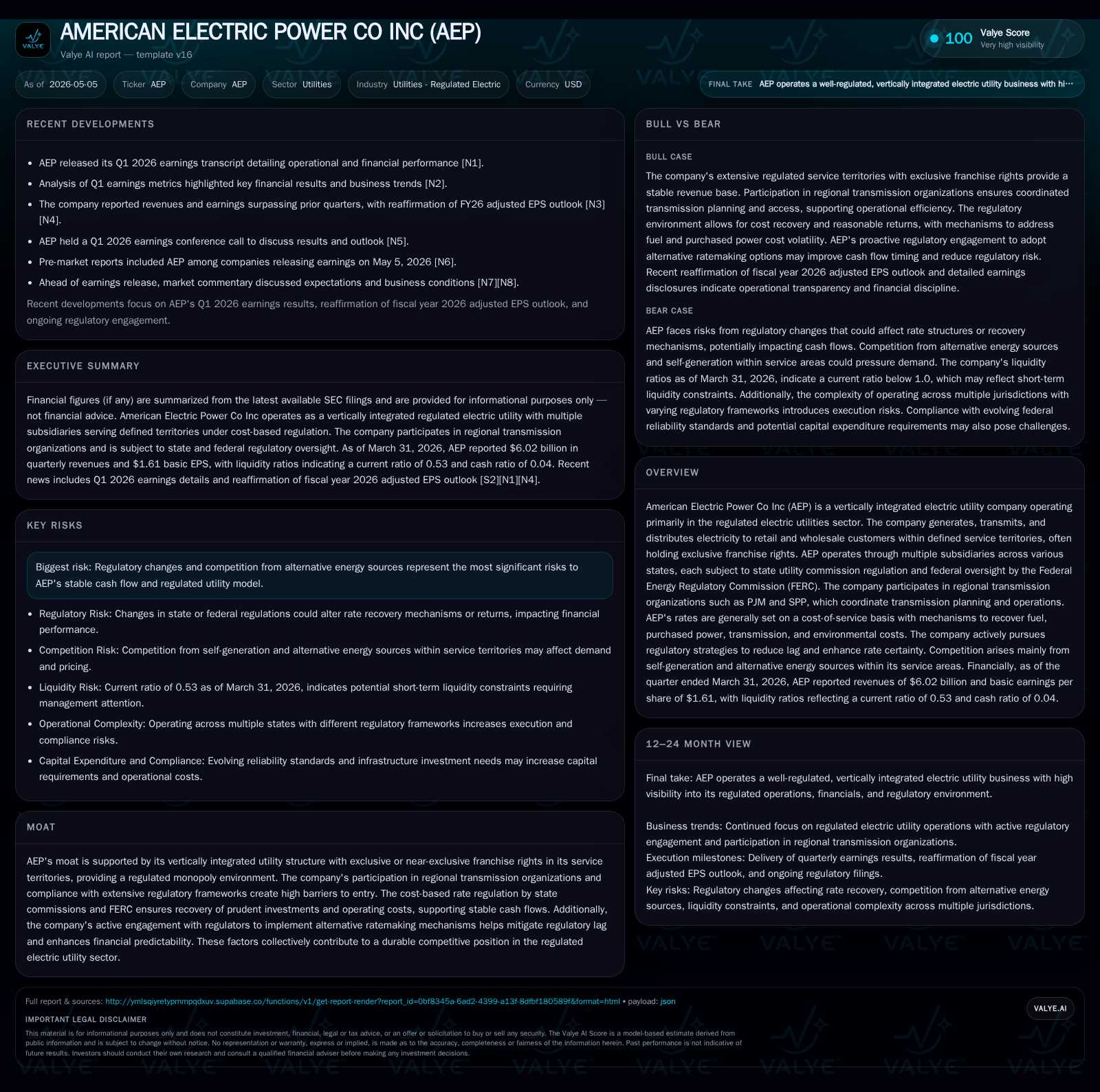
American Electric Power's latest quarterly filing dated May 5, 2026, highlights improved operational performance supported by accelerated regulatory rate recoveries and tariff adjustments within key transmission subsidiaries. The company's vertically integrated utility model benefits from exclusive franchise rights and participation in FERC-approved regional transmission organizations, underpinning a stable cash flow profile. Growth is driven by ongoing infrastructure investments, formulaic cost recovery mechanisms, and strategic engagement with regulators to reduce lag. Risks remain rooted in regulatory changes and rising competition from alternative energy sources, but AEP maintains a durable moat reinforced by its regulatory frameworks and transmission coordination agreements.
Latest Quarterly Operating Update: Q1 2026 Highlights and Implications
American Electric Power's first quarter of 2026 reflects strengthening regulated utility earnings primarily attributed to more effective regulatory rate recovery practices and proactive tariff management. The May 5, 2026 10-Q discloses that the transmission and distribution utilities segment saw a favorable rise in revenues compared to the prior year Q1, driven by fuel cost trackers and purchased power adjustments embedded in approved rate mechanisms [S2]. These incremental revenue gains point to successful navigation of traditional regulatory delays, often termed “regulatory lag,” through accelerated rider filings and settlement agreements.
The company also announced reaffirmation of its full-year adjusted EPS outlook for FY2026 during May earnings calls [N12]. Notably, transmission subsidiaries under the PJM Open Access Transmission Tariff (OATT) have benefited from FERC-sanctioned rate increases enabling timely cost pass-through. This dynamic reinforces steady cash inflows amid rising input costs for fuel and maintenance.
Operational execution aligns well with financial outcomes as evidenced by AEP topping Q1 earnings expectations on both revenue and net income metrics [N3]. The company's ability to maintain cost-of-service pricing while implementing modern transmission coordination has mitigated margin pressure typically associated with commodity price fluctuations.
Business Model and Product Quality: Vertically Integrated Regulated Utility Dynamics
AEP operates as a vertically integrated electric utility comprising generation, transmission, and distribution functions within designated service territories largely protected by franchise rights recognized by state regulators. These territories often grant AEP an exclusive or near-exclusive monopoly providing a natural barrier to competition [S1]. Revenue is chiefly secured through cost-of-service regulation where state commissions approve rates designed to allow recovery of prudent capital expenditures plus operating expenses.
Transmission services constitute a significant part of the revenue mix with various subsidiaries like APCo, I&M, KGPCo, KPCo, WPCo, PSO, SWEPCo all participants in major Regional Transmission Organizations (RTOs) such as PJM Interconnection and Southwest Power Pool (SPP). These RTOs coordinate grid reliability planning while enforcing open-access tariffs approved by FERC that fairly allocate costs across users [S1].
By integrating generation availability with extensive transmission systems subject to federal oversight, AEP ensures product relevance through reliable electricity delivery coupled with transparent tariff structures enhancing financial predictability. The company aggressively pursues mechanisms to reduce revenue timing gaps (regulatory lag), including formula rates and rider surcharges that adjust billed amounts more dynamically based on changing fuel or environmental costs.
Competitive Position Within the Utilities Sector: Regulatory Moat and Transmission Agreements
AEP's competitive strength stems from its utility franchises that confer substantial control over local electricity markets. These are buttressed by multi-jurisdictional regulatory approvals linking retail rates strictly to cost recovery principles which leave little room for direct price competition. This regulated monopoly status forms the backbone of its enduring moat [S1].
On the transmission front, AEP benefits materially from coordinated Transmission Agreements (TA) among its subsidiaries that define revenue sharing under the PJM OATT framework—a FERC-approved protocol ensuring non-discriminatory access to transmission assets [S1]. Similarly, the Transmission Coordination Agreement (TCA) among PSO, SWEPCo, and AEPSC assigns joint responsibility for network reliability monitoring and complies fully with SPP's tariff requirements.
These agreements effectively lock in revenue streams derived from federally regulated tariffs while facilitating joint planning exercises that optimize capacity investments across entities. Such alignment reduces redundant infrastructure expenditure while strengthening barriers for potential entrants who must navigate complex regulatory approvals to interconnect or operate competing grids.
Growth Drivers: Regulatory Mechanisms, Transmission Participation, and Infrastructure Investment
Key growth levers for AEP include continuous expansion of its transmission asset base facilitated both through capital expenditure programs targeting modernization projects and formulaic rate adjustments built into RTO tariffs [S1], [N12]. Capital deployment focused on grid resilience enhancement—such as storm hardening deferred cost recovery—and system upgrades positions AEP favorably to meet evolving reliability standards mandated by regulators.
Regulatory innovation in rider mechanisms allows more rapid recovery of volatile cost elements like fuel or purchased power expenses via periodic reconciliations rather than prolonged base rate cases. This approach materially dampens regulatory lag risk while enabling better margin management. Rate cases underway or expected in states such as Kentucky, Ohio, West Virginia cater additional base rate uplift opportunities tied directly to asset additions brought online [S2].
AEP's active participation in PJM/SPP regional planning processes also opens avenues for incremental transaction-based revenue via ancillary services or network upgrades deemed critical in expanding renewable energy integration or accommodating distributed energy resources (DER).
Risks and Constraints: Regulation, Alternative Energy Competition, and Economic Factors
Despite its strengths, AEP faces headwinds including ongoing regulatory changes toward more aggressive decarbonization policies which could pressure allowed returns or impose capital expenditures not fully recovered in timely fashion [S1]. Increasing penetration of renewables at the distributed level also challenges traditional load growth patterns requiring more complex rate designs potentially eroding volumetric sales basis.
Tightening environmental standards raise compliance costs which if not fully reflected in cost recovery riders may compress future earnings margins. Meanwhile legislative dynamics at state commissions could alter ratemaking formulas or introduce performance-based regulation frameworks with uncertain financial impacts.
Economic factors influencing customer demand elasticity—such as energy efficiency trends or electrification uptake variability—add complexity to forecasting future load profiles that feed into rate case assumptions.
Forward-Looking Considerations: Key Milestones and Monitoring Points
Critical upcoming events include pending rate case filings across multiple jurisdictions slated for decision in mid-to-late FY26 timeframe which could shift base rates materially higher given recent capital additions [N12]. Completion timelines for major grid modernization initiatives also warrant attention as they directly affect the regulated rate base growth trajectory.
Monitoring AEP’s interactions with FERC regarding transmission formula rate updates under PJM/SPP platforms provides early signals on potential tariff revisions impacting revenue stability.
Furthermore, tracking adoption metrics around new tariff riders addressing fuel cost pass-throughs or system resiliency ensures visibility into how effectively AEP mitigates exposure to input cost inflation.
Analysts should also gauge management commentary during subsequent quarterly earnings calls for any revision in guidance due to regulatory outcomes or operational developments [N4].
Consolidated Financial Snapshot: Liquidity, Leverage and Earnings Context
Latest financial snapshot
| Metric | Value | Period |
|---|---|---|
| Cash & equivalents | $306mm | |
| 2026-03-31 | ||
| Total debt | $47.7bn | |
| 2025-12-31 | ||
| Net debt | $47.4bn | |
| 2025-12-31 | ||
| Current assets | $6.6bn | |
| 2026-03-31 | ||
| Current liabilities | $12.6bn | |
| 2026-03-31 | ||
| Current ratio | 0.53x | |
| 2026-03-31 |
Source: SEC companyfacts cache [F1].
| Metric | Value | Period End |
|---|---|---|
| Cash & Equivalents | $306M | |
| 2026-03-31 | ||
| Total Debt | $47.7B | |
| 2025-12-31 | ||
| Current Assets | $6.62B | |
| 2026-03-31 | ||
| Current Liabilities | $12.6B | |
| 2026-03-31 | ||
| Current Ratio | 0.53 | |
| 2026-03-31 | ||
| Revenue (latest annual) | $21.9B | |
| 2025-12-31 |
At quarter-end March 2026, AEP holds $306 million in cash equivalents against total debt of approximately $47.7 billion reported at year-end 2025 [F1].
Overall, the financial profile underpins operational flexibility sufficient to fund ongoing capex plans driving growth while managing leverage within acceptable bounds for public utilities.
This analysis synthesizes the most recent SEC filings alongside sector-specific context to provide a precise understanding of American Electric Power Co Inc’s operating environment without offering investment advice or recommendations.
Disclaimer: This is research-only, informational analysis and not investment advice. It may include AI-generated interpretation and general industry context. Always verify important details using primary sources.

Comments