
M&T Bank Strengthens Earnings on Broad-Based Net Interest Income and Fee Growth
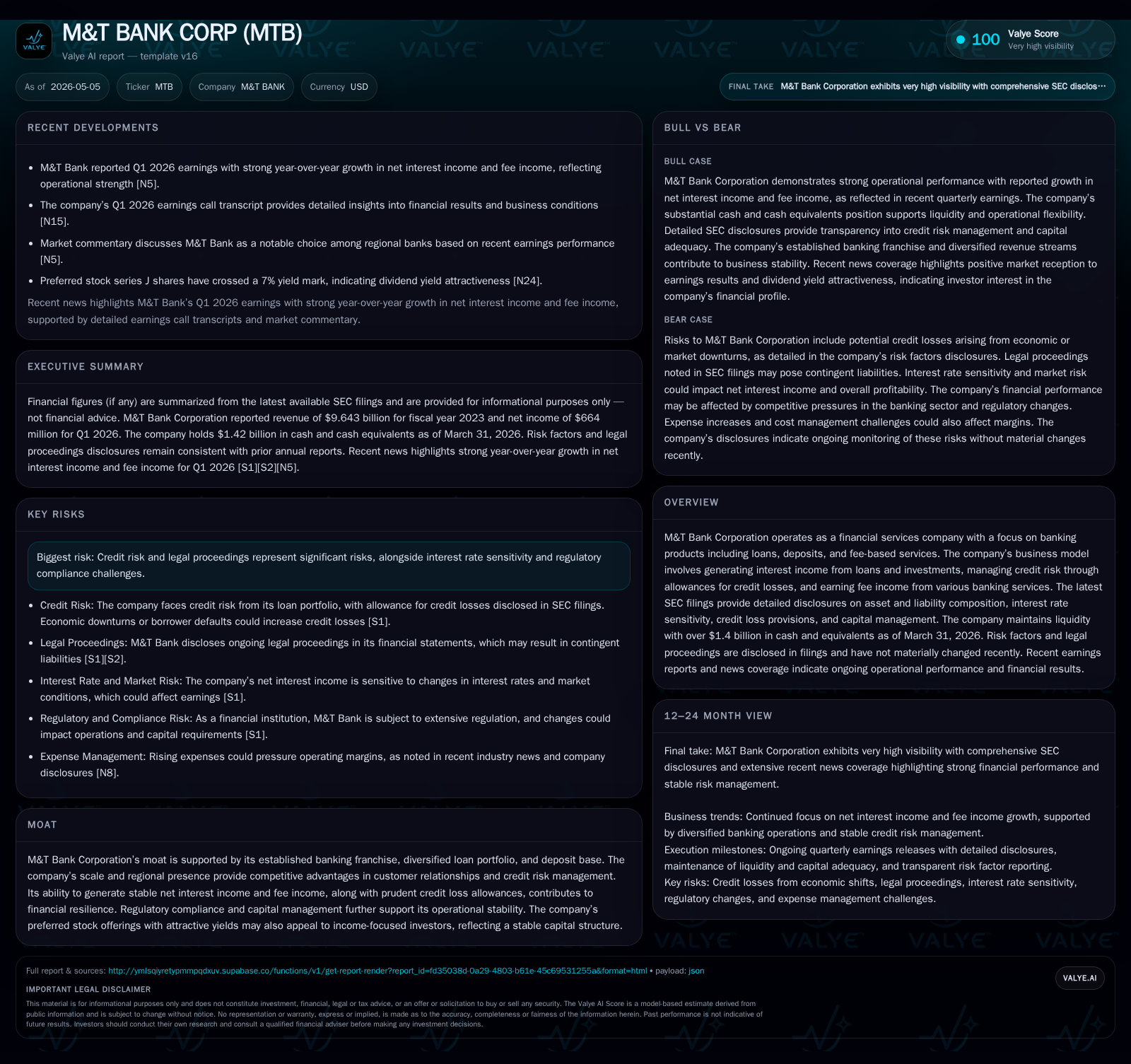
M&T Bank’s Q1 2026 results showcase robust net interest income and fee revenue expansion, reflecting its resilient regional franchise and disciplined credit management.
In its latest quarterly filing, M&T Bank reported a significant earnings beat driven by strong growth in net interest income and increased fee-based revenue streams. The bank’s diversified loan portfolio and stable deposit base underpin its ability to navigate interest rate volatility while maintaining credit quality. As a mid-sized regional bank, M&T leverages its scale and customer relationships to sustain competitive advantages despite evolving industry pressures. Ongoing growth prospects hinge on expanding lending activities and fee income, balanced against credit risk and regulatory challenges.
Latest Quarterly Operating Update: Solid Earnings Beat and Revenue Momentum
M&T Bank Corporation's first quarter 2026 10-Q filing reveals a noteworthy earnings surprise underscored by broad-based revenue strength [S2]. The bank's taxable-equivalent net interest income (NII) rose sharply year-over-year, benefiting from higher prevailing interest rates which enhanced yields on its sizable loan portfolio while deposit costs increased at a more measured pace [S2]. Concurrently, fee income grew robustly across segments such as treasury management services, signaling stronger client engagement beyond traditional lending.
Credit loss provisions remained stable without signs of material asset quality deterioration; this stability reflects M&T's conservative underwriting standards and prudent allowance for credit loss management despite macroeconomic uncertainties [S2]. Overall, these factors combined to elevate net income beyond consensus estimates as highlighted by recent market commentary corroborating the operational momentum [N9][N10][N12].
Business Model Overview: Diverse Banking Franchise Driving Stable Income
M&T's core business model revolves around generating net interest margin by originating loans funded primarily through its deposit base [S1]. The bank extends a diversified array of loan products—from commercial loans supporting regional businesses to selective consumer lending—allowing it to mitigate concentration risks inherent in single-segment exposures [S1]. Deposits form a low-cost funding source that underpins lending capacity while providing essential liquidity buffers.
Crucially, M&T complements interest income with fee revenues derived from ancillary banking products including wealth management advisory, payment processing, and treasury solutions [S1]. This diversified revenue mix cushions earnings variability typical in pure lending operations where net interest spreads can fluctuate with monetary policy shifts. The company's regional banking franchise fosters deeper client relationships that support cross-selling initiatives and enhance retention.
Risk management practices are emphasized throughout the loan lifecycle—from disciplined underwriting criteria to ongoing monitoring—supporting stable credit performance and underpinning allowances for expected losses aligned with regulatory guidelines [S1][S2]. This balance positions M&T as a relatively resilient midsize player in a market increasingly influenced by both larger national banks and fintech competitors.
Industry Structure and Competitive Position: Regional Strengths in an Evolving Landscape
Operating predominantly within the Northeast and Mid-Atlantic corridors, M&T occupies a well-established regional banking niche characterized by moderate scale yet meaningful customer intimacy [S1]. Its footprint limits direct competition with the largest money center banks whose capabilities often skew toward wholesale or large-scale corporate banking. Instead, M&T competes on relationship depth, localized knowledge, and underwriting discipline.
The banking industry currently navigates dual pressures: heightened regulatory oversight post-financial crisis continues alongside accelerating technological disruptions from fintech entrants aiming at payment systems, lending automation, or wealth management platforms. While these dynamics squeeze margins for some regional players, M&T appears insulated owing to entrenched client bases alongside steady capital adequacy compliance [S1][N14].
Additionally, regulatory capital frameworks implemented under Basel III impose constraints but also advantages for banks maintaining robust Tier 1 capital ratios. M&T manages these demands through targeted equity offerings including preferred stock issuances that balance cost considerations with capital structure optimization [S3]. Such prudence sustains confidence among regulators and investors alike.
Growth Drivers: Expanding Loan Portfolio and Increasing Fee Income
Key growth prospects for M&T hinge on measured expansion of its loan book particularly within higher-yield corporate sectors benefiting from moderate economic activity rebound [S2]. Increased demand for small-to-medium business (SMB) financing presents an opportunity given the bank's strong local branch network providing tailored lending solutions.
Simultaneously, the bank seeks to broaden non-interest income through scaling treasury services fees coupled with deeper penetration of wealth management offerings among affluent clients [S2][N12]. These fee streams tend to be less sensitive to economic cycles than lending spreads, offering revenue stability.
Loan production metrics such as volume increases in commercial real estate or equipment financing alongside deposit inflows in key service markets will serve as observable indicators of growth execution. Similarly, increases in registered users of digital payment platforms or upticks in assets under advisory reflect traction in fee-based areas.
Risks and Constraints: Credit, Interest Rate Sensitivity, and Regulatory Factors
Despite stable credit metrics reported recently, potential macroeconomic shocks could expose vulnerabilities if certain industry verticals or geographic markets experience deterioration impacting borrower repayment capacity [S1][S2]. Ongoing surveillance of default trends against the allowance for credit losses remains critical.
Interest rate risk is another salient concern given the lagged repricing differences between assets (loans) versus liabilities (deposits). Rapid Federal Reserve tightening or subsequent easing could compress net interest margins temporarily until portfolio adjustments take effect [S2].
Regulatory compliance costs linked to evolving capital adequacy norms may also constrain flexibility if additional buffer requirements arise unexpectedly. Capital allocations toward preferred stock issuances are one mechanism deployed to optimize balance sheet leverage without sacrificing prudential safeguards [S3]. However, balance must be maintained to avoid dilution effects or increased cost of funds.
Looking Ahead: Key Milestones and Market Signals to Track
Going forward, investors should monitor quarter-to-quarter loan origination volumes segmented by product type to gauge whether growth targets remain intact amid competitive pressures [S2][S3]. Deposit base composition—especially trends in uninsured versus insured deposits—will indicate funding stability which directly influences lending capacity.
Net interest margin trajectory remains a vital signal as Fed policy shifts unfold; observing how asset yield curves respond relative to deposit cost curves will reveal margin sustainability under various rate scenarios. Fee income growth rates provide insight into effectiveness of cross-selling initiatives beyond core lending.
Capital deployment choices—including timing of preferred stock issuances or share repurchases—reflect strategic prioritization between growth investments versus shareholder returns [S3]. Any commentary on legal proceedings or emerging risk factors disclosed quarterly also warrants close attention given potential financial impact.
Brief Financial Profile: Balance Sheet Robustness Supports Strategy Execution
M&T's latest disclosed total debt stands near $11.2 billion as of March 31, 2026, offset by cash equivalents exceeding $1.4 billion per company facts data [F1], indicating sound liquidity positioning supportive of planned loan growth initiatives [S2]. The company’s provision coverage for credit losses remains aligned with historic norms without material spikes noted this quarter [S2], which bodes well for earnings durability.
The combination of disciplined capitalization policies backed by equity issuances including preferred shares enhances financial flexibility allowing the bank to navigate sector headwinds or pursue opportunities without undue leverage strain [S3]. This balance sheet strength is foundational for sustaining operational momentum amid ongoing macro-financial uncertainties.
Disclaimer: This analysis is based exclusively on public SEC filings dated up to May 5th, 2026, supplemented by publicly available news reports referenced herein. It represents an interpretive summary intended for informational purposes only without any investment recommendation.
Disclaimer: This is research-only, informational analysis and not investment advice. It may include AI-generated interpretation and general industry context. Always verify important details using primary sources.

Comments