
Stock Yards Bancorp Advances Scale with Field & Main Merger and Q1 Surges
Strong first-quarter financials and the completion of the Field & Main Bancorp acquisition position Stock Yards Bancorp for expanded regional banking growth.
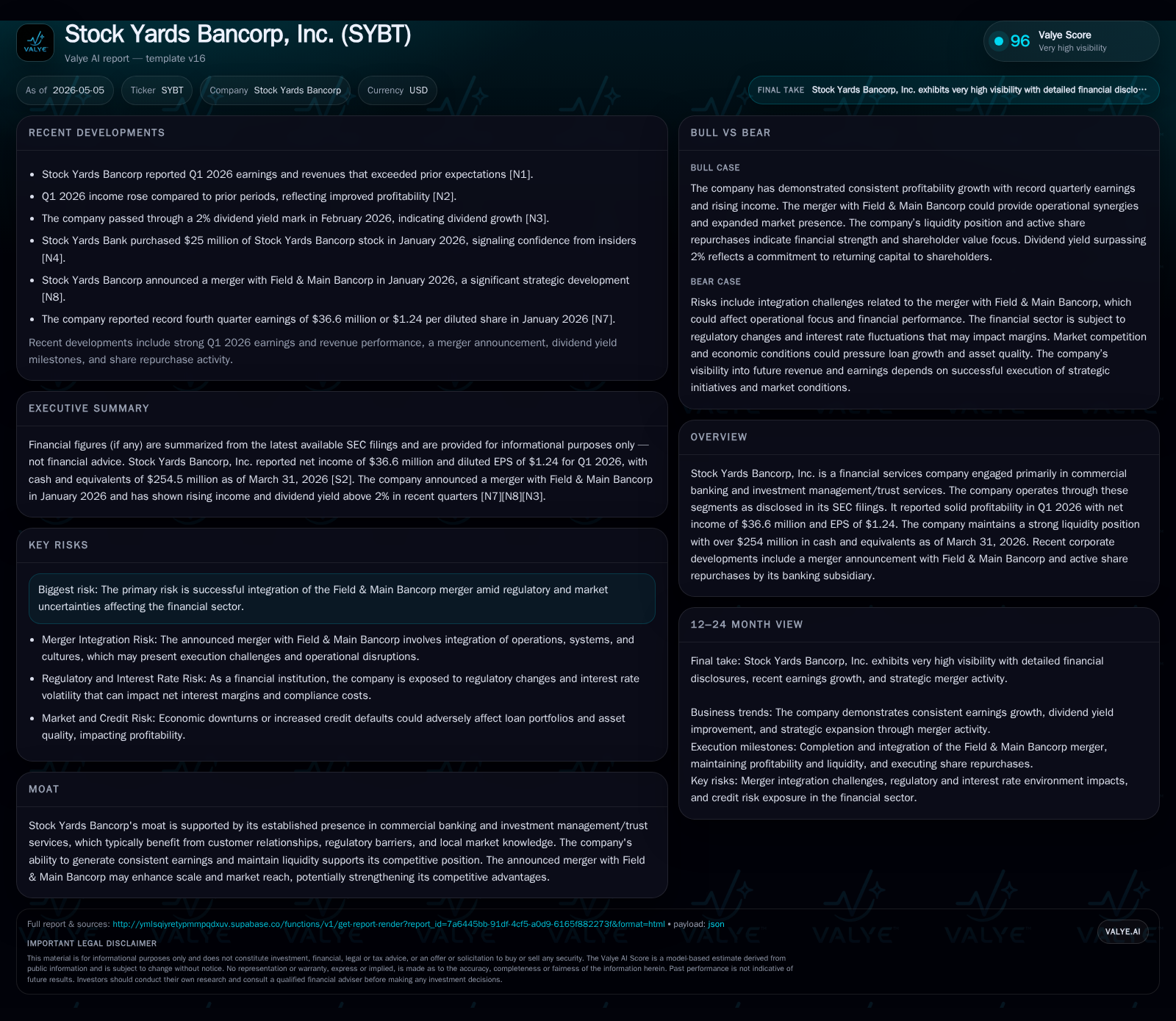
Stock Yards Bancorp reported solid Q1 2026 earnings with net income of $36.6 million and EPS of $1.24, highlighting operational momentum. The strategic acquisition of Field & Main Bancorp closed May 1, significantly expanding the company's scale and market footprint. The combined entity is positioned to leverage cross-selling opportunities, operational synergies, and strengthened liquidity to drive growth within its commercial banking and wealth management segments. However, merger integration risks and sector uncertainties remain key watchpoints for maintaining growth trajectory.
Latest Quarterly Operating Highlights and Merger Completion
Stock Yards Bancorp posted robust financial results in the first quarter of 2026, achieving net income of $36.6 million and earnings per share (EPS) of $1.24, surpassing analyst expectations reported in April [N1]. This performance reflects underlying business stability amid a challenging regional banking environment. Concurrently, on May 1, the company successfully completed its previously announced acquisition of Field & Main Bancorp, integrating Field & Main Bank's operations into its platform [S2][S3]. This merger marks a pivotal milestone by increasing Stock Yards Bancorp’s scale and broadening its geographic footprint in regional commercial banking.
This near-term update materially shifts the growth outlook for Stock Yards Bancorp by reinforcing management’s execution competence both in delivering profits organically and managing complex deal integration. The immediate operational momentum lends potential for incremental revenue channels through expanded client bases while enhancing cost structures.
Stock Yards Bancorp’s Business Model and Services Portfolio
Stock Yards Bancorp operates primarily through two segments: commercial banking and investment management/trust services [S1]. The commercial banking segment generates revenue mainly from interest income on loans extended to small- to mid-sized businesses alongside deposit-taking activities. Client profiles typically involve locally based enterprises requiring treasury management solutions and commercial credit facilities.
The investment management/trust segment contributes recurring fee income derived from fiduciary services including wealth administration, asset management mandates, and trust administration. This service mix fosters high customer stickiness driven by deep relationships and regulatory barriers that limit entrant competition for managed assets.
Strategically, this dual-segment approach balances cyclical volatility inherent in loan-related revenues with steadier fiduciary fees. Fee-based wealth offerings provide a structural margin buffer even when lending volumes fluctuate due to macro conditions. Moreover, Stock Yards' entrenched local market knowledge combined with regulatory compliance expertise presents competitive advantages in retaining core clients over time.
Competitive Environment and Industry Dynamics
Within the regional banking sector, Stock Yards faces competition from similarly sized banks blending commercial banking with wealth management capabilities. Pricing power in traditional loan products is compressed given commoditization across industry players, placing emphasis on customer service quality and relationship depth for retention.
Regulatory frameworks impose constraints on branch expansion and capital deployment strategies which temper horizontal growth pursuits. Furthermore, supply-side factors such as limited qualified credit demand among local businesses present moderate headwinds for aggressive loan book growth.
Technology adoption remains an essential competitive factor; banks investing in digital platforms gain efficiency benefits as well as improved client onboarding experiences contributing to lower attrition rates.
Growth Catalysts: Scale, Market Reach, and Offerings Expansion
The Field & Main Bancorp acquisition serves as the primary near-term catalyst propelling Stock Yards’ growth prospectus [S2][S3]. By merging two complementary franchises with overlapping regional footprints but distinct client bases, the company can:
- Expand deposit base materially enhancing liquidity resources available for lending opportunities,
- Increase lending capacity particularly in commercial real estate and development loans,
- Leverage cross-selling prospects by introducing investment management/trust products to Field & Main's clientele,
- Realize operational efficiencies through consolidation of back-office functions resulting in cost synergies,
- Bolster capital adequacy ratios supporting future organic growth through retained earnings.
KPIs indicative of synergy progress include sequential increases in total deposits post-close, acceleration in new loan originations within combined territories, rising fee income contribution from expanded trust assets under management (AUM), and improvements in efficiency ratios stemming from enhanced economies of scale.
Risks and Integration Challenges
Integration presents the foremost execution risk. Harmonizing corporate cultures between the companies requires effective leadership communications to maintain employee morale critical for client retention [S3]. Regulatory approvals historically pose timing uncertainties delaying full synergy capture.
Short-term pressures may arise from merger-related one-time expenses impacting margins temporarily during system integration upgrades or branch consolidation efforts [S1]. Elevated economic volatility could depress loan demand or increase credit losses within the newly enlarged book if regional industries encounter downturns.
Additionally, broader sector challenges include continued low interest rate environments compressing net interest margins despite recent rate hikes broadly across financial institutions. Monitoring credit quality trends will be essential given cyclical sensitivity tied to commercial real estate exposures.
Key Upcoming Milestones and Monitoring Points
Investors should watch subsequent quarterly reports for evidence that merger synergies translate into tangible financial improvements such as rising pre-provision earnings before operating costs increase sustainably. Deposit growth rates will serve as a barometer of client reception to the combined institution’s offering.
Updates on capital adequacy following merger-related adjustments will clarify balance sheet capacity to support additional lending or shareholder returns via dividends or buybacks. Management commentary regarding integration progress timelines provides qualitative cues about execution risks minimization.
Tracking fiduciary fee income trends will be critical to understand if cross-selling initiatives effectively broaden revenue streams beyond transaction-based lending volumes.
Summarized Financial Position and Performance Snapshot
At quarter-end March 31, 2026, Stock Yards maintained substantial liquidity with approximately $254 million in cash and cash equivalents against reported total debt near $26.8 million resulting in a strong net cash position supportive of funding agility [F1]. This robust liquidity underpins resilience amid ongoing merger activities enabling discretionary investments while safeguarding operating flexibility.
The recent quarter’s profitability with EPS at $1.24 reinforces business model durability focusing on core earnings generation rather than volatile trading revenues common at larger financial institutions [S2]. Together with an expanded footprint post-merger completion[S3], these metrics form a foundation conducive to scaling revenue sustainably while managing risk prudently.
This analysis is based solely on publicly available SEC filings and verified news sources as of May 5, 2026. It does not constitute investment advice or recommendations.
Disclaimer: This is research-only, informational analysis and not investment advice. It may include AI-generated interpretation and general industry context. Always verify important details using primary sources.

Comments