
Greenlane Holdings Executes Lock-Up Agreement Solidifying Digital Asset Strategy
Greenlane’s April 2026 lock-up on warrants tied to its digital asset PIPE financing underscores commitment amid governance and market challenges.
In April 2026, Greenlane Holdings entered into lock-up agreements restricting sale of strategic advisory warrants stemming from its October 2025 PIPE financing. This action stabilizes shareholder composition and signals strong alignment with the company’s pivot towards a specialized digital asset treasury strategy centered on Berachain’s BERA tokens. Governance enhancements, including a dedicated Digital Assets Committee, underpin oversight of staking, lending, and trading activities. Although liquidity remains robust, the company faces ongoing risks from volatile crypto markets and regulatory ambiguity. Key near-term catalysts include warrant exercises starting late April and evolving digital asset performance impacting capital allocation and valuation.
Recent Corporate Actions: Lock-Up Agreements and Strategic Advisory Update
On April 21, 2026, Greenlane Holdings publicly announced entering lock-up agreements affecting holders affiliated with its board concerning strategic advisory warrants issued in October 2025 as part of its PIPE financing. These warrants became exercisable on April 23, 2026; however, under the lock-up terms, holders agreed not to sell or transfer their shares for one year until April 23, 2027. The locked securities represent approximately 162,760 shares of common stock that otherwise could have introduced immediate selling pressure or dilution risk after exercise [S3].
This lock-up exemplifies the management and director-aligned support toward the company’s evolving business model concentrated on digital assets. It simultaneously stabilizes shareholder structure post-PIPE capital raise and symbolizes confidence in the digital asset strategy as a core enterprise pillar. Notably, this timing closely follows the completion of a critical reverse stock split earlier in April aimed at Nasdaq listing compliance.
Business Model Overview: Combining Legacy Operations with Digital Asset Treasury
Greenlane operates through two intertwined business segments: legacy operations consisting primarily of wholesale distribution services within cannabis-adjacent channels and a newly established digital asset treasury concentrating on the Berachain ecosystem’s native token BERA.
The traditional legacy segment generates revenues from product distribution but has faced margin pressures given market saturation and commoditized offerings. In contrast, the digital asset treasury represents a high-risk/high-reward pivot involving active management of proprietary token holdings acquired primarily via purchase agreements paired with lending obligations to protocol counterparties.
Specifically, Greenlane's wholly owned subsidiary engages in acquisition contracts for BERA tokens alongside lending agreements that permit deployment into validator infrastructures for staking rewards as well as arbitrage trading opportunities. These yield-bearing operations are governed by agreements allowing token purchases executed by counterparty liquidity providers including BSQD Corp., an entity owned by Greenlane's CIO Benjamin Isenberg—highlighting internal ecosystem integration but also introducing complexities around related-party transactions [S1], [S27].
Revenue generation thus comprises legacy distribution sales alongside realized gains or yields from token staking/lending activities and any arbitrage advantage captured through trading desks associated with token movement within protocol constraints.
Governance Framework: Emphasis on Digital Assets Committee Oversight
Acknowledging the inherent volatility and operational risks attached to its expanding digital asset segment, Greenlane instituted a Digital Assets Committee at the Board level tasked explicitly with reviewing strategy execution involving staking, lending/yield-bearing initiatives, arbitrage trading activities, voting participation rights within Berachain governance structures, and oversight of valuation methodologies including mark-to-market accounting for tokens [S1], [N1].
The committee is charged with monitoring market dynamics affecting token valuations and risk exposures while also setting internal control policies such as wallet access restrictions and segregation of duties designed to mitigate cyber and compliance risks. Its presence is a distinct differentiation point indicating heightened governance rigor uncommon among many younger enterprises in hybrid legacy/crypto niches.
This committee also evaluates all related-party transactions tied to digital assets under protocols ensuring arm’s-length dealings despite ownership crossovers such as those involving BSQD Corp., aiming to safeguard shareholder interests against potential conflicts arising within complex token deployment arrangements.
Competitive Environment and Industry Dynamics in Niche Digital Asset Custody
Greenlane occupies a specialized niche at the confluence of traditional cannabis-adjacent distribution channels and emerging decentralized finance (DeFi) protocols targeting layer-1 blockchain networks represented by Berachain.
However, competition is multifaceted: legacy operations face pressure from entrenched distributors with scale economies; meanwhile, the digital asset treasury directly competes against institutional investors increasingly integrating crypto-assets into diversified portfolios alongside crypto-native firms specializing in token stake provisioning or validator infrastructure management.
Strategic moat is limited given easy replicability of token acquisition strategies barring privileged counterparty access and nuanced protocol governance participation rights controlled by external stakeholders. Moreover, regulatory uncertainties surrounding custody obligations for digital assets elevate execution risk since future legislation could impose stringent compliance costs impacting returns.
Growth Drivers: Berachain Exposure, Token Management, and Operational Liquidity
Growth hinges primarily upon effective scale-up of BERA deployment into validator infrastructure which generates staking rewards bolstering yield streams alongside ongoing acquisition opportunities across varied liquidity providers enabling portfolio expansion.
As of early April 2026, Greenlane possessed approximated holdings near 77.9 million units of BERA and had actively deployed roughly 50 million tokens supporting validator infrastructure—a tangible operational milestone demonstrating hands-on protocol engagement capable of generating recurring returns beyond passive holding benefits [S11].
This deployment leverages underlying operational liquidity backed by a strong balance sheet featuring $32.5 million in cash equivalents as of December 31, 2025 against modest current liabilities ensuring flexibility for additional strategic investments or opportunistic buybacks under its approved repurchase program [$2 million authorization] enhancing share price support mechanisms if warranted [F1], [S11].
Moreover, real-time board involvement facilitated via updated appointments adds expertise potentially accelerating refined execution across both legacy sales optimization and treasury management efficiency parameters [N1].
Risks and Constraints: Volatility, Governance Complexities, and Market Regulatory Uncertainty
The company's dual focus entails significant challenges requiring careful navigation.
Firstly, extreme price volatility characteristic of BERA tokens directly affects mark-to-market valuations translating into unpredictable earnings swings that undermine sustainable margin development despite operational controls. Secondly, management turnover has complicated consistent strategy implementation creating execution headwinds during this critical transition phase accompanied by evolving executive roles particularly recognized among named officers appointed during late-stage fiscal years [S1], [N1].
Thirdly, regulatory ambiguity around decentralized finance activities—staking protocols flagged under emerging securities legislations—pose latent compliance costs or forced structural pivots threatening embedded arbitrage or yield models.
Additionally noteworthy is exposure via a Tax Receivable Agreement obligating substantial post-IPO tax benefit sharing (85% payout share) contingent on future profitability metrics posing deferred liabilities not yet accounted due to valuation allowances but representing potential future earnings drag if realizable tax benefits materialize negatively impacting net income trends substantially already running losses over $85 million for latest fiscal year ending December 31, 2025 [F1], [S1].
Related-party transaction complexities necessitate vigilant audit committee oversight to avoid conflicts eroding investor trust amid intricate counterparty arrangements particularly involving affiliated entities executing protocol trade flow.
Near-Term Catalysts: Warrant Exercises, Digital Asset Performance, and Board Stability
Key upcoming milestones include the initial warrant exercise window commencing April 23, 2026—this event could trigger incremental equity issuance altering dilution dynamics but balanced by corresponding lock-up restraints limiting immediate selling pressure which sustains controlled float normalization [S3].
Investor sentiment may be swayed materially by short-term ups-and-downs in BERA’s market price given its direct correlation with Greenlane's treasury valuation adjustments affecting reported earnings volatility combined with newsflow regarding decentralized governance outcomes relating to Berachain’s network upgrades or partnership announcements.
Moreover, recent board refresh actions such as the appointment of Jonathan Hue-Fay Ip imbue additional strategic guidance potentially fortifying corporate stability amidst prior director resignations underscoring institutionalization efforts required to catalyze internal processes further aligned with public company standards [N1], [S20].
Execution focus will center on proving scalable returns from digital asset portfolio strategies supporting pathway toward eventual profitability stabilization beyond predominant operating loss phases evident historically.
Latest Financial Snapshot and Liquidity Position
Latest financial snapshot
| Metric | Value | Period |
|---|---|---|
| Cash & equivalents | $33mm | |
| 2025-12-31 | ||
| Current assets | $36mm | |
| 2025-12-31 | ||
| Current liabilities | $7mm | |
| 2025-12-31 | ||
| Current ratio | 5.01x | |
| 2025-12-31 |
Source: SEC companyfacts cache [F1].
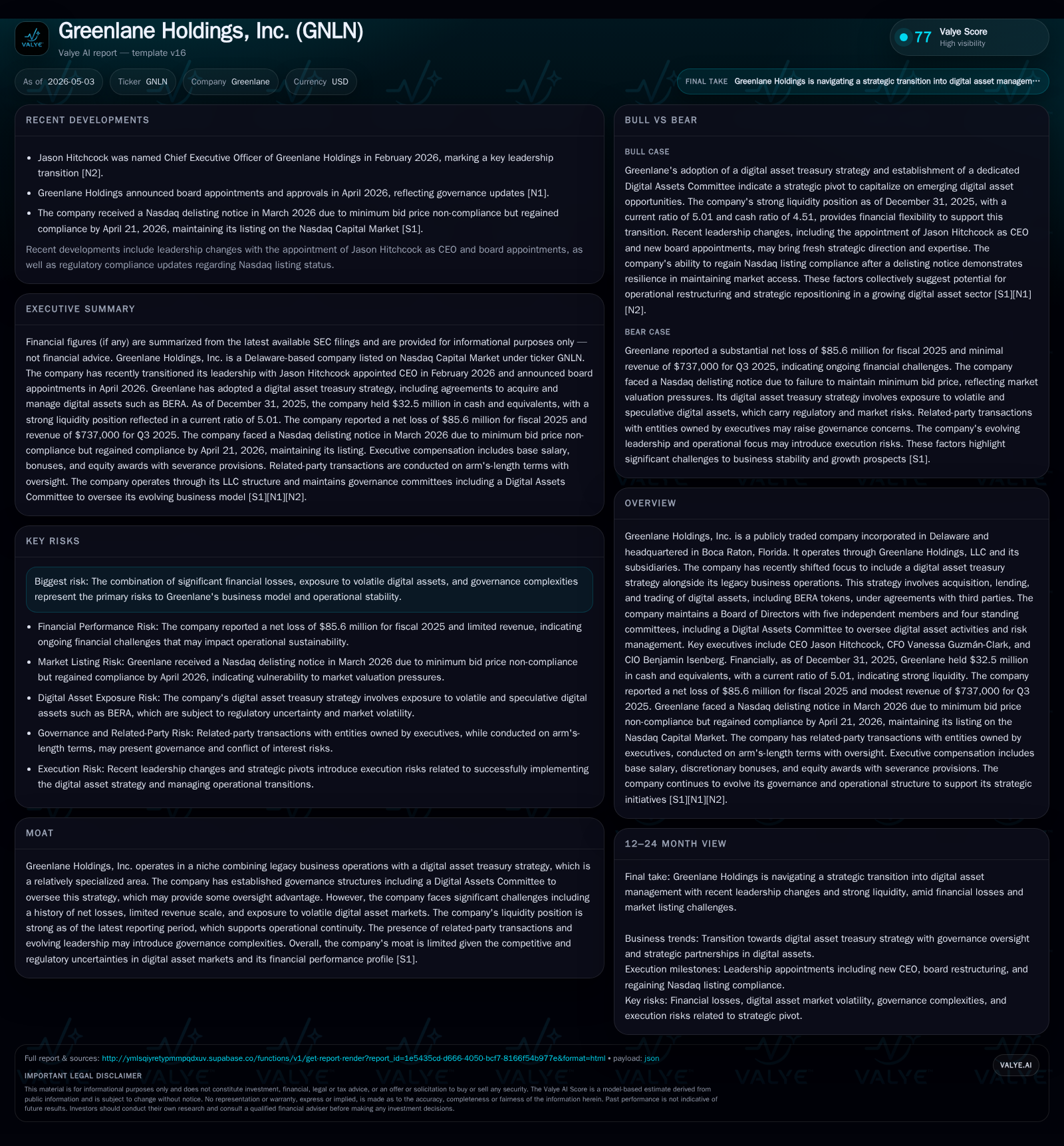
Greenlane enters mid-2026 fortified by substantial liquidity reserves relative to modest debt levels last reported in September 2023—with net debt effectively negative—providing operational runway supportive for active treasury investment tactics amidst turbulent market conditions.[F1] Despite these strengths in cash position and current ratio indicating sound short-term solvency, the company continues to report deep net losses driven primarily by new strategic investments coupled with restructuring costs inherent to its business model evolution.[F1] Hence financial resilience currently acts mainly as an enabler rather than reflecting profitability nor growth self-sufficiency at this stage.
Disclaimer: This is research-only, informational analysis and not investment advice. It may include AI-generated interpretation and general industry context. Always verify important details using primary sources.

Comments