
FTC Solar Reports Q1 Setback While Renewing Focus on Supply Chain and Growth
Q1 financial setbacks highlight FTC Solar’s urgent need to fortify supply chain resilience and pursue growth avenues in a competitive solar tracker market.
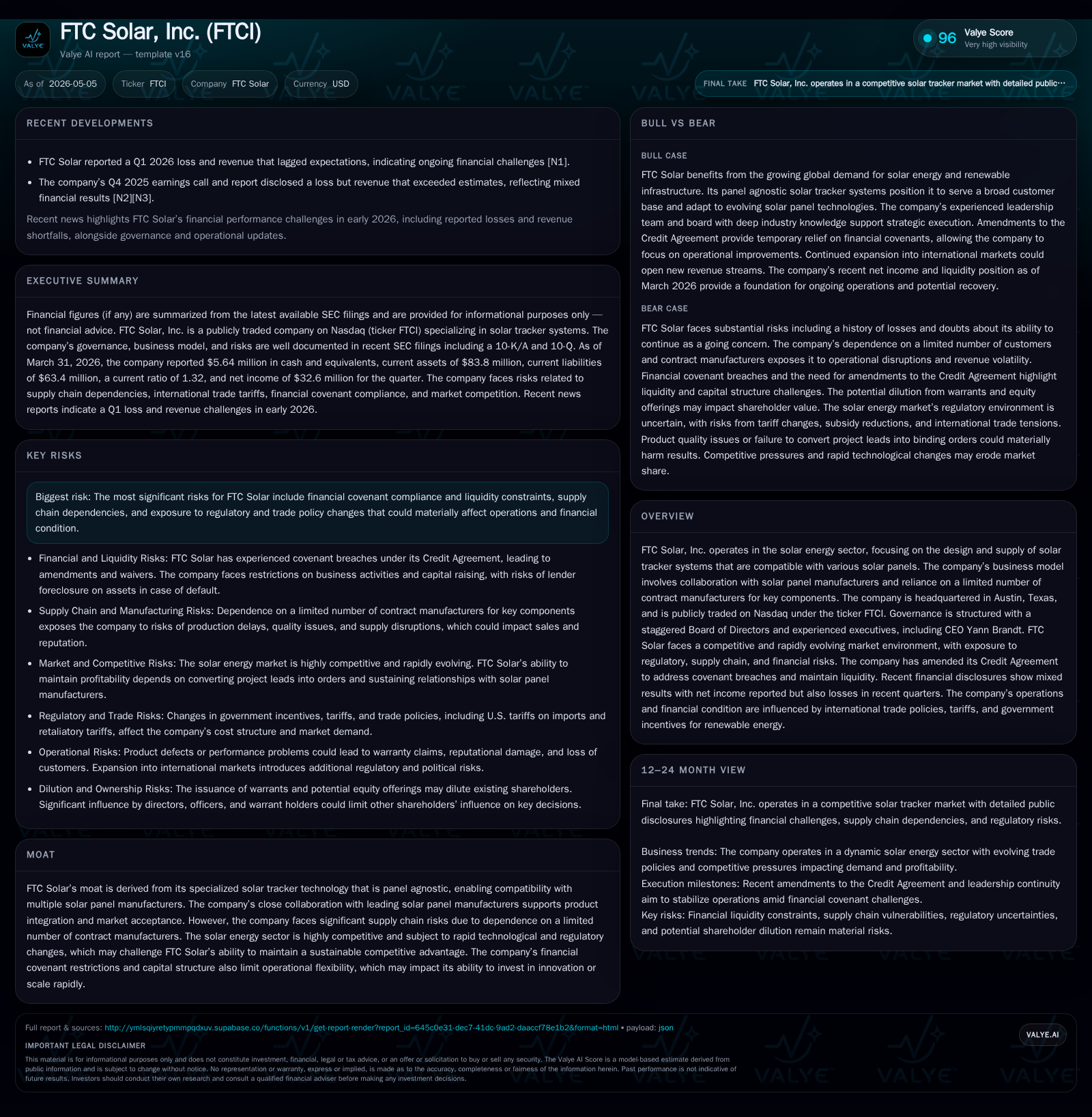
FTC Solar’s 2026 Q1 results revealed continued profitability challenges and liquidity pressures, underscoring risks from limited contract manufacturer dependencies and tightening financial covenants. The company maintains a distinct position with its panel-agnostic solar trackers but faces an evolving regulatory environment and intense competition. Growth prospects hinge on deepening customer collaborations and international expansion, while navigating supply chain bottlenecks and capital structure constraints remain critical. Upcoming quarters will test FTC Solar’s ability to comply with amended credit agreements and translate strategic initiatives into order flow and margin improvements.
Latest Operating Update: Q1 Results Reveal Profitability Challenges
FTC Solar reported first-quarter results on May 5, 2026, indicating continuing operational headwinds. Despite efforts to scale business activities, the company recorded losses driven by sluggish demand conversion and persistent cost pressures. The quarterly revenue fell short of estimates, reflecting delays in customer project development cycles and the complexity of converting project leads into binding orders [S2][N1]. Meanwhile, working capital dynamics strained cash flows amid elevated inventory needs linked to supply chain disruptions. Concurrent disclosures emphasized the hurdle of maintaining liquidity under existing credit agreements while managing escalating contractual obligations [S3].
These developments underscore a recurring challenge for FTC Solar in achieving profitability amid volatile end-market conditions and internal execution gaps.
Business Model and Product Quality: Panel-Agnostic Solar Trackers Driving Market Relevance
According to the latest annual filing amendment, FTC Solar’s core business revolves around designing and supplying advanced solar tracker systems that are uniquely panel agnostic—compatible with multiple brands of solar panels. This interoperability is a strategic strength that facilitates integration into diverse photovoltaic installations ranging from utility-scale projects to commercial arrays [S1]. The company does not manufacture trackers directly but relies heavily on a handful of contract manufacturers for key components, a concentration which exposes it to supplier-related risks.
Maintaining product quality is critical given warranty liabilities and reputational considerations; FTC Solar invests considerable effort collaborating with major solar panel OEMs to engineer solutions ensuring performance reliability across platforms. This collaboration enhances customer confidence but also ties the company closely to partner roadmaps, potentially limiting agility.
Industry Structure and Competitive Position: Navigating a Rapidly Evolving Solar Technology Sector
The solar tracking market is characterized by rapid innovation cycles, intense competition, and significant regulatory influence. FCC Solar competes against larger integrated renewable energy firms as well as specialized technology providers vying for share in expanding utility-scale solar deployments. Pricing pressure has intensified amid overcapacity concerns within the global supply chain ecosystem compounded by recent tariff fluctuations on imported components that elevate costs unpredictably [S2][S19][S21].
Moreover, FTC Solar’s dependence on limited contract manufacturers creates exposure to production bottlenecks or cost escalations exacerbated by geopolitical trade tensions. Regulatory shifts such as accelerated tax credit phase-outs per recent legislation pose demand uncertainties affecting project financing timelines [S18][S21]. Despite these challenges, the company’s modular technology design offers differentiation enabling smoother integration in heterogeneous panel scenarios where competitors may struggle.
Growth Drivers: Expanding International Footprint and Customer Collaborations
Management disclosed strategic intent to amplify growth through geographic diversification beyond core U.S. markets into select international regions where renewable energy mandates are tightening [S1][S2]. Collaborations with leading solar panel manufacturers fostered through co-engineering efforts underpin product acceptance globally.
KPI-wise, growth depends heavily on securing new large-scale purchase orders and converting identified project leads efficiently into booked contracts—a historically uneven area for the company. Success in scaling margins hinges on improving direct tracker margin thresholds stipulated under lender agreements alongside enhanced operational efficiencies [S2][S23].
Investment in R&D targeted at maintaining panel agnosticism while reducing installation complexity represents an ongoing commitment supporting long-term competitive positioning.
Risks and Constraints: Financial Covenants, Supply Chain Dependence, and Regulatory Exposure
Perhaps most pressing are the constraints imposed by the company's credit facility amendments which enforce strict covenants around minimum cash balances (projected at $15–$20 million depending on repayment schedules), quarterly revenue floors rising progressively through 2026, direct tracker margin minima starting Q1 2026, consolidated EBITDA floors beginning with fiscal year-end 2026, and purchase order volume requirements effective March 2027 [S2][S6][S8][S23].
Non-compliance triggers default risks including lender foreclosure rights over company assets — a material threat given current liquidity tightness: cash reserves stood at $5.64 million at quarter-end against net debt of approximately $48 million [F1]. These limitations restrict capital deployment flexibility necessary for aggressive innovation or market expansion.
Compounding financial strain is reliance on limited contract manufacturers susceptible to supply interruptions or tariff-induced cost upheavals—any disruption can delay shipments leading to lost sales or margin erosion. Additionally, evolving U.S. trade policy has led to fluctuating tariffs impacting import costs unpredictably. Execution of expansion strategies internationally as well as possible advancements in supply chain diversification or vertical integration could mitigate component sourcing risks.
Management’s capacity to sustain senior leadership stability is an intangible yet important factor evidenced by recently announced sign-on bonuses for key executives aimed at retention through 2029 [S3]. How effectively FTC Solar navigates competing demands of liquidity preservation while investing prudently in growth-driving initiatives will shape near-term trajectory.
Financial Snapshot: Liquidity and Leverage in Focus
Latest financial snapshot
| Metric | Value | Period |
|---|---|---|
| Cash & equivalents | $5.64mm | |
| 2026-03-31 | ||
| Total debt | $53.63mm | |
| 2026-03-31 | ||
| Net debt | $47.99mm | |
| 2026-03-31 | ||
| Current assets | $83.82mm | |
| 2026-03-31 | ||
| Current liabilities | $63.45mm | |
| 2026-03-31 | ||
| Current ratio | 1.32x | |
| 2026-03-31 |
Source: SEC companyfacts cache [F1].
FTC Solar ended Q1 2026 with constrained liquidity—cash reserves just above $5.6 million juxtaposed with substantial gross debt exceeding $53 million results in net leverage near $48 million [F1]. Recent amendments to credit facilities provide some covenant relief but impose stringent ongoing requirements restricting access to additional secured financing or asset sales without lender approval [S2][S6][S8].
Profitability remains under pressure with reported net losses continuing into fiscal periods ending December 2025; this financial profile emphasizes the importance of improving order book quality and operational efficiency while managing working capital prudently.
This analysis is based exclusively on publicly available SEC filings as of May 2026 ([S1], [S2], [S3], et al), recent news reports ([N1]), and validated company facts ([F1]). It does not contain investment recommendations or price targets but aims to provide an informed operating context for buy-side industrial analysis purposes.
Disclaimer: This is research-only, informational analysis and not investment advice. It may include AI-generated interpretation and general industry context. Always verify important details using primary sources.

Comments