
GENCO Shipping Strengthens Shareholder Defenses to Support Long-Term Value
The company’s recent amendment to its shareholder rights agreement fortifies defenses against hostile takeovers, aligning with its strategy to preserve value amid drybulk market cyclicality.
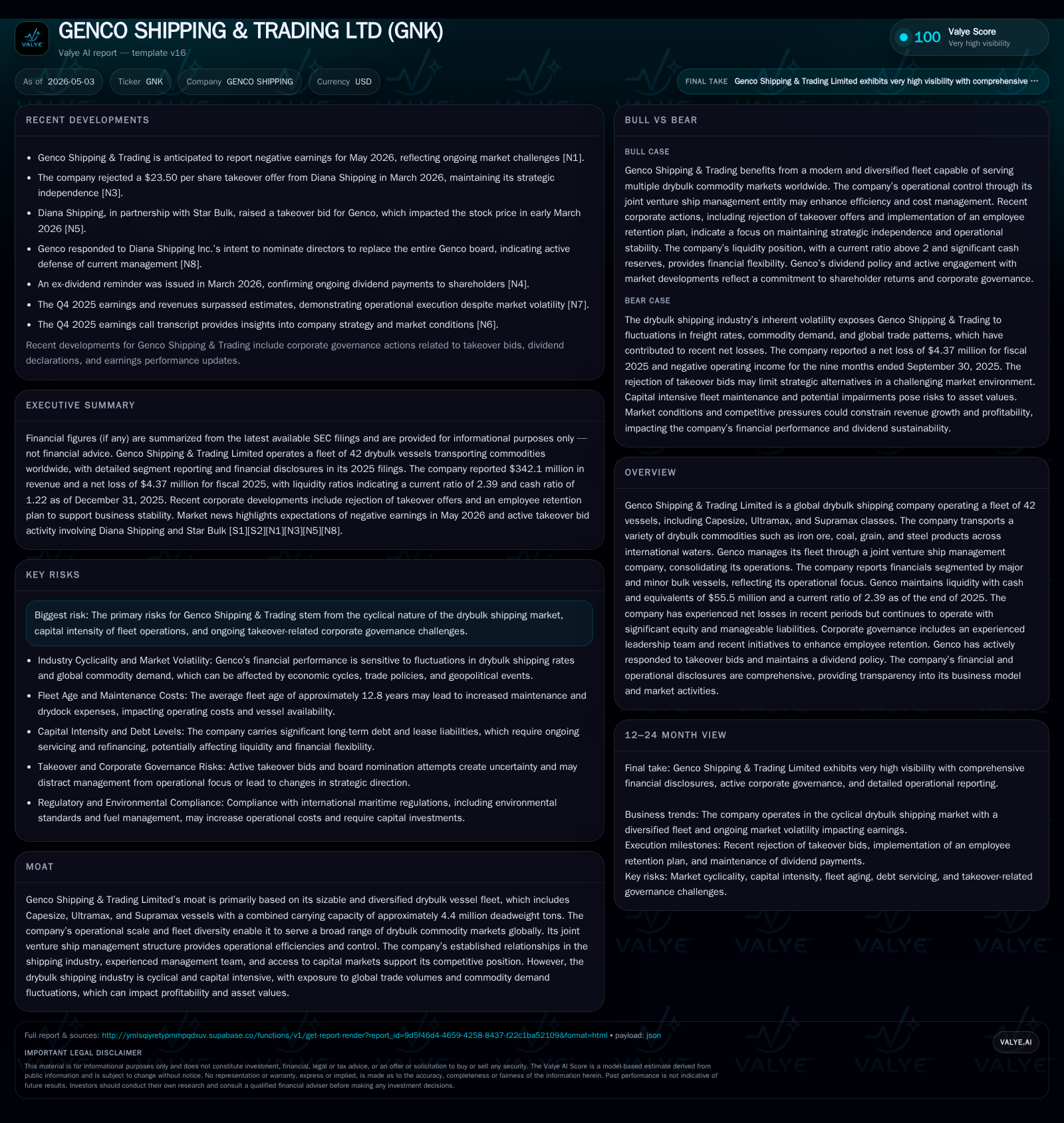
GENCO Shipping & Trading Limited announced a Second Amendment to its shareholder rights agreement in May 2026 to better protect long-term shareholder interests by deterring control acquisitions without appropriate premiums [S3]. Operating a diversified fleet of 42 drybulk vessels, the company’s business model centers on transporting major commodities globally under charter contracts [S1][F1]. Within the capital-intensive and volatile drybulk shipping sector, GENCO maintains competitive strength through fleet diversity and operational scale but faces cyclical demand risks and freight rate fluctuations [S1][F1]. Growth is supported by an increased $600 million revolver facility, extended debt maturity, and strong liquidity standing, positioning the company for fleet expansion or market opportunities [S1][S2].[F1]. Investors should monitor quarterly freight rate developments, fleet utilization, and governance milestones as near-term indicators.
Recent Governance Update and Its Strategic Significance
On May 1, 2026, GENCO Shipping & Trading Ltd. executed a Second Amendment to its Shareholder Rights Agreement originally established in October 2025 and previously amended in November 2025 [S3]. This amendment reinforces protections designed to prevent any party from gaining control or significant influence over the company through open-market accumulation or other tactics that could disadvantage existing shareholders without paying an appropriate control premium. Such defensive governance measures are increasingly critical in the cyclical drybulk sector where share price volatility can invite activist investors or unsolicited takeover attempts. By proactively fortifying these barriers, GENCO aims to safeguard the collective long-term interests of shareholders amid an uncertain macroeconomic backdrop.
Business Model and Fleet Operational Overview
GENCO operates as a global drybulk shipping entity managing a fleet of approximately 42 vessels comprising Capesize, Ultramax, and Supramax classes totaling about 4.4 million deadweight tons (DWT) [S1][F1]. The company transports essential bulk commodities including iron ore, coal, grain, and steel products across extensive international trade routes. Revenues are generated principally through charter arrangements — both time charters and voyage charters — whereby customers pay for the transportation capacity of vessels. The company's segment reporting distinguishes major bulk vessels (Capesize) from minor bulk vessels (Ultramax/Supramax), reflecting differences in cargo types served and operational dynamics.
Operational efficiencies are pursued through a joint venture ship management company consolidating technical and crewing functions, supporting cost containment across the vessel base. This structure aligns operating margins closely with fleet utilization rates and prevailing charter rates. Each vessel represents an individual operating segment monitored by management for performance optimization [S1].
Position in the Cyclical Drybulk Shipping Industry
Drybulk shipping is inherently cyclical and capital intensive. Charter rates fluctuate widely based on global commodity demand cycles tied to economic growth patterns — particularly steel production and raw materials consumption. Fleet maintenance costs such as periodic drydocks create significant fixed overheads irrespective of earnings volatility. Asset values also shift with newbuilding deliveries and scrapping rates impacting supply availability.
GENCO's size and diversified fleet provides operational flexibility across multiple cargo types and trade lanes but faces competitive pressures from numerous global bulk operators. Freight rate volatility directly impacts revenue streams measured via Time Charter Equivalent (TCE) rates intrinsic to daily earnings comparisons across charter types [S1][F1]. Regulatory changes around emissions also introduce cost uncertainties as vessels comply with international maritime standards.
Growth Drivers: Fleet Capacity, Market Demand, and Financial Flexibility
The company's growth orientation is underpinned by recent enhancements in financial capacity. The revolving credit facility was upsized from $500 million to $600 million on July 10, 2025, extending maturity to July 2030 with no commitment reductions until March 2027 contingent on covenant compliance [S2][S5]. This expanded lending framework supports fleet acquisitions or upgrades aligned with market opportunities.
Strong liquidity complements this financial flexibility—cash balances reached approximately $55.5 million at fiscal year-end 2025 while the current ratio remained robust at 2.39 signaling healthy short-term asset coverage [F1]. These resources enable disciplined capital deployment even in periods of market softness.
Fleet utilization improvements driven by demand recovery among iron ore exporters and agricultural commodity flows represent another growth vector. Meanwhile, the company sustains sizeable quarterly dividend payments reinforcing investor return policies despite intermittent net losses reflecting industry cyclicality [S1][F1].
Risks and Constraints: Market Volatility and Capital Intensity
GENCO’s primary risk exposure relates to drybulk market cyclicality which affects freight rates and consequently profitability. Recent net losses in financial results highlight how sharp downturns in demand can compress margins given high fixed costs from vessel operations including crew expenses, insurance, fuel bunkers, maintenance drydocks scheduled intermittently every five years or so plus regulatory compliance costs [S1][F1].
Geopolitical tensions present additional hazards as ongoing conflicts may disrupt key shipping corridors such as the Red Sea or impact fuel pricing dynamics affecting voyage economics [S1]. Although shareholder rights amendments bolster governance fortifications against unwanted changes in control, they do not eliminate risks related to activist pressures or strategic missteps.
Outlook and Key Monitoring Points Ahead
Market observers should watch forthcoming quarterly disclosures for guidance updates on charter rates which serve as leading proxies for underlying demand strength in steel and raw material industries globally. Charter coverage levels per vessel will indicate how well bookings secure future cash flow amid seasonal variability.
Progress or modifications related to shareholder defense mechanisms will be relevant given sustained focus on corporate governance frameworks within shipping firms subject to cyclical investment cycles.
Fleet acquisition activity or unexpected dispositions may signal shifts in growth posture responding dynamically to market conditions ahead.
Current Financial Snapshot Supporting Strategic Review
Latest financial snapshot
| Metric | Value | Period |
|---|---|---|
| Cash & equivalents | $56mm | |
| 2025-12-31 | ||
| Total debt | $200mm | |
| 2025-12-31 | ||
| Net debt | $144mm | |
| 2025-12-31 | ||
| Current assets | $109mm | |
| 2025-12-31 | ||
| Current liabilities | $46mm | |
| 2025-12-31 | ||
| Current ratio | 2.39x | |
| 2025-12-31 |
Source: SEC companyfacts cache [F1].
As of December 31, 2025, GENCO reported revenues of $342.1 million alongside a positive operating income of $7.47 million but recorded a net loss of $4.37 million reflecting ongoing market challenges [F1]. Liquidity remains healthy with cash reserves exceeding $55 million balanced against total debt near $200 million resulting in a conservative current ratio above two times [F1]. This financial posture supports the company's strategic initiatives aimed at navigating industry cyclicality without compromising operational continuity.
This analysis is based exclusively on publicly filed SEC documents up to May 2026 combined with Valye News’ sector knowledge; it does not constitute investment advice.
Disclaimer: This is research-only, informational analysis and not investment advice. It may include AI-generated interpretation and general industry context. Always verify important details using primary sources.

Comments