
Roper Technologies Advances with Strong Q1 Results and Acquisition-Led Growth
Roper's latest quarterly performance confirms the effectiveness of its decentralized model and acquisition strategy in driving growth and operational agility.
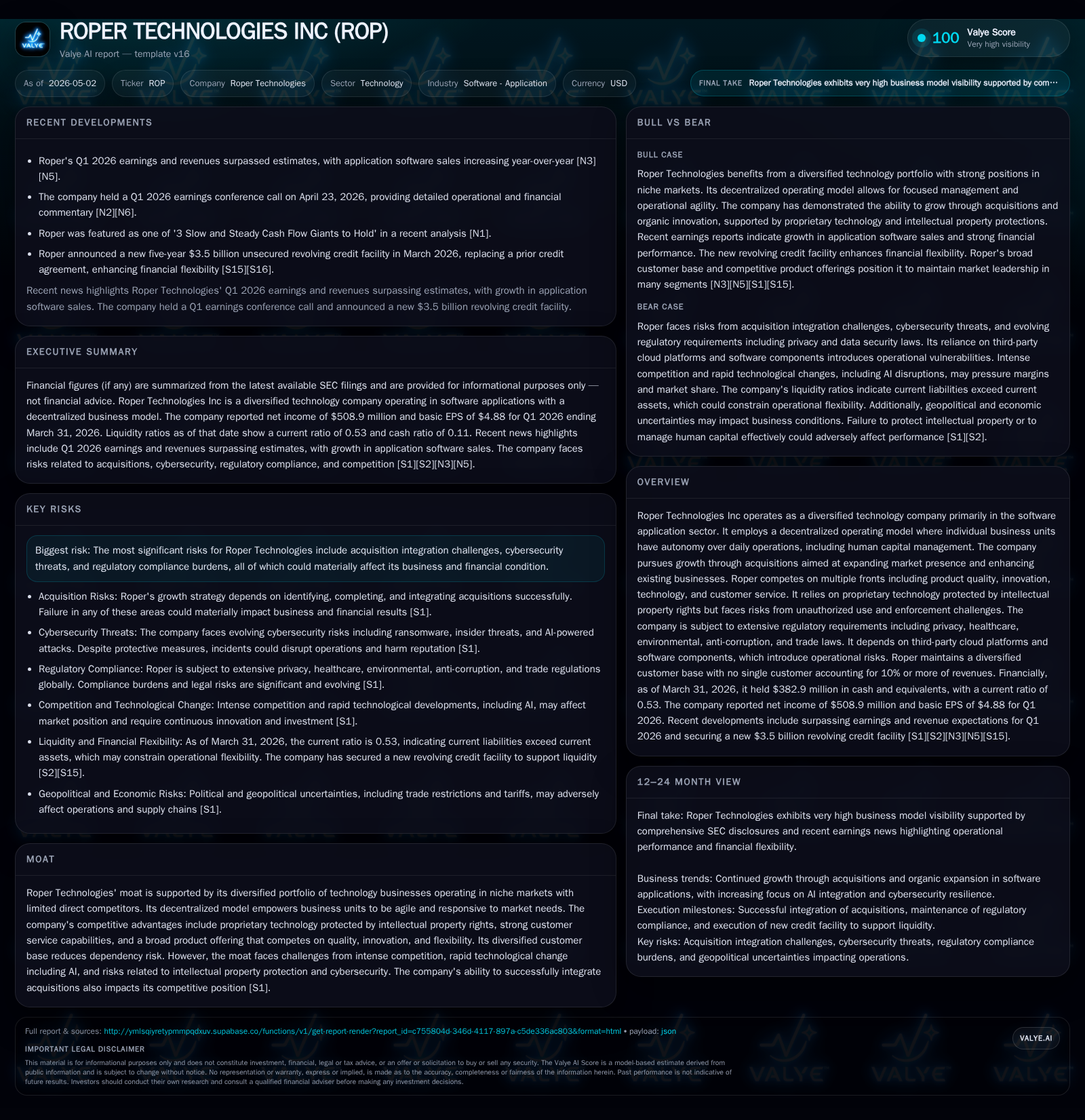
In Q1 2026, Roper Technologies reported robust operational momentum marked by revenue growth and improved guidance, underscoring its acquisition-led expansion approach. The company's decentralized business units foster agility and innovation across diversified software niches, supported by proprietary technologies and strong customer service. Growth is primarily fueled by disciplined bolt-on acquisitions, advanced product development including AI integration, and expanding subscription revenues. However, regulatory compliance complexities, cybersecurity risks, and integration challenges remain key watchpoints. Financially, Roper sustains a leveraged capital structure balanced by healthy cash flows and strategic investment capacity.
Latest Quarterly Operating Update: What Changed in Q1 2026
Roper Technologies’ first quarter 2026 filing ([S2]) reveals sustained operational strength characterized by above-consensus revenue growth and an upward revision to the fiscal year adjusted EPS outlook ([N12],[S3]). While exact top-line figures for Q1 were highlighted to be positive on a year-over-year basis with application software segments showing meaningful uplift ([N3]), management noted continued demand resilience across its diversified business platform. The April 23 8-K release ([S3]) coincided with the earnings announcement emphasizing that acquisition activity remains central to their growth strategy.
This quarterly update not only confirms the effectiveness of Roper's decentralized operating model but signals confidence in integration capabilities following recent acquisitions. The boost to FY26 guidance from these fresh results emphasizes momentum beyond cyclical trends, reflecting broad-based end-market strength rather than isolated pockets of demand ([N12],[N13]).
Decentralized Business Model Driving Roper's Product Quality and Agility
At the core of Roper’s success lies a unique decentralized operating structure where individual business units retain full autonomy over daily operations including decisions on human capital management ([S1],,[S15]). This organizational architecture empowers units to act nimbly within their specialized niches, fostering rapid innovation cycles responsive to specific customer needs.
This autonomy extends to talent development frameworks enabling localized selection, engagement, and retention programs aligned closely with unit objectives ([S15]). The decentralized approach also facilitates smoother acquisition integration by avoiding cumbersome central mandates that often delay value capture. Proprietary technology portfolios maintained within each unit promote tailored R&D cycles complemented by consistent corporate oversight on legal compliance and strategic alignment ().
Such a model supports differentiated product quality through targeted improvements rather than broad-brush changes; it also promotes enhanced customer service standards as decision rights reside closer to client-facing teams.
Competitive Positioning in the Application Software Sector
Roper operates predominantly in specialized application software verticals characterized by limited direct competition but high demands for quality, innovation, and compliance ([S1],). Their moat arises from a diverse portfolio of technology solutions effectively protected by intellectual property—patents, copyrights, trade secrets—with vigilant enforcement measures despite acknowledged risks of infringement or unauthorized replication ([S10],).
They compete on multiple fronts including technology sophistication (integrating AI tools), performance reliability, price structuring, deep applications expertise within regulated industries like healthcare, and robust distribution networks ([S19],). Unlike monolithic software enterprises with broad horizontal offerings, Roper’s targeted niches reduce competitive intensity while facilitating premium positioning that supports pricing power.
Roper’s dependency on third-party cloud providers such as AWS, Azure, Google Cloud introduces operational risk due to concentration; outages or price hikes at these platforms could disrupt service continuity impacting reputation and sales conversion ([S7],). Regulatory shifts involving international data transfers (GDPR constraints) impose compliancy overheads that may slow adoption cycles especially in cross-border SaaS deployments ([S11],[S18]).
Growth Drivers: Acquisitions, Innovation, and Market Penetration
Strategic acquisitions remain the linchpin of Roper’s growth engine. The company pursues bolt-on deals aimed either at entering new verticals or deepening domain expertise within existing markets ([S10],[S1]). Successful deal sourcing benefits from Roper’s financial capacity but also poses integration execution risks that management actively monitors (,[S10]).
On innovation frontiers, sustained investments into AI-enabled software enhancements underpin their competitive differentiation in increasingly data-driven applications ([S9],[S12]). However, reliance on external AI platform providers such as OpenAI or Microsoft creates vendor dependency concerns around pricing volatility or service access restrictions ([S12]). A proactive stance on embedding AI functionalities while managing ethical/legal considerations remains critical.
Recurring revenue streams—driven by SaaS subscription models—have gained traction providing more predictable cash flows alongside greater customer stickiness ([N14],). Scaling sales channel penetration for these offerings presents opportunity levers tied closely to retention metrics and contract renewals.
Risks and Headwinds: Regulatory, Integration, and Cybersecurity Challenges
Roper faces multifaceted risks principally stemming from regulatory complexities associated with privacy/data protection laws including GDPR in Europe and evolving U.S. state regulations like CCPA which broaden reporting obligations and consumer rights ([S11],[S4],[S25]). Concurrently stringent FDA requirements for healthcare devices add layer of compliance burdens ([S4]) possibly delaying launches or escalating costs.
Integration risk from acquisitions could impair financial outcomes if newly acquired operations fail to harmonize processes or underperform expectations ([S10]). Cybersecurity remains an escalating threat vector involving potential breaches affecting customer data hosted on third-party cloud platforms or flaws in proprietary AI systems. Such incidents could incur reputational harm alongside financial penalties threatening future sales momentum ([S7],[S29],).
Political/geopolitical uncertainties such as tariffs or sanctions regimes affecting supply chains add external volatility layers hindering cost control or delaying component availability important for product deliveries ([S23],). The operational dependencies on sole suppliers or cloud vendors further compound supply chain fragility risks ( [S21]).
Monitoring Points: Upcoming Milestones and Demand Signals
Key indicators to track going forward include:
- Further updates to FY26 EPS guidance post-Q1 performance reflecting execution confidence or emerging headwinds ([N12],[S2])
- Announced acquisitions timing/size revealing the sustainability of deal flow fueling growth curves ([N13],[S3])
- Customer renewal rates within SaaS segments illustrating subscription revenue stability ( [N13])
- Regulatory developments especially around AI usage policies impacting product feature availability or market access ([S12],)
- Integration milestones providing early signals on post-deal synergy realizations removing uncertainty around goodwill impairment risk ([S10])
Tracking these factors offers insight into whether Roper can maintain its growth trajectory amid intensifying sector complexities.
Financial Profile: Current Liquidity, Debt, and Operational Efficiency
Latest financial snapshot
| Metric | Value | Period |
|---|---|---|
| Cash & equivalents | $383mm | |
| 2026-03-31 | ||
| Total debt | $9.3bn | |
| 2025-12-31 | ||
| Net debt | $8.9bn | |
| 2025-12-31 | ||
| Current assets | $1912mm | |
| 2026-03-31 | ||
| Current liabilities | $3.6bn | |
| 2026-03-31 | ||
| Current ratio | 0.53x | |
| 2026-03-31 |
Source: SEC companyfacts cache [F1].
As of March 31, 2026 quarter-end per companyfacts data [F1], Roper held approximately $383 million in cash & equivalents against total debt near $9.3 billion (year-end 2025 figure) leaving net debt close to $8.9 billion indicative of a highly leveraged balance sheet.
The company’s funding strategy hinges heavily on sizable debt financing primarily used for acquisitions balancing leverage risk against returns from newly acquired businesses confirming disciplined capital allocation priorities ([F1],[S5]). Although leverage levels are elevated relative to many peers in technology sectors due to acquisition-driven growth posture, steady operating cash flows support serviceability of debt obligations without immediate refinancing pressure reported in filings ([F1],[S2]).
DISCLAIMER: This document is for informational purposes only. It does not constitute investment advice or recommendations regarding securities or other financial instruments. Any financial figures are drawn solely from disclosed filings or reputable sources as cited; no projections or forecasts are intended.
Disclaimer: This is research-only, informational analysis and not investment advice. It may include AI-generated interpretation and general industry context. Always verify important details using primary sources.

Comments