
Healthcare Realty Trust Advances Redevelopment Strategy While Managing Tenant and Debt Risks
Q1 2026 filings reveal ongoing share repurchases and redevelopment investments amid stable tenant lease negotiations.
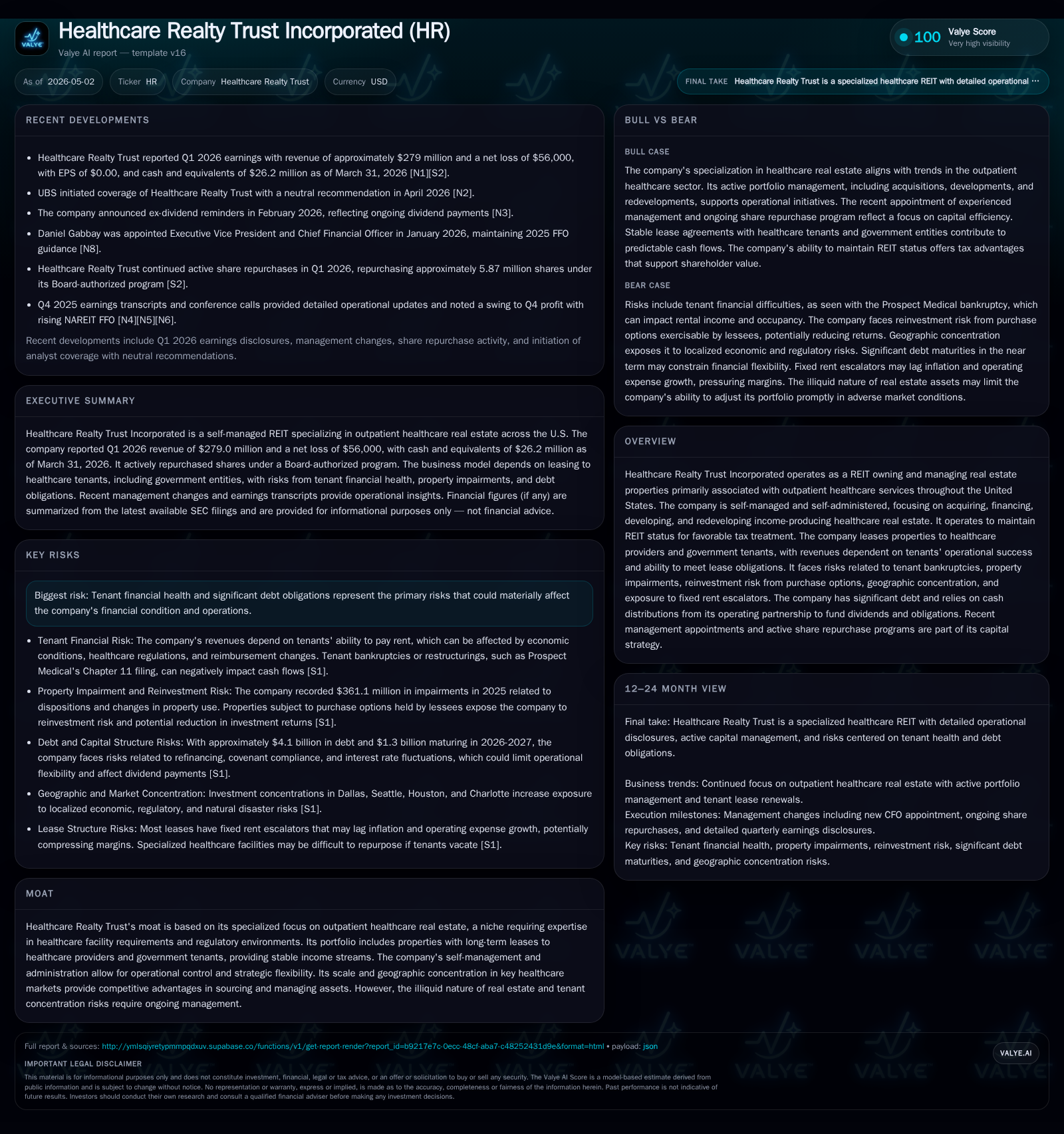
Healthcare Realty Trust Incorporated (HR), a REIT specializing in outpatient healthcare real estate, reported steady operational progress in Q1 2026 marked by aggressive share repurchases and active leasing negotiations. The company continues to invest heavily in tenant improvements and redevelopment projects designed to maintain high occupancy and lease renewals, critical for sustaining consistent rental income streams. Despite facing tenant credit risks tied to the healthcare sector’s reimbursement environment and a substantial debt load, HR leverages its focused portfolio and self-managed structure to retain competitive positioning in targeted healthcare markets.
Recent Operating Update
Healthcare Realty Trust (HR) reported its first-quarter results for 2026 via its Form 10-Q filed May 1, 2026 [S2], supported by an earnings press release dated April 30, 2026 [S3][N1]. The quarter was notable for significant common stock repurchases totaling approximately $100 million across January and March at an average price near $17.35 per share. This buyback activity aligns with a broader board authorization of up to $500 million in share repurchases valid through October 2026, supporting capital return strategies.
On the operating front, HR emphasized active lease negotiations involving ten single-tenant buildings with leases expiring in 2026. Four of these have been renewed already; six remain under negotiation with expectations for renewals or backfill leasing. This pursuit is critical to maintaining occupancy rates and sustaining rental cash flows.
Capital allocation remains focused on tenant improvements—with first-generation (space built out from shell condition) and second-generation upgrades (refurbishments during occupancy) constituting large ongoing investments. Commitments for tenant improvements reached $161.8 million as of year-end 2025 (excluding active developments), signaling HR's strategic emphasis on property quality enhancement to retain and attract healthcare providers.
Business Model
Healthcare Realty Trust operates as a self-managed REIT that owns and manages a portfolio primarily composed of outpatient healthcare real estate across the United States [S1]. Its revenue model hinges on leasing properties long-term to healthcare providers—medical office buildings mostly—and occasionally government tenants indirectly affiliated with healthcare delivery. These leases generate recurring rental income but depend strongly on tenants' operational performance.
Distinctive aspects of HR's business include:
- Long-term leases: Average lease terms for single-tenant buildings are roughly 11.6 years, with about 5.7 years remaining on average per lease cycle. This longevity supports predictable cash flows [S1].
- Tenant improvement financing: HR often finances tenant improvements exceeding initial allowances by extending the costs amortized over the lease term as additional rent income.
- Leasing commissions: Significant upfront outlays are incurred for external broker commissions (4–6% of gross lease values) for new leases and incentives paid internally for lease execution [S1].
- Ground leases: The company operates many properties under very long ground leases (40–99 years), adding layers to asset control dynamics.
- REIT status: Maintaining REIT status is crucial for tax efficiency, necessitating regular dividend distributions funded via cash flows from operations or partnership distributions.
Revenue generation volumes are driven by leased square footage occupancy levels, rental rates tied mostly to long-term contractual escalators or market resets upon renewal, plus amortized tenant improvement reimbursements and other ancillary recoveries. Margins are influenced by maintenance costs, property taxes, utilities, leasing expenses including commissions and abatements used as inducements.
Industry Structure and Competitive Position
HR competes within the specialized niche of healthcare real estate investment trusts that cater almost exclusively to outpatient medical facilities rather than general commercial real estate sectors. This specialization requires nuanced understanding of healthcare tenant requirements including regulatory compliance (e.g., certificate of need states), facility specifications essential for clinical use, and operational trends affecting tenant viability.
Key competitive strengths include:
- Self-management: Unlike externally managed peers, HR’s self-administration fosters greater control over operations and strategy alignment.
- Geographic concentration in high-demand markets: With over 5% exposure each in Dallas (9.5%), Seattle (6.1%), Houston (6%), and Charlotte (5.4%) among others, HR targets robust regional demand centers benefiting from demographic growth influencing outpatient care needs [S27].
- Long weighted-average lease terms: Lease durations exceed general commercial real estate norms providing cash flow visibility.
- Robust redevelopment pipeline: Ongoing investment enhances asset quality aiding retention amidst competitive leasing environments.
However, the firm faces challenges stemming from tenant credit dependency on a highly regulated healthcare sector vulnerable to reimbursement changes affecting hospital systems or outpatient groups. Furthermore, geographic market concentration introduces exposure risks that require portfolio diversification vigilance.
Growth Drivers
Several factors underpin potential growth trajectories:
- Development & Redevelopment Activity: Capital-intensive development initiatives aim to launch modernized medical office spaces meeting evolving clinical needs; redevelopment projects refresh existing properties to stabilize occupancy amid retailer-like churn patterns seen elsewhere in commercial real estate [S1][S26].
- Lease Renewal & Leasing Velocity: Successfully renewing expiring single-tenant leases or backfilling vacancies directly drives occupancy metrics—a key cash flow lever identified specifically for the upcoming expirations in 2026 [S1].
- Acquisitions Strategy: Opportunistic acquisitions strengthen market footholds or expand presence into complementary geographies aligned with demographic aging trends driving outpatient care demand.
- Share Repurchases: Large-scale share buybacks enhance per-share earnings representation while signaling confidence in intrinsic asset values supported by stable rents [S2][N1].
- Pricing Power Through Structured Rent Escalators: Contractual rent escalations embedded in leases help counterbalance inflationary pressures impacting operating expenses.
These drivers link closely to measurable KPIs such as percentage of leased square feet across the portfolio, net operating income margins after leasing commissions/abatements and cost capitalization activities related to tenant improvements.
Risks / Watchpoints / Growth Constraints
HR’s risk profile features both cyclical elements influenced by macroeconomic shifts impacting healthcare spending patterns and structural challenges tied to industry specifics:
- Tenant Credit Risk: Healthcare operators’ ability to honor lease agreements depends on Medicare/Medicaid reimbursement policies which remain susceptible to government legislative actions or budget appropriations affecting federal tenants [S1].
- Reinvestment Risk from Purchase Options: Properties with exercisable purchase options present reinvestment timing uncertainties potentially yielding lower returns relative to sold assets [S1].
- Geographic Concentration Concentrates Market Downside Exposure especially if local economic conditions deteriorate or natural disasters disrupt operations unexpectedly [S27].
- Leverage Burden & Refinancing Risks: With nearly $3.1 billion net debt estimated combining reported total debt less cash reserves ([F1]), maintaining covenant compliance amid rising interest rates constrains capital flexibility reducing firepower for acquisitions or dividend sustenance [F1][S4][S9][S16].
- Operating Cost Inflation Impacting Net Operating Income Margins, including rises in property taxes or utilities which may not be fully recoverable from tenants depending on lease structures [S1].
- Competitive Environment & Supply Dynamics, where oversupply of medical office space could pressure rents or occupancy if new developments exceed demand growth.
Continued vigilance around macroeconomic factors affecting healthcare funding streams alongside prudent capital management remains essential.
What To Watch Next
Key indicators shaping near-term outlooks include:
- Lease renewal results for the six pending single-tenant buildings scheduled for expiration in 2026—successful renewals will shore up occupancy rates critical for cash flow stability.
- Execution pace of redevelopment projects alongside cost control benchmarks impacting overall property profitability post-renovation.
- Leasing commission trends which reflect underlying velocity of new tenant attraction impacting upfront absorbing costs affecting short-term free cash flows.
- Share repurchase volume moderation or acceleration signaling changes in management outlook regarding valuation versus available liquidity.
- Interest rate movements affecting cost of debt refinancing particularly given significant maturities scheduled through 2027 [S4][S9].
- Updates on government budget appropriations influencing federal tenant payment reliability particularly relevant as public funding cycles unfold.
Financial Profile Context
While detailed financial statements are not restated herein beyond policy allowance limits, current liquidity comprises approximately $26 million in cash equivalents ([F1]) against a gross total debt figure last recorded near $3.12 billion adjusted herewith ([F1]). Absence of immediate leverage deterioration disclosures suggests covenant compliance but refinancing remains a material operational consideration given large maturities approaching within two years ([F1], S4).
Net operating incomes reflect balancing impacts from leasing commissions averaging near $54.8 million annually plus amortization rhythms from tenant incentives aligned with stable revenue generation profiles underpinned by long-term contract structures ([S1]). Divergent challenges arise from partial impairments associated with non-renewed or backfilled leases if ongoing market conditions turn adverse but management retains active redevelopment pipelines aimed at offsetting these effects strategically.
This analysis is based solely on publicly available SEC filings as well as credible recent company disclosures up through May 2026 without extrapolation beyond documented data points. No investment advice is provided herein.
Disclaimer: This is research-only, informational analysis and not investment advice. It may include AI-generated interpretation and general industry context. Always verify important details using primary sources.

Comments