
Oportun Financial Advances Financial Health Solutions with New CEO and Strengthened Capital Structure
Oportun Financial’s recent quarterly metrics and executive transition underscore its strategic commitment to serving underserved consumers through innovative credit and savings products backed by a fortified balance sheet.
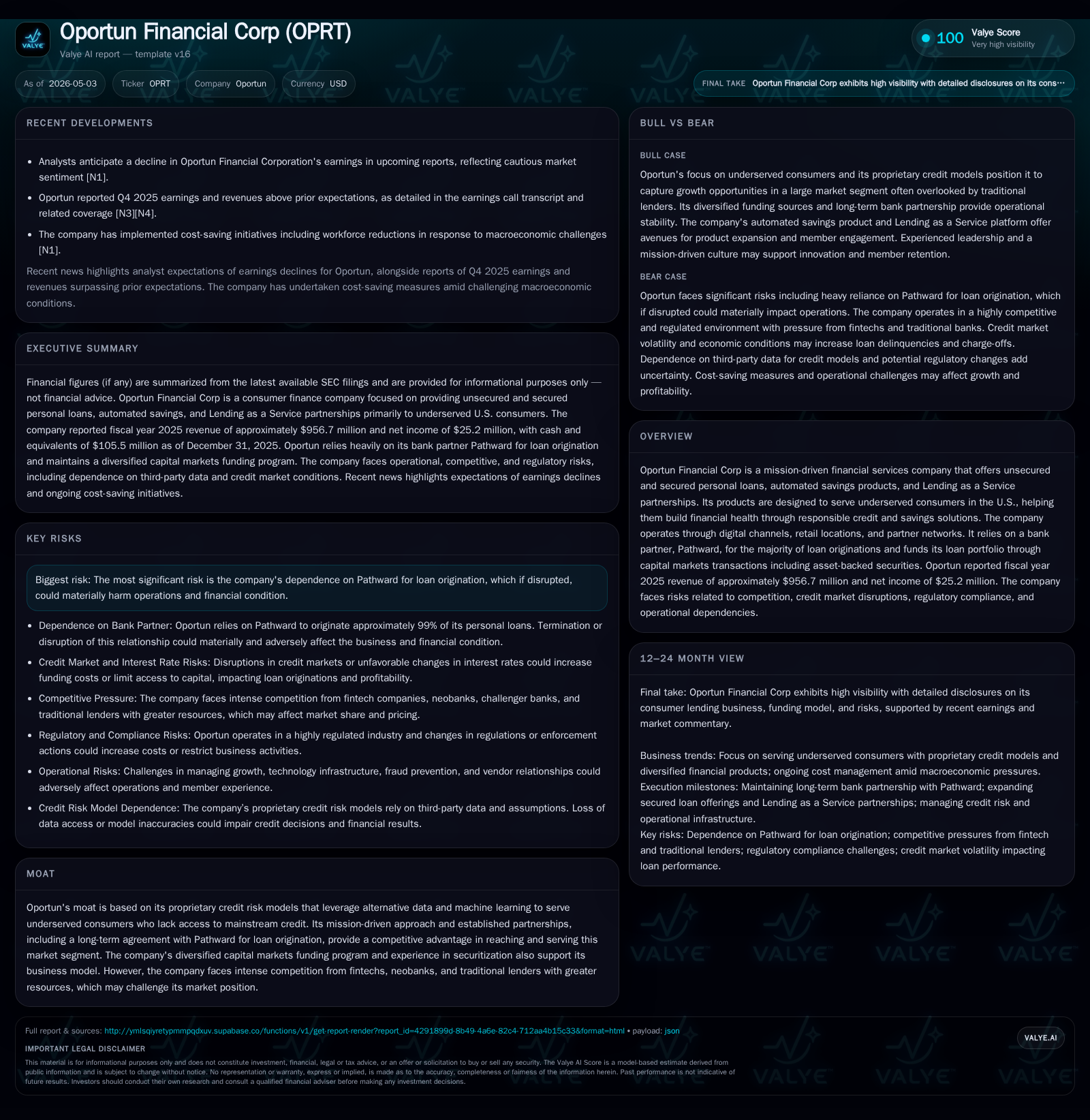
In the latest quarterly filing dated November 5, 2025, Oportun Financial Corp reported steady originations growth and improved delinquency rates, reflecting operational resilience in its core loan portfolio. The April 2026 appointment of Doug Bland as CEO marks a critical leadership shift poised to drive strategic refinement amid competitive fintech pressures. Oportun’s mission-centric business model leverages proprietary credit risk algorithms alongside diversified capital markets funding to serve underserved U.S. consumers. Despite these strengths, dependency on the Pathward banking partner for loan origination and elevated charge-off rates remain material risks. The company’s growth outlook centers on digital expansion, product diversification, and scaling Lending-as-a-Service partnerships, underpinned by a stronger capital base achieved through debt reduction and improved asset-backed securitization ratings.
Recent Operational Developments Highlighting Business Continuity
Oportun Financial's latest quarter ended September 30, 2025 ([S2]) demonstrated continuity in its core lending operations amid challenging macroeconomic conditions impacting consumer credit. Year-to-date aggregate originations rose to approximately $1.46 billion from $1.25 billion in the prior year period—a solid increase of around 7%, underscoring growth momentum. Portfolio yield remained stable near 33%, showing disciplined pricing management despite competitive pressures.
Credit quality metrics reveal improvement with a decline in the 30+ day delinquency rate from 5.2% in prior comparable periods to 4.7%, indicating effective risk controls and collection efforts. Nonetheless, annualized net charge-off rates stayed elevated yet steady at roughly 12%, consistent with the company's focus on an underserved borrower base inherently carrying higher credit risk.[S2]
Product accessibility remains diversified across Oportun's digital platforms—the mobile app and website—as well as over the phone and through an extensive physical footprint comprising 127 retail stores plus nearly 470 Lending-as-a-Service partner locations extending reach into new communities.[S2]
A pivotal recent development is the appointment of Doug Bland as CEO effective April 20, 2026 ([S3]). This executive transition signals potential strategic recalibration with an emphasis on leveraging Oportun's mission-driven lending approach amid intensifying competition within fintech and traditional lending sectors.
Business Model Focused on Serving Underserved Consumers Through Credit Innovation
Oportun Financial operates primarily by originating unsecured and secured personal loans aimed at financially underserved populations in the U.S., complemented by its 'Set & Save' automated savings product and Lending-as-a-Service (LaaS) partnerships.[S1][S2][F1] Revenue generation hinges mainly on interest income from its loan portfolio combined with fees from its lending services.
A key enabler is the partnership with Pathward—a banking institution responsible for originating most loans—allowing Oportun to classify loans as bank-originated while performing underwriting and servicing functions internally.[S1] This arrangement supports compliance but also introduces operational dependencies.
Proprietary credit risk models employ machine learning techniques utilizing alternative data beyond traditional credit bureau files to evaluate borrowers often excluded from mainstream credit markets.[S1] This scientific underwriting enables differentiation by targeting thin-file or non-prime consumers judged creditworthy under adjusted risk parameters.
To finance loan originations cost-efficiently, Oportun has developed a sophisticated capital markets funding program comprising asset-backed securities issuance—recently achieving investment-grade AAA ratings on senior tranches—and structured loan sales to institutional investors.[S1][S8] These instruments help hedge interest rate risk through fixed-rate debt while supporting scale.
Beyond direct lending, Oportun expands customer reach via LaaS partnerships that deploy its technology platform through third-party storefronts, enabling lead generation and service integration faster than traditional expansions.[S8]
Competitive Edge and Industry Position in a Crowded Fintech Ecosystem
Oportun’s moat rests primarily on its data-driven proprietary credit models tuned specifically for underserved borrower segments—an area less penetrated by larger banks or conventional lenders due to perceived risk or regulatory constraints.[S1] Its status as a Certified Community Development Financial Institution (CDFI) since 2009 further reinforces trust within these communities.
However, the competitive landscape is crowded with nimble fintech startups deploying AI underwriting frameworks, neobanks offering alternative financial products, and traditional lenders increasingly digitizing their services.[S1] These competitors often have deeper capital reserves or broader distribution networks.
While Oportun exhibits some pricing power derived from its niche focus and integrated savings offerings supporting member financial health improvements,[S1] sector-wide competition limits margin expansion potential. Regulatory scrutiny—particularly concerning bank partnership structures ("true lender" risks) and consumer protection laws—adds complexity that could pressure operational agility compared with less regulated fintech peers.
Growth Drivers Fueled by Product Diversification and Digital Expansion
Oportun is positioned to capitalize on several tangible growth vectors:[S2][S1]
- Loan Originations Expansion: Multi-channel origination through digital apps/website alongside physical outlets and LaaS partner locations fuels new member acquisition volumes. The incremental +7% YTD originations highlight execution effectiveness here.[S2]
- Set & Save Platform: Growth of automated savings products not only augments revenue streams but increases stickiness through cross-selling opportunities enhancing member lifetime value.[S2]
- Lending-as-a-Service Scaling: Faster lead-to-market capability expanding the company’s footprint without proportional fixed costs enhances scalability.[S8]
- Portfolio Yield Stability: Maintaining portfolio yield near historical ~33% levels while managing delinquencies supports sustainable margin preservation despite economic headwinds.[S2]
- Capital Markets Optimization: Enhanced balance sheet structure with AAA-rated ABS issuances lowers funding costs; improving leverage dynamics supports profitable growth.[S1]
Macroeconomic uncertainty may periodically affect loan demand or delinquency trends but underlying structural demand for responsible credit products among underserved consumers provides resiliency.
Risks and Key Constraints Centered on Origination Dependencies and Credit Market Volatility
Operational reliance on Pathward for origination constitutes a significant single point of failure; any disruption or termination would materially impact Oportun's ability to generate new loans and thus revenue flow.[S1][S2] Efforts to identify alternate bank partners are ongoing but no guarantees exist regarding timing or terms.
Credit quality remains an inherent risk given customer base characteristics—with annualized net charge-offs ~12% posing a steady drag on profitability requiring rigorous risk management.[S2][S18] Prolonged economic downturns could elevate delinquency beyond modeled expectations triggering covenant breaches under funded ABS or warehouse facilities affecting liquidity access.[S11][S20]
Regulatory environment including state licensing requirements, “true lender” litigation risks concerning bank partnership structures, fee caps, rate limits, or increased CFPB supervisory scrutiny introduce legal/compliance uncertainties potentially increasing operating costs or constraining product offerings.[S18]
Funding structures require ongoing compliance with performance covenants tied to asset pool quality; breach of such covenants risks facility acceleration or loss of capital markets alternatives forcing disruptive refinancing or business curtailment scenarios.[S20][S23]
Upcoming Milestones and Market Signals to Monitor
Attention should be directed toward quarterly filings following Doug Bland’s ascendance as CEO ([S3]) evaluating evidence of strategic shifts such as new product introductions, revised underwriting policies, adaptation of LaaS growth initiatives, and marketing investments aimed at expanding membership footprint. Key KPIs for ongoing assessment include:
- Loan origination trends relative to guidance updates,
- Delinquency rate trajectories reflecting macroeconomic stress tolerance,
- Net charge-off fluctuations influencing margin stability,
- Capital markets issuance activity signaling confidence in funding cost control, and - Regulatory developments impacting cost structure or permissible product features. External analyst commentary surrounding earnings releases ([N2], [N4]) will also provide sentiment cues influencing valuation context.
Financial Profile Shows Strengthened Capital Base Post-2025 Optimization
This analysis synthesizes the most recent SEC filings coupled with company disclosures through early May 2026 documents for informed evaluation purposes only. It reflects public information as of filing dates without providing investment advice or forward-looking projections beyond confirmed guidance.
Disclaimer: This is research-only, informational analysis and not investment advice. It may include AI-generated interpretation and general industry context. Always verify important details using primary sources.

Comments