
Saratoga Investment Corp. Updates Operational Strategy with Diverse Middle-Market Financing
May 2026 filings illustrate Saratoga's focused portfolio management and capital strategy emphasizing leveraged lending and opportunistic investments in U.S. middle-market firms.
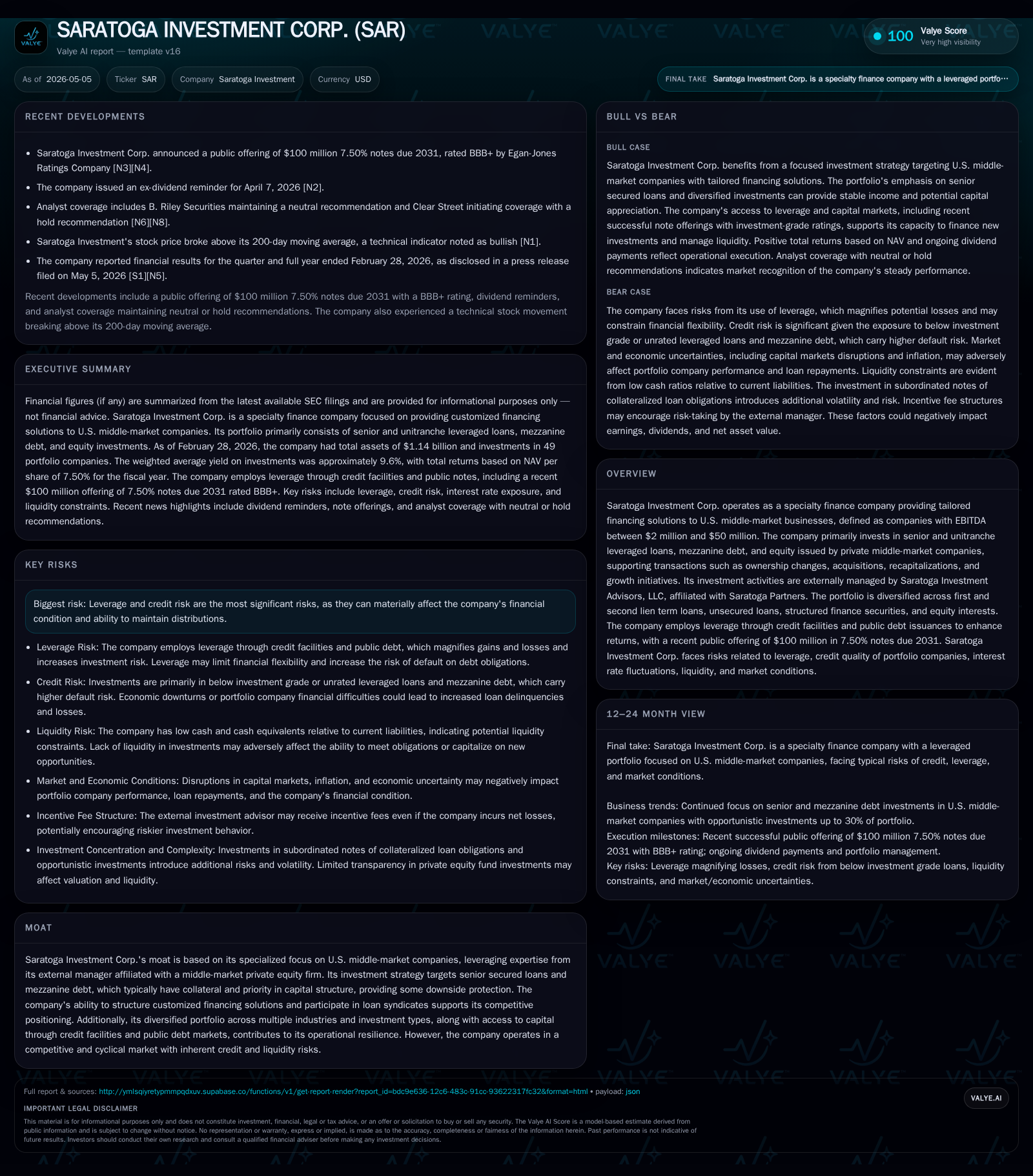
Saratoga Investment Corp.'s May 5, 2026, 8-K and 10-K filings reveal a $1.14 billion asset base invested across 49 portfolio companies within the middle market, predominantly in senior and unitranche leveraged loans. Externally managed by Saratoga Investment Advisors, the firm specializes in tailored financing solutions for private companies with EBITDA between $2 million and $50 million. The firm maintains a diversified loan and equity portfolio, leveraging credit facilities and public debt while navigating credit and leverage risks inherent to below investment grade lending. Key growth drivers include a sustained demand for customized capital structures in ownership transitions and growth projects, supported by recent $100 million note issuance.
Latest Operating Highlights from May 2026 Filing
On May 5, 2026, Saratoga Investment Corp. released its quarterly and full-year financial results via an SEC Form 8-K accompanied by a comprehensive annual report (10-K) also dated May 5. These filings anchor the current operating landscape for Saratoga, detailing a portfolio that includes investments across 49 distinct middle-market companies totaling $1.139 billion in assets as of February 28, 2026 [S3][S1]. The company's investments span primarily leveraged loans – characterized by seniority in capital structure – along with mezzanine debt and some equity positions.
The firm remains externally managed by Saratoga Investment Advisors, LLC, affiliated with a private equity entity specialized in middle-market investing; this relationship provides Saratoga direct access to proprietary deal flow and structuring expertise.
Specialty Finance Model: Business Mechanics and Product Quality
Saratoga operates as a specialty finance company focused specifically on U.S. middle-market businesses generating EBITDA typically between $2 million and $50 million [S1]. Its revenue model derives largely from interest income and fees on senior secured debt instruments - namely senior term loans, unitranche loans combining senior and subordinated tranches into one facility, mezzanine loans - along with gains generated from selective equity stakes.
These credit investments usually underpin transactions involving ownership transitions such as buyouts or recapitalizations, enabling growth initiatives through carefully tailored financing solutions [S1]. Senior leveraged loans occupy a structurally advantaged position in borrower's capital stacks, often secured by liens on company assets that rank ahead of subordinated claims; this collateral hierarchy supports downside protection relative to unsecured creditor positions.
With most loan repayments structured as "interest-only" until maturity coupled with balloon principal payments, Saratoga’s revenues are sensitive to portfolio performance but also reflect stable coupon streams when credit quality holds [S1]. Customized deal structuring differentiates their offer versus traditional banks or broadly syndicated loan markets where flexibility is more constrained.
Competitive Position in the Middle-Market Lending Landscape
Within the crowded specialty finance space serving middle-market companies, Saratoga’s competitive edge lies significantly in its external management arrangement linked to Saratoga Partners private equity platform [S1]. This nexus facilitates deep sector knowledge, superior sourcing capabilities for bespoke lending opportunities, and alignment with sponsor-backed transactions frequently required to fill funding gaps left by larger institutional lenders.
Participation in loan syndicates allows Saratoga to diversify single-name concentration risk while selectively deploying capital into high-conviction credits aligned with its risk tolerance. Its diversified portfolio across industries reduces vulnerability to sector-specific downturns common in middle-market finance.
Nevertheless, the firm confronts structural competition from other BDCs (Business Development Companies), specialty finance firms offering broadly syndicated loans, and alternative credit providers ramping up presence post regulatory easing. Cyclicality inherent to below investment grade credit markets implies fluctuating originations tied closely to economic cycles impacting borrower creditworthiness.
Drivers Fueling Growth in Saratoga’s Portfolio and Market Reach
Growth is underpinned largely by persistent demand within the U.S. middle market for non-bank financing solutions tailored around ownership changes or strategic acquisitions [S3]. As traditional lenders retrench from this niche due partially to capital requirements or risk policies, specialty finance firms like Saratoga capture increasing deal flow.
Saratoga actively leverages its ability to issue public notes evidenced by the recent $100 million offering of fixed-rate 7.50% notes due in 2031 — enhancing capital capacity for opportunistic deployment amid macroeconomic uncertainty. Additionally, investing up to 30% of its portfolio into opportunistic segments such as distressed securities or structured finance vehicles enables incremental return enhancement beyond core loan yields.
Risks and Constraints Around Leverage and Credit Exposure
Leverage is central yet double-edged; while it magnifies returns when portfolio performance is robust, it substantially increases downside risk should defaults rise or valuations deteriorate [S1]. Saratoga operates within defined covenants under two principal credit facilities — Live Oak Credit Facility ($37.5 million drawn) and Valley Credit Facility ($32.5 million drawn) — which impose operating limits including minimum loan quality standards [S5][S6][S8]. Compliance risks can constrain flexibility or trigger accelerated repayments under adverse conditions.
Interest-only payment structures heighten refinancing risks at loan maturities.
The firm's exposure is further complicated by illiquid components such as mezzanine debt or subordinated notes tied to collateralized loan obligation (CLO) vehicles where valuation volatility can impair apparent NAV stability [S1]. External manager incentive structures could incentivize higher risk tolerance than conservative investors might prefer.
Key Milestones and Indicators to Monitor Moving Forward
Investors should monitor subsequent quarters' realized performance metrics – notably default rates within portfolio companies – which directly influence income distributions given reliance on current yield streams [S3][S12].
Distributions sustainability offers insight into cash generation robustness amid evolving economic cycles.
Potential revisions to fee arrangements between SARATOGA INVESTMENT CORP. and Saratoga Investment Advisors could shift incentive alignments impacting risk posture — though no explicit updates are noted currently.[S1]
Financial Profile Overview
As per latest fiscal year data ending February 28, 2026, Saratoga reports positive net income approximating $36.6 million supported by revenue generation through interest income primarily from its loan portfolio [F1]. Cash and equivalents stood around $1.68 million indicating some buffer against near-term obligations while total debt was approximately $838 thousand as of August 31, 2024, resulting in negative net debt of about $842 thousand at that date, reflecting a strong liquidity position [F1].
Total assets comprised just over $1.13 billion distributed over nearly fifty operating borrowers illustrating substantive scale within mid-cap lending markets. Although complete quarterly detail is unavailable for nuanced trending analysis, current annual financials reinforce stability amidst prudent leverage management abiding regulatory requirements inherent to Business Development Companies [F1][S5][S6].
Disclaimer: This analysis uses publicly available information from SEC filings dated May 5, 2026 ([S1], [S3]) combined with companyfacts data as of February 28, 2026 ([F1]) without speculative extrapolations or forecasts. No investment advice or price targets are provided herein. Readers should evaluate all relevant disclosures directly before forming conclusions about SARATOGA INVESTMENT CORP.'s business prospects.
Disclaimer: This is research-only, informational analysis and not investment advice. It may include AI-generated interpretation and general industry context. Always verify important details using primary sources.

Comments