
Huron Consulting Group Advances Integrated Consulting and Digital Solutions
Recent quarterly results highlight Huron's operational stability and financial flexibility underpinning its growth across healthcare, education, and commercial segments.
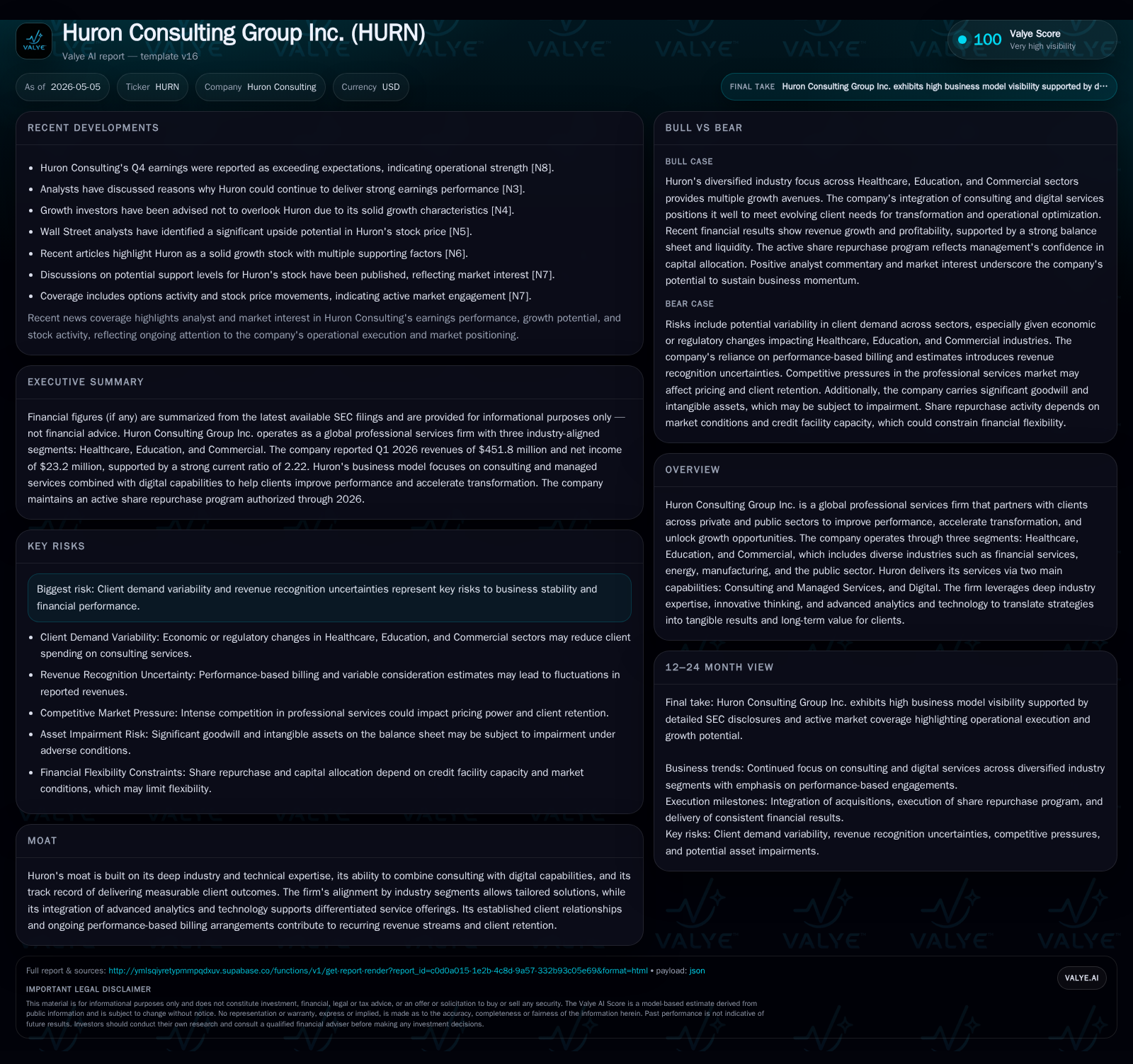
In Q1 2026, Huron Consulting Group reported stable net income and maintained strong covenant compliance amid modest restructuring costs. The company’s business model combines consulting expertise with digital solutions tailored across industry verticals—healthcare, education, and commercial—allowing differentiated client engagements and recurring revenue streams. Recent acquisitions augment its managed services capability and deepen sector specialization, supporting expansion in digitization-driven demand. Risks include variability in client demand and revenue recognition complexities. Monitoring future contract wins and digital adoption rates alongside margin trends will be critical for gauging sustained growth.
Recent Quarter Operational Highlights
Huron Consulting Group's Q1 2026 earnings release and regulatory filings dated May 5, 2026, present a picture of operational steadiness paired with deliberate financial management. Net income for the quarter was $23.2 million—virtually flat compared to prior-year periods—translating to basic EPS of $1.37, steady on a year-over-year basis [S2]. While the period included modest restructuring charges totaling approximately $0.7 million related primarily to severance expenses and office lease modifications, these were largely offset by non-cash gains on lease amendments that enhanced overall expense management.
Liquidity remains robust with $26.5 million in cash & equivalents paired against current liabilities of $232 million, yielding a current ratio of 2.22—a comfortable buffer signaling healthy working capital management [F1][S2]. At March 31, 2026, total debt was $856 million gross, with a consolidated leverage ratio of 3.14 to 1.00 and a consolidated interest coverage ratio of 7.57 to 1.00, both indicating compliance with financial covenants [S2]. Revolver borrowings stood at $471 million as of March 31, 2026, up from $121 million at year-end 2025, reflecting strategic liquidity management to support potential acquisitions or general corporate purposes without impairing covenant compliance [S2].
Business Model and Service Offerings
Huron's revenue model integrates traditional consulting services with managed services contracts enhanced by digital capabilities—organizing its offering across three core industries: Healthcare, Education, and Commercial sectors including financial services, energy, manufacturing, and public sector entities [S1]. This segmentation facilitates tailored engagement models whereby clients pay for both advisory project work and ongoing managed services often linked to performance improvements or transformation milestones.
The firm's key competitive edge arises from combining industry-specific technical expertise with sophisticated analytics platforms enabling real-time insights deployment within client environments—a fusion that converts strategy into actionable outcomes sustaining long-term value creation for customers [S1]. For instance, healthcare clients benefit not only from regulatory compliance advice but also from revenue cycle optimization delivered via recently acquired Eclipse Insights LLC enhancing margin recovery efforts.
Moreover, Huron has increasingly cultivated recurring revenue streams through performance-based billing arrangements that align its incentives with client success metrics—a structural aspect reinforcing client retention while smoothing revenue cyclicality often seen in discretionary consulting budgets [S1].
Competitive Position and Industry Dynamics
Within the professional services landscape dominated by large multi-disciplinary firms such as Deloitte or Accenture on one end and niche consultancies on the other, Huron differentiates itself through sector-focused expertise coupled with scalable digital tools allowing it to serve mid- to large-sized clients seeking deep domain knowledge plus technology-enabled execution.
This positioning compares favorably against peers like CRA International (CRAI) or FTI Consulting (FCN), where recent discussions highlight competitive pressures but also opportunities from earnings beats tied to specialization ([N1],[N2],[N3]). Huron's moat rests heavily on its ability to intertwine consulting acumen with advancing technology such as predictive analytics for healthcare workflows or governance frameworks in education fundraising—capabilities that are hard for more generalist firms to replicate swiftly.
The company’s investment in acquisitions further solidifies its foothold in complex verticals requiring specialized compliance frameworks like financial services advisory through the TVG-Treliant acquisition [S22], creating higher switching costs and underpinning pricing power even amid intensifying competition.
Levers for Growth Across Segments
Healthcare remains a prime growth engine fueled by ongoing transformation imperatives around value-based care reimbursement models requiring both strategic advisory and executed digital transformations. The acquisition of Eclipse Insights enhances footprint in revenue cycle consulting critical to improving provider cash flows amidst regulatory flux [S22].
Education faces secular challenges related to funding constraints that drive demand for efficiency improvements and fundraising strategies supported by recently acquired firms like Halpin Partnership Limited known for governance expertise within higher education foundations—a niche but growing market segment given institutional pressures [S22].
Commercial segment growth is led by increased regulatory complexity in financial services where Treliant Holdings brings advisory plus managed compliance capabilities essential for navigating evolving rules post-financial crises—another example of how targeted acquisitions deepen service breadth to meet escalating client demands [S22].
Across all sectors, digitization acts as a multiplier enabling more comprehensive managed services contracts replacing fee-for-service advisory engagements—a shift enhancing predictability of revenues while boosting lifetime client value through embedded technology solutions [N5]. Cross-selling these capabilities presents further upside potential as clients seek integrated solutions rather than piece-meal consulting projects.
Key Risks and Operational Challenges
Despite the promising setup, Huron faces risks common to the professional services industry including variability in client demand driven by economic cycles affecting discretionary spending on consulting projects. Revenue recognition complexities arise due to multi-element contracts combining consulting deliverables with longer-term managed service fees leading to fluctuations quarter-to-quarter [S1][S2].
Restructuring charges though minor this quarter indicate ongoing cost optimization efforts reflecting incremental challenges managing office footprints post-pandemic yet are not material enough to impair broader operating results [S2]. Pricing pressure persists given competition; however, the firm’s domain specialization mitigates some margin risk while consistent performance-based billing reinforces customer stickiness.
Upcoming Milestones and Market Indicators
Looking ahead, shareholders should monitor Huron’s progress evaluating recently issued ASU accounting standards slated for adoption starting fiscal year-end 2028 relating to hedge accounting (ASU 2025-09) and internal-use software costs (ASU 2025-06), potentially impacting deferred revenue disclosures or software capitalization practices [S14][S2].
Additionally, quarterly earnings releases focusing on contract win rates within digital offerings across segments will provide critical insight into the sustainability of growth trajectories outlined by management during recent event filings [S3][N3]. Early indicators from margin improvement initiatives tied to integration efficiencies following recent acquisitions will also serve as important barometers.
Financial Position and Capital Structure Snapshot
Latest financial snapshot
| Metric | Value | Period |
|---|---|---|
| Cash & equivalents | $26mm | |
| 2026-03-31 | ||
| Total debt | $856mm | |
| 2026-03-31 | ||
| Net debt | $830mm | |
| 2026-03-31 | ||
| Current assets | $515mm | |
| 2026-03-31 | ||
| Current liabilities | $232mm | |
| 2026-03-31 | ||
| Current ratio | 2.22x | |
| 2026-03-31 |
Source: SEC companyfacts cache [F1].
The financial snapshot underscores steady profitability paired with ample liquidity supported by a boosted revolver balance providing capital flexibility for organic investments or bolt-on acquisitions [F1][S2]. It does not constitute investment advice but rather an informed evaluation intended for industry analysts assessing business quality, competitive posture, operational trends, risks, and growth potential.
Disclaimer: This is research-only, informational analysis and not investment advice. It may include AI-generated interpretation and general industry context. Always verify important details using primary sources.

Comments