
Onity Group Restructures Amid Subservicing Shift and Reverse Mortgage Sale
Recent filings reveal significant portfolio realignment with a major client exit and an asset sale impacting Onity’s servicing scale and liquidity.
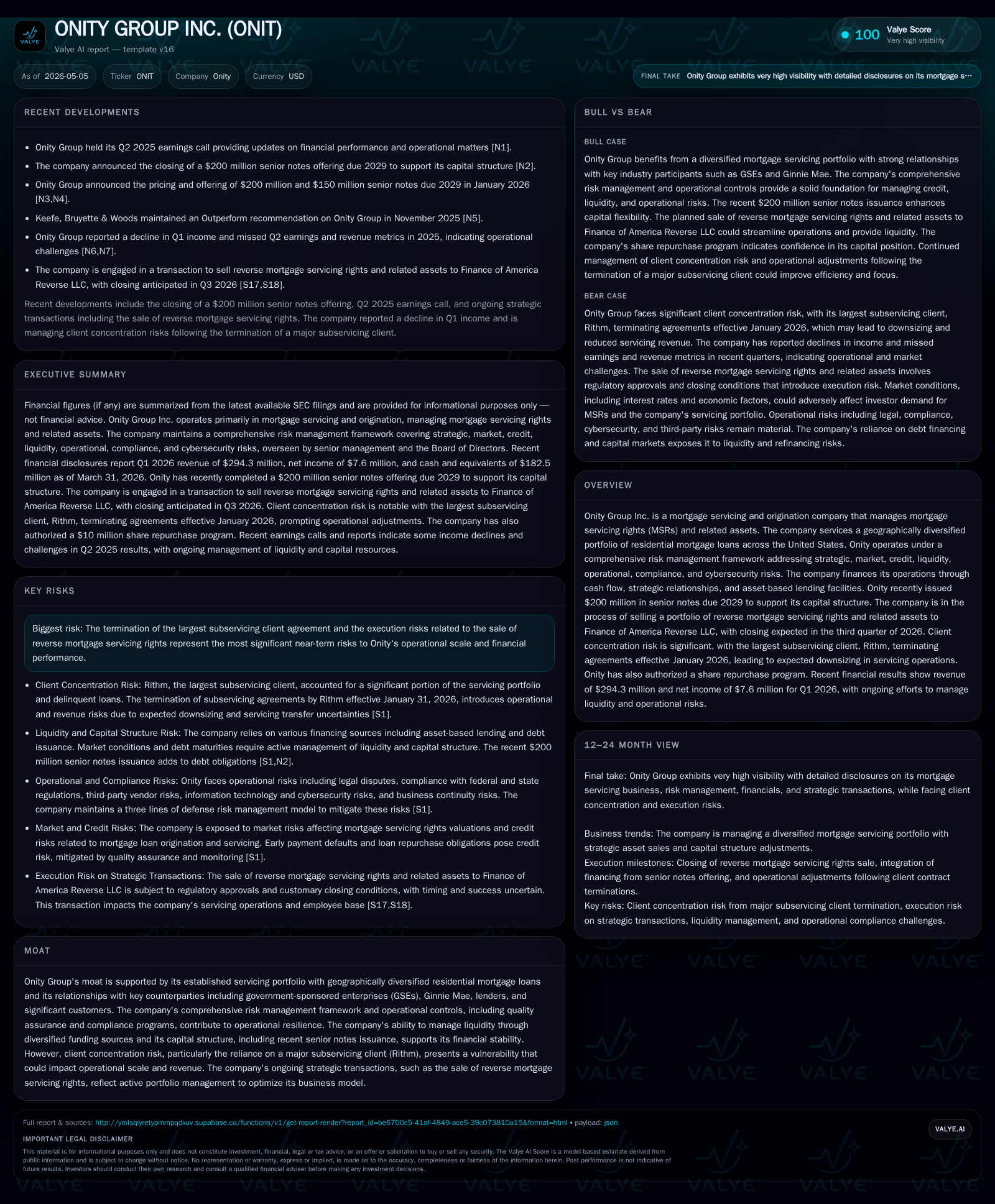
Onity Group Inc.'s latest quarterly 10-Q and simultaneous 8-K filings disclose the termination of a principal subservicing client, Rithm, effective January 31, 2026, which involves the transfer of approximately $8.3 billion unpaid principal balance (UPB) and leads to downsizing operations. Concurrently, the company is selling its reverse mortgage servicing rights portfolio to Finance of America Reverse LLC, aiming for a close in Q3 2026 with net proceeds estimated between $70 million and $80 million. These developments materially reshape Onity’s operational footprint, financial profile, and risk exposure, underscoring the critical need for strategic recalibration amid client concentration risks and regulatory dependencies.
Latest Operating Developments: Client Exit and Asset Disposition
Onity Group’s May 5, 2026 quarterly filing crystallizes a watershed moment for the company’s mortgage servicing business: the termination by Rithm—its largest subservicing client—of agreements effective January 31, 2026 [S2], [S5]. This client had contributed approximately $32.2 billion UPB or around 10% of Onity’s total servicing UPB as of year-end 2025. Moreover, Rithm accounts for nearly half of all delinquent loans under Onity's care [S5]. The transfer of roughly $8.3 billion in UPB involved in this termination marks a pronounced scaling back in Onity’s operational footprint; consequential workforce reductions in related servicing units and corporate support functions are underway or planned as part of this transition.
Simultaneously disclosed is Onity's strategic sale of its reverse mortgage servicing rights portfolio (primarily Home Equity Conversion Mortgages or HECM) to Finance of America Reverse LLC (FAR), anticipated to close in the third quarter of 2026 pending customary regulatory approvals [S3]. Transaction proceeds before costs are estimated between $105 million and $115 million; after transaction costs and repayment adjustments—such as warehouse financings—the net cash inflow is expected to range from $70 million to $80 million [S3]. This monetization reflects a tactical capital recycling move but also reduces recurring fee income streams from these assets.
Together these two developments reshape Onity's near-term revenue base materially: loss of significant UPB serviced via Rithm diminishes fee revenue potential while reverse mortgage portfolio divestiture trims asset holdings but bolsters liquidity.
Business Model Overview: Mortgage Servicing and Asset Management
Onity Group operates principally as a residential mortgage servicer managing a geographically diversified MSR portfolio spanning the United States [S1], [S5]. Its revenues derive primarily from fees earned on servicing both originated mortgages retained on-balance-sheet and loans subserviced for third parties. MSR economics drive revenue based on unpaid principal balance volumes under service adjusted for prepayment speeds and default risks; efficient operational cost controls and compliance adherence enhance margin profiles.
Clients encompass government-sponsored enterprises (GSEs), Ginnie Mae securitizations, lenders, subservicing clients like Rithm before contract terminations, and other counterparties [S1], [S5]. These relationships impose dependency concentrations—but also provide entry barriers through regulatory approvals required for loan acquisition or loan transfers.
Risk oversight pervades all business lines with an enterprise-wide governance framework that covers strategic decisions to market exposure mitigation [S1]. Dedicated executive leadership—including the Chief Risk & Compliance Officer—oversees credit risk tied to early payment defaults from acquired loans sourced from third-party originators who provide indemnifications against defects. Operational resilience is fortified through cybersecurity governance managed at board level via a Risk & Compliance committee structure ensuring adherence to federal standards that mitigate information system vulnerabilities which could otherwise disrupt services [S1].
Funding sources blend operating cash flow with asset-based lending facilities structured around MSR valuations and mortgage warehouse financing [S6]. Recent senior notes issuance totaling $200 million due in 2029 supports Onity’s optimal capital structure alongside existing debt arrangements contributing toward funding liquidity needs [S26], [S28].
Industry Structure: Competitive Dynamics and Regulatory Environment
The mortgage servicing industry within which Onity operates is characterized by intricate interactions among lenders, GSEs (e.g., Fannie Mae and Freddie Mac), Ginnie Mae-insured securities programs, regulators, investors in MSRs, and capital market participants furnishing leverage [S1]. Competitive dynamics are influenced heavily by counterparty relationships since servicing contracts require approvals from trustees or regulators making service transfer processes protracted and uncertain.
Market risk factors including interest rate volatility impact investor appetite for MSRs thereby affecting Onity’s ability to acquire or retain servicing portfolios competitively [S1]. Capacity constraints linked to regulatory compliance cycles also shape business scalability.
Operational moats are partially created by technical proficiency required in managing complex loan modifications or foreclosure workflows plus robust cybersecurity frameworks overseen at executive levels reduce internal disruption risk – an increasing priority given rising financial services cyber threats [S1]. This multi-layered risk framework distinguishes players capable of sustaining long-term service offerings amidst regulatory scrutiny.
Growth Drivers: Portfolio Management and Strategic Transactions
Growth pathways rely substantially on new portfolio acquisitions or originations triggering incremental MSR volume management [S2], [S3]. Retention or replacement of large former clients such as Rithm represents a critical growth lever given the associated ~10% UPB share lost upon contract termination. Efforts to diversify client bases mitigate concentration risks while broadening future revenue sources.
Asset monetization strategies like the reverse mortgage rights sale afford immediate liquidity fueling reinvestment opportunities or debt reduction that could lower financing costs and improve financial flexibility [S3], [S6]. Moreover, hedging capabilities supporting originations pipelines help manage market risk exposures linked with interest rates fluctuations affecting MSR valuations.
Efficient execution of these transactions aligned with competitive pricing enhances margins while strategic capital deployment underpins sustainable expansion prospects.
Risks and Constraints: Client Concentration and Sale Execution
Foremost among risks is client concentration exemplified by Rithm representing approximately one-fifth of loan count serviced plus disproportionately high exposure to delinquent loans—loss of which significantly curtails fee income bases forcing organizational downsizing post-contract exit [S5]. Transfer timing uncertainty due to required consents from trustees creates execution risk possibly delaying expected operational cost savings or requiring interim working capital settlements including float repayments to exiting clients.
The reverse mortgage servicing rights sale also faces customary contingencies such as receipt of regulatory approvals without which transaction timing or completion remain uncertain affecting projected liquidity inflows [S3], [S16]. Market conditions influencing MSR valuation volatility further constrain ability to finance growth initiatives prudently.
Cybersecurity incidents or compliance failures could disrupt services potentially leading to fines or reputational damage despite extensive governance frameworks currently implemented [S1]. Maintaining adequate liquidity buffers is critical for absorbing shocks arising from these various uncertainties.
Forward Look: Monitoring Milestones and Market Signals
Key upcoming milestones include closing the reverse mortgage servicing rights sale anticipated in Q3 2026 following receipt of regulatory approvals [S3]. Monitoring progress on servicing transfer workflows for Rithm accounts throughout first half 2026 will shed light on operational execution effectiveness.
Subsequent quarterly earnings releases will be instructive as they disclose realized impacts on revenue trends from both portfolio contractions due to client exits but also proceeds gains from asset sales along with any margin pressure from restructuring costs or legacy obligations repayments [N3], [N1]. Capital markets feedback regarding debt refinancing conditions plus prevailing MSR pricing are pivotal external indicators informing Onity's near- to medium-term strategic capacity execution capability.
Financial Snapshot: Liquidity, Debt, and Capital Position
Onity closed its first quarter ending March 31, 2026 with cash & equivalents totaling approximately $182.5 million providing sizeable liquidity headroom amid transactional transitions [F1]. The company expects net proceeds of $70 million to $80 million from the reverse mortgage servicing rights sale pending closing in Q3 2026 [S3].
Earlier in 2026, Onity issued $200 million senior notes due 2029, supporting its capital structure and funding flexibility [S26].
It does not constitute investment advice but seeks to illuminate underlying operational shifts affecting Onity’s business model viability, competitive standing, risk profile, growth prospects, and financial health as reflected in publicly available data up to May 5, 2026.
Disclaimer: This is research-only, informational analysis and not investment advice. It may include AI-generated interpretation and general industry context. Always verify important details using primary sources.

Comments