
AMC Robotics Pushes Forward Post-SPAC with Kyro™ Platform Innovation
AMC Robotics focuses on advancing its Kyro™ physical AI robotics platform while managing early-stage commercialization and financial sustainability challenges.
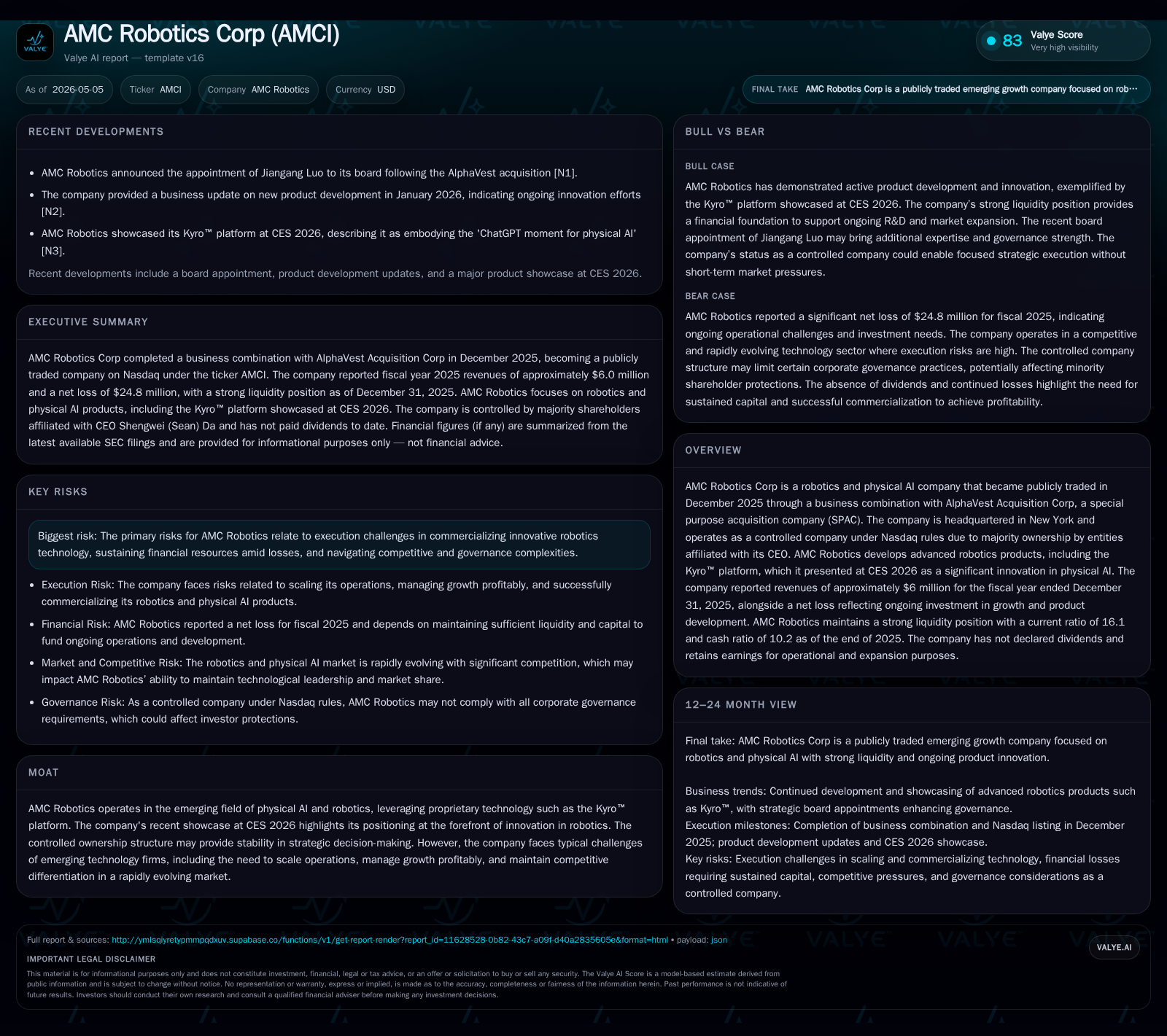
AMC Robotics completed its SPAC merger in December 2025 and has since concentrated on developing and showcasing its Kyro™ platform, a cutting-edge physical AI robotics solution. The company reported revenues near $6 million for FY25 but continues to operate at a significant net loss due to heavy investment in technology and growth. Its controlled ownership structure secures strategic stability, facilitating focused R&D amid a competitive physical AI robotics landscape. Going forward, AMC’s commercial execution, product maturity, and financial discipline will be key growth determinants.
Latest Operating Update Highlights: Quarterly and Event Filing Insights
AMC Robotics filed its latest quarterly report (Form 10-Q) on November 19, 2025 [S2], supplemented by an April 16, 2026 current report (8-K) [S3], which disclosed a delay in its annual report filing for FY25. The filings confirm no material changes to previously disclosed risk factors but emphasize ongoing operational progress following the business combination completion in December 2025 [S1]. This recent period anchors AMC firmly in an early growth phase as it transitions from private development into public markets. The controlled company status—majority owned by entities affiliated with CEO Yong (David) Yan—provides management with decision-making stability advantageous for navigating the complex robotics landscape.
Business Model Foundation: Physical AI Robotics and The Kyro™ Edge
AMC Robotics’ core value proposition lies in developing sophisticated physical AI platforms that merge robotics hardware with advanced software intelligence. The flagship Kyro™ platform showcased at CES 2026 represents a tangible leap in this space [S1]. This integrated platform is designed for industries seeking automation solutions that require physical interaction capabilities beyond conventional robotic applications. Customers value AMC’s offering for innovation-driven efficiencies, such as precision automation tailored to dynamic environments, enabled by proprietary physical AI algorithms.
Revenue generation primarily stems from sales of robotics units incorporating Kyro™, along with potential software licensing or service contracts tied to the platform’s ecosystem. Given the infancy of large-scale physical AI applications, unit economics are currently constrained by upfront R&D costs and relatively modest sales volumes—revenue totaled approximately $6 million for FY25 with operating income negative at -$505K and a net loss of -$24.8 million reflecting continued investment [F1]. Scalable profitability hinges on increasing production volumes, improving manufacturing efficiency, and expanding software functionality that can drive recurring revenue.
Competitive Industry Structure in Robotics and Physical AI
The physical AI robotics industry remains nascent but fast-evolving, featuring a competitive field fragmented among several innovators pushing different technology approaches. Key barriers include high technical complexity integrating real-time sensor data processing with mechanical agility, making entry costly and risky. AMC’s proprietary Kyro™ platform provides some differentiation rooted in unique intellectual property and early mover advantage demonstrated through notable showcase events like CES.
Competition spans established industrial robotics firms extending into AI integrations as well as pure-play startups focusing exclusively on physical AI solutions. Pricing power is modest given market immaturity but could improve as product maturity advances and specialized use cases proliferate. Regulatory factors mainly pertain to safety certifications applicable across verticals rather than direct hurdles to innovation.
Controlled ownership concentrates voting power, enabling swift strategic shifts unlike more dispersed governance seen in peers; however, it presents oversight risks common to closely held firms.
Growth Drivers: Scaling Technology Adoption and Market Penetration
Growth prospects for AMC Robotics are rooted in the maturation of its Kyro™ platform and broader adoption rhythms within automation sectors requiring physical AI capabilities. Demonstrated at CES 2026 [S1], this public unveiling signals readiness to deepen commercial engagement. Key drivers include:
- Expanding customer order pipeline leveraging proven automation efficiencies.
- Strategic partnerships possibly hinted at through planned hiring moves such as board addition of Jiangang Luo [N1] enhancing governance depth.
- Incremental production scale improvements lowering per-unit costs.
- Software ecosystem enhancements allowing tiered service offerings beyond hardware sales.
These factors collectively support measurable KPIs like backlog growth, unit deployment increases, and improved demand visibility outlined in periodic disclosures.
Risks and Constraints: Commercialization, Financial Sustainability, Governance
AMC faces classic emerging tech commercialization risks including integration challenges between hardware precision and adaptive software controls vital for reliable operation. Failure to achieve robust product-market fit could impair scalability efforts. Financially, the company navigates ongoing net losses (-$24.8M FY25) even as liquidity remains strong (current ratio ~16) [F1]. Efficient capital deployment balancing aggressive innovation investments against sustainability is critical.
Governance risks arise from the controlled company structure where CEO-affiliated ownership dominates — providing leadership continuity but potentially delaying broader shareholder influence or creating conflicts if not managed transparently [S2]. Execution discipline under these conditions will dictate trustworthiness among institutional investors.
Strategic Milestones to Watch for in AMC’s Next Phases
Monitoring near-term developments includes:
- Resolution of pending Annual Report filing delays communicated in April 2026 [S3], reinstating regular transparency cadence.
- Follow-on product enhancements or new platform iterations extending Kyro’s applicability.
- Further board strengthening following the addition of Jiangang Luo in April 2026 [N1], indicating professionalization of governance structures.
- Observable traction from pilot programs or client testimonials validating product performance under operational conditions.
- Nasdaq listing compliance updates maintaining market visibility.
These checkpoints will shed light on operational momentum and investor confidence evolution.
Financial Snapshot: Liquidity, Leverage, and Investment Profile
Latest financial snapshot
| Metric | Value | Period |
|---|---|---|
| Cash & equivalents | $7mm | |
| 2025-12-31 | ||
| Current assets | $11mm | |
| 2025-12-31 | ||
| Current liabilities | $686821 | |
| 2025-12-31 | ||
| Current ratio | 16.1x | |
| 2025-12-31 |
Source: SEC companyfacts cache [F1].
As of December 31, 2025 (latest available data), AMC reported:
- Revenue: $5.98 million;
- Operating Income: -$505 thousand;
- Net Income: -$24.8 million;
- Cash & Equivalents: $7.0 million;
- Current Assets: $11.06 million versus Current Liabilities: $687 thousand (Current Ratio ~16.1);
- Total Debt (as of Dec 2024): ~$822 thousand yielding an approximate net cash position near $6.18 million [F1].
| Metric | Value | Period End |
|---|---|---|
| Revenue | $5,980,847 | |
| 2025-12-31 | ||
| Operating Income | -$505,166 | |
| 2025-12-31 | ||
| Net Income | -$24,817,342 | |
| 2025-12-31 | ||
| Cash & Equivalents | $7,004,601 | |
| 2025-12-31 | ||
| Current Ratio | 16.1 | |
| 2025-12-31 |
This analysis synthesizes publicly filed regulatory disclosures alongside known industry context to provide a grounded view of AMC Robotics’ current positioning and forward trajectory without speculative extrapolation.
Disclaimer: This document is for informational purposes only and does not constitute investment advice or recommendations.
Disclaimer: This is research-only, informational analysis and not investment advice. It may include AI-generated interpretation and general industry context. Always verify important details using primary sources.

Comments