
Solventum Corporation Advances Material Science and Digital Health Amid Operational Realignment
Solventum's latest quarterly report highlights ongoing operational integration post-3M spin-off alongside solid momentum in its diverse healthcare segments.
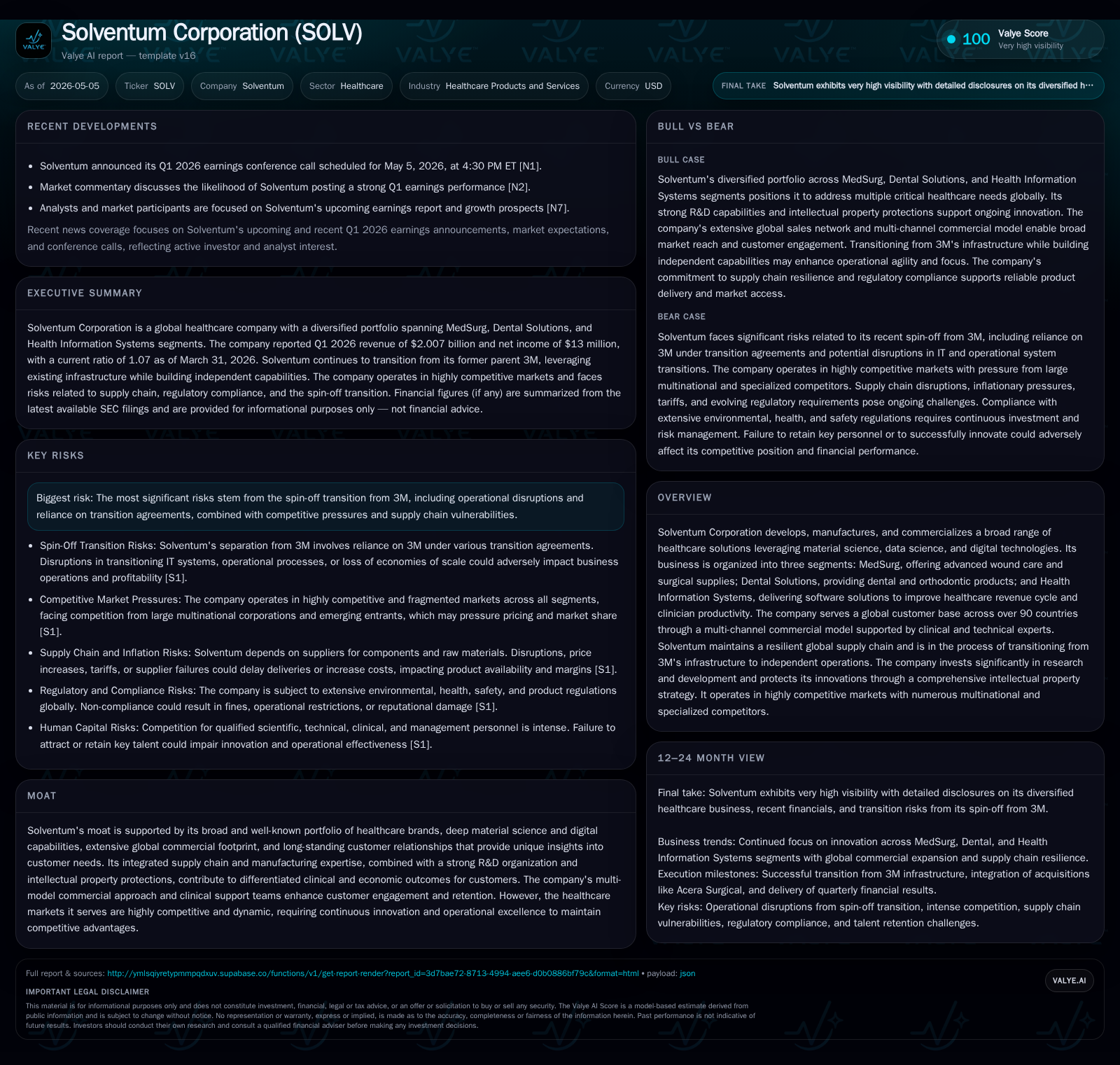
Solventum’s Q1 2026 filing reveals continuing challenges and progress in disentangling from 3M’s infrastructure, with operational costs and supply chain complexity elevated but manageable. The firm’s diversified healthcare portfolio, spanning MedSurg, Dental Solutions, and Health Information Systems, benefits from deep material science and digital innovation driving clinical value. Competitive pressures and regulatory compliance risks persist, yet growth catalysts include scaling software solutions and emerging market expansion. Liquidity remains adequate despite leverage reflecting spin-off refinancing.
Latest Quarterly Operating Highlights and Transition Update
Solventum’s Q1 2026 10-Q filing dated May 5 confirms an operational landscape marked by ongoing transition away from legacy 3M infrastructure following the spin-off [S2]. While this shift has introduced increased operating costs and complexity, management reports no material change to existing risk profiles or emergent issues affecting near-term operations [S2]. Concurrent 8-K disclosures reiterate stable execution of the separation plan alongside the release of first-quarter financial results [S3]. The company continues to adapt core corporate functions—such as IT, finance, and supply chain logistics—from outsourced arrangements under 3M to self-sufficient stand-alone operations, a process presenting inevitable integration friction.
No disruption significant enough to impair customer fulfillment or channel performance was highlighted, though transitional expenses contribute to margin pressure partially offset by stable revenue trends in healthcare solutions [N1]. The cadence of controlled restructuring efforts suggests a measured approach balancing continuity with independent capability building. Transition agreements with 3M remain critical near-term arrangements supporting service continuity during this period.
Business Model Overview: Integrated Healthcare Solutions Portfolio
Solventum operates a three-segment business aligned with downstream healthcare needs leveraging advanced materials science combined with data-driven digital technologies [S1; S24].
MedSurg (57.9% of total sales) chiefly addresses acute care settings by delivering advanced wound care products like negative pressure therapy systems, surgical supplies (e.g., medical tapes, bandages), and infection prevention technologies. Its OEM medical devices underpin differentiated product offerings designed to shorten healing timelines while lowering total cost of care through clinical effectiveness.
Dental Solutions (16.2% of total sales) provides a broad range of orthodontic brackets, aligners, restorative cements, and bonding agents supporting the complete dental lifecycle—from preventive interventions to complex restorative procedures. This segment exploits long-established brand strength within dentists’ practices globally.
Health Information Systems (16.3% of total sales) delivers software platforms focusing on physician documentation automation, direct-to-bill coding optimization, speech recognition, classification algorithms, and visualization tools targeting clinical efficiency gains and revenue cycle waste reduction. These digital solutions respond to escalating administrative burdens in healthcare delivery improving payment accuracy while enabling more time for patient care.
Commercially, Solventum employs a multi-channel model combining direct salesforces for large hospital accounts with distribution partnerships supporting smaller practices across over 90 countries [S24]. Clinical and technical specialists embedded within sales teams act as trusted advisors creating switching costs through specialized knowledge transfer and service quality.
Competitive Landscape and Industry Dynamics
The firm competes in highly fragmented global healthcare markets characterized by constant innovation cycles, regulatory scrutiny, and competitive intensity spanning multinational conglomerates to agile tech upstarts [S1; S4].
Key moat elements include its extensive IP portfolio encompassing both patented material formulations and proprietary software algorithms backed by consistent R&D spending. However, Solventum’s global supply chain — increasingly decentralized post-3M — confronts typical industry risks such as raw material availability fluctuations amid geopolitical tensions. Yet the hub-and-spoke distribution model enhances logistical resilience despite the elevated complexity induced by spin-off reshaping.
Regulatory environs emphasize FDA oversight on medical devices combined with expanding PFAS-related environmental compliance demands; while legacy indemnities straddle through end-2025 with 3M covering pre-spin liabilities connected to PFAS-containing products sold until then [S4]. Competition in digital health extends beyond traditional medtech companies into AI-enabled startups aggressively capturing clinical documentation markets—pressuring pricing power especially within Health Information Systems.
Key Growth Drivers Across Segments
Growth avenues are multi-faceted:
- Continued R&D investment supports product life-cycle innovations—approximately 2,000 scientists, engineers, and digital experts fuel advancements in biomaterials and next-generation health IT solutions [S1].
- Expansion of Health Information Systems aligns with broader healthcare administrative digitization trends emphasizing revenue cycle management efficiency enhancement and clinician burnout mitigation via automation.
- Emerging markets penetration leverages export commercial models supported by regional partners facilitating regulatory navigation and local distribution network formation [S24].
- M&A remains an articulated strategic option to augment capabilities or portfolio breadth though no announced transactions emerged from recent filings [N7].
Cross-segment synergies exist especially where integrated data intelligence informs both hardware product design improvements and software analytics enhancements—positioning Solventum uniquely compared against peers strictly grounded in one domain.
Risks and Constraints Post-Spin-Off
Spin-off related operational risk dominates near-term considerations including potential service disruptions as independent corporate functions mature outside the erstwhile parent company infrastructure [S1]. Costs for replicating functions once shared are higher than legacy allocations reflected previously under 3M’s umbrella. Furthermore:
- High leverage remains a constraining factor; net debt approximates $4.5 billion against cash reserves of $561 million at quarter-end translating into a tight current ratio at 1.07 [F1], [S2]. This capital structure limits financial flexibility particularly against adverse market conditions or unexpected expenditure spikes.
- Regulatory exposure includes PFAS-related litigation risks beyond indemnity expiry possibly triggering contingent liabilities across certain product lines still containing such substances despite efforts toward substitutes [S4], [S5].
- Competitive pressure intensifies particularly from new entrants leveraging AI technology potentially disrupting Health Information Systems segment margins [S22].
- Execution risk accompanies restructuring initiatives including workforce reorganizations could lead to short-term inefficiencies or loss of institutional knowledge harming operational consistency [S11].
Near-Term Catalysts and Milestones to Watch
Looking ahead, key indicators investors should monitor include:
- Subsequent quarterly earnings reports will offer crucial visibility into progression on integration metrics such as cost reductions attributable to severed ties from 3M support functions.
- New product launches within MedSurg addressing unmet clinical needs or improved cost-effectiveness could signal sustained innovation payoffs.
- Uptake rates for Health Information Systems’ digital modules amid accelerating healthcare provider adoption of automated coding/billing platforms represent important demand markers.
- Any announcements regarding acquisitions or divestitures would reveal strategic directional shifts particularly regarding portfolio rationalization or expansion ambitions [N7], [N1].
Close attention should be paid to any updates on regulatory compliance outcomes especially surrounding PFAS governance after the indemnity period ends.
Latest Financial Snapshot
Latest financial snapshot
| Metric | Value | Period |
|---|---|---|
| Cash & equivalents | $561mm | |
| 2026-03-31 | ||
| Total debt | $5.1bn | |
| 2026-03-31 | ||
| Net debt | $4.5bn | |
| 2026-03-31 | ||
| Current assets | $3.6bn | |
| 2026-03-31 | ||
| Current liabilities | $3.3bn | |
| 2026-03-31 | ||
| Current ratio | 1.07x | |
| 2026-03-31 |
Source: SEC companyfacts cache [F1].
This snapshot underscores Solventum’s capital intensity stemming largely from spin-off financing arrangements coupled with divestment proceeds utilized initially for debt repayment but leaving meaningful leverage outstanding [F1]. Liquidity metrics point to adequate but closely managed working capital sufficiency at present requiring vigilance given macroeconomic uncertainties affecting capital markets access.
This analysis is based solely on publicly available SEC filings dated up to May 5th, 2026 ([S1],[S2],[S3],[F1]) supplemented by relevant news articles ([N1],[N7]). It does not incorporate non-public information nor provide investment advice. Users should consult further sources for comprehensive decision-making.
Disclaimer: This is research-only, informational analysis and not investment advice. It may include AI-generated interpretation and general industry context. Always verify important details using primary sources.

Comments