
KalVista Pharmaceuticals Locks in Chiesi Merger Amid EKTERLY Expansion
KalVista’s April 2026 merger agreement with Chiesi reshapes ownership amid advancing EKTERLY sales and clinical development in hereditary angioedema treatments.
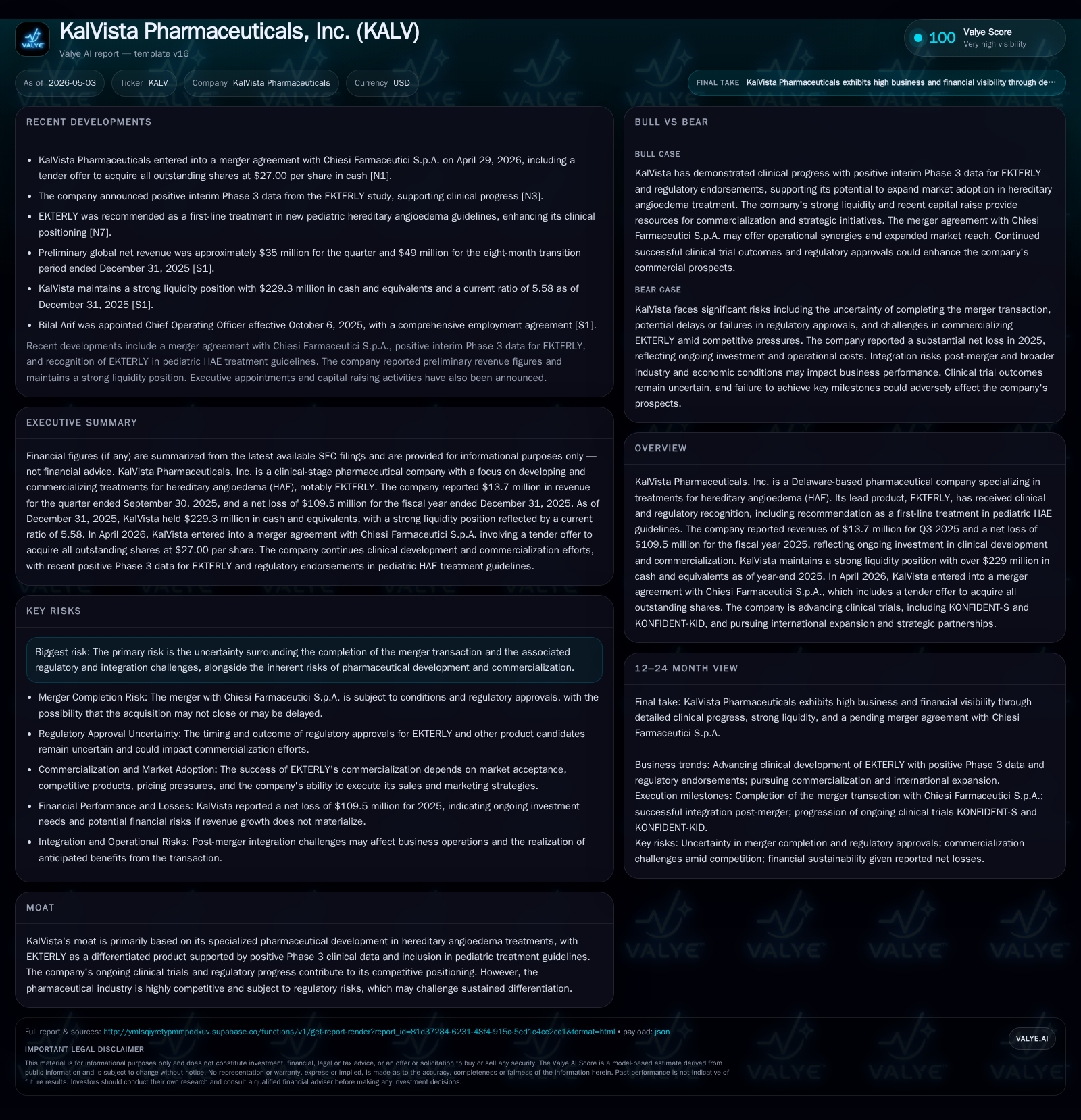
KalVista Pharmaceuticals recently entered a definitive merger agreement with Chiesi Farmaceutici S.p.A. that includes a $27 cash per share tender offer, underscored by a significant $66.4 million termination fee. This deal marks a pivotal strategic shift against the backdrop of EKTERLY’s emerging commercial footprint as a pediatric first-line therapy for hereditary angioedema (HAE), supported by positive Phase 3 data. While the merger promises expanded resources and international reach, it introduces regulatory and integration uncertainties. KalVista’s focused pipeline and orphan disease niche underpin its market differentiation, but execution risks and competitive pressures prevail.
Merger Agreement Anchors Near-Term Strategic Outlook
On April 29, 2026, KalVista Pharmaceuticals entered into a material definitive agreement to be acquired by Italy-based Chiesi Farmaceutici S.p.A., marking a significant inflection point for the company [S3]. The transaction specifies a tender offer priced at $27.00 per share in cash for all outstanding common stock excluding certain excluded or dissenting shares. Key features include customary termination provisions whereby either party can terminate under specified conditions—with KalVista obligated to pay a substantial termination fee of $66.4 million if it opts to pursue an alternative superior proposal [S3].
This strategic move reflects underlying financial and operational realities: KalVista’s expansive investment in R&D and commercialization efforts around EKTERLY necessitates deeper capital infusion and international reach. The deal could accelerate scale benefits through Chiesi’s established global footprint, particularly across Europe where orphan drug penetration requires nuanced market access strategies. However, successful closure hinges on satisfying regulatory approvals and tender acceptance thresholds which introduce typical deal execution risks.
The merger alters control dynamics but preserves KalVista's operations pending consummation, requiring continued focus on commercial momentum and pipeline advancement during integration uncertainties.
EKTERLY and Clinical Pipeline: Franchise Fundamentals
KalVista’s flagship product EKTERLY has carved a distinctive niche within the hereditary angioedema (HAE) treatment landscape. Recognized as a recommended first-line option in pediatric HAE guidelines owing to positive Phase 3 data, EKTERLY targets a critical underserved segment. Early traction is evidenced by reported revenues reaching $13.7 million in Q3 2025 and preliminary net revenue projections of around $49 million for the eight-month period ending December 2025 indicating growing adoption [S2][S6].
Clinical progression underpins this momentum; interim data releases from ongoing KONFIDENT-S and KONFIDENT-KID Phase 3 studies demonstrate favorable safety and efficacy signals supportive of broadening indications or expanded label claims targeting younger age cohorts [N3]. These trials not only validate EKTERLY's therapeutic profile but also enhance its payer acceptance given the emphasis on controlled evidence in orphan pediatric markets.
Further regulatory ambitions center on securing approvals for sebetralstat administration beyond the U.S., aiming to capitalize on international markets where unmet need remains significant [S18]. This multi-pronged clinical-commercial approach represents the backbone of KalVista’s franchise value proposition.
Business Model Nuances and Product Differentiation
KalVista generates revenue predominantly through direct sales of EKTERLY to healthcare providers managing HAE patients—a rare genetic disorder characterized by episodic swelling episodes requiring specialized intervention. As an orphan drug with pediatric endorsement, pricing power benefits from limited competition within this specialized segment alongside favorable reimbursement mechanisms designed for rare diseases.
The company’s business model involves navigating complex payer negotiations where treatment adherence, patient retention on chronic use regimens, and physician prescribing preferences drive sustained revenue streams. Orphan drug exclusivity provides temporal margins insulation although lifecycle management depends heavily on successful clinical data outputs to justify premium pricing tiers.
Switching costs are meaningful given the gravity of HAE episodes; patients and prescribers prioritize therapies with established efficacy-safety profiles like EKTERLY. Ongoing efforts to accelerate geographic expansion broaden volume potential via regulatory filings internationally while tactical partnerships complement distribution capabilities outside core markets.
Competitive Environment and Regulatory Dynamics
Healthcare providers’ options in HAE treatment encompass established agents developed by major pharmaceutical incumbents involving prophylactic monoclonal antibodies or plasma kallikrein inhibitors. Despite this crowded field, EKTERLY distinguishes itself through pediatric guideline inclusion supported by clinical data that address particular safety concerns in younger populations.
Nonetheless, competition is intense with pressure points arising from payor cost-containment initiatives applying scrutiny to pricing structures across orphan drugs. Regulatory pathways add complexity—requirements differ materially across U.S., European Union, and other jurisdictions affecting launch timelines and potential label breadth. Biosimilar threats remain remote currently but highlight the importance of post-approval life cycle management.
KalVista’s ability to maintain differentiation relies on timely regulatory clearances for international indications coupled with sustained clinical evidence generation reinforcing EKTERLY’s positioning against newer entrants or alternative modalities.
Growth Catalysts and Opportunities for Market Penetration
Key growth drivers revolve around achieving positive outcomes from Phase 3 KONFIDENT programs which are designed to substantially expand the approved population segments for EKTERLY—including potentially younger pediatrics or related indications [N3][S3]. Success here would underpin new revenue bookings from label extensions enhancing lifetime patient pool size.
International expansion represents another major catalyst as KalVista pursues registrations beyond U.S. borders leveraging Chiesi’s regional expertise post-merger for accelerated market entry. Strategic partnerships formed pre- or post-acquisition aim to facilitate localized commercialization capabilities crucial for orphan specialty products where stakeholder relationships dictate uptake velocity.
Commercial scaling is also tied to leveraging pediatric guideline endorsements that influence prescribing patterns globally—this drives physician adoption beyond existing HAE centers of excellence towards broader specialist networks engaged in rare disease management.
Risks Associated With Transaction, Regulation, and Development
Despite strategic promise, notable risks persist. The merger carries standard execution uncertainty dependent on regulatory gymnastics including antitrust clearances and shareholder tender dynamics; failure could disrupt continuity plans or delay capital inflows required for ongoing development [S3].
Pipeline risk remains inherent with any late-stage biopharmaceutical asset—clinical trial delays or negative readouts from KONFIDENT-S/KID programs could materially impair growth prospects by constricting label scope or dampening prescriber confidence.
Commercial front challenges include potential pricing pressures amid evolving insurance reimbursement landscapes targeting specialty pharmaceuticals plus the risk of unforeseen adverse safety events impacting EKTERLY utilization rates.
Finally, KalVista’s net losses underscore capital intensity; balancing cash burn against sustainable revenue ramps frames managerial decision-making particularly during transition phases surrounding mergers.
Upcoming Catalysts and Monitoring Points
Investors should prioritize monitorable events including:
- Progression of tender offer timelines capped at approximately 20 business days post-April 29 commencement per merger terms,
- Interim and final readouts expected from KONFIDENT-S and KONFIDENT-KID trials within the calendar year,
- Updates on international regulatory submissions particularly within EU jurisdictions,
- Quarterly sales trends reporting reflecting EKTERLY uptake velocity amidst ongoing commercialization efforts,
- Potential announcements regarding strategic collaborations or expansions facilitated by merged entity synergies.
These forthcoming developments collectively will chart KalVista’s trajectory through an inflection-rich period balancing integration with continued organic growth attempts.
Current Financial Position — A Supporting Context
Latest financial snapshot
| Metric | Value | Period |
|---|---|---|
| Cash & equivalents | $229mm | |
| 2025-12-31 | ||
| Total debt | $172mm | |
| 2025-12-31 | ||
| Net debt | $-57mm | |
| 2025-12-31 | ||
| Current assets | $320mm | |
| 2025-12-31 | ||
| Current liabilities | $57mm | |
| 2025-12-31 | ||
| Current ratio | 5.58x | |
| 2025-12-31 |
Source: SEC companyfacts cache [F1].
As of December 31, 2025, KalVista held cash & equivalents totaling approximately $229 million against total debt near $172 million yielding a net cash position near $57 million supported by robust current assets totaling $320 million versus $57 million current liabilities—manifested in a strong current ratio of about 5.58 evidencing ample short-term liquidity to fund near-term activities [F1].
Notwithstanding revenues still concentrated at under $14 million quarterly scale earlier in fiscal year quarters reflecting early commercialization stages, net losses exceeding $109 million indicate substantive ongoing investment especially into clinical development programs that underpin long-term growth aspirations [F1].
This financial footing rationalizes the merger-driven capital injection imperative while providing operational runway during transaction execution uncertainties.
This analysis incorporates forward-looking elements based on public filings including KalVista Pharmaceuticals’ recent SEC disclosures along with sector knowledge reflecting typical biopharma industry dynamics. It does not constitute investment advice.
Disclaimer: This is research-only, informational analysis and not investment advice. It may include AI-generated interpretation and general industry context. Always verify important details using primary sources.

Comments