
CERo Therapeutics Secures New Financing to Extend Clinical Development of Lead Immunotherapy
CERo Therapeutics raises convertible notes to address liquidity constraints and sustain Phase 1/2 AML immunotherapy trials.
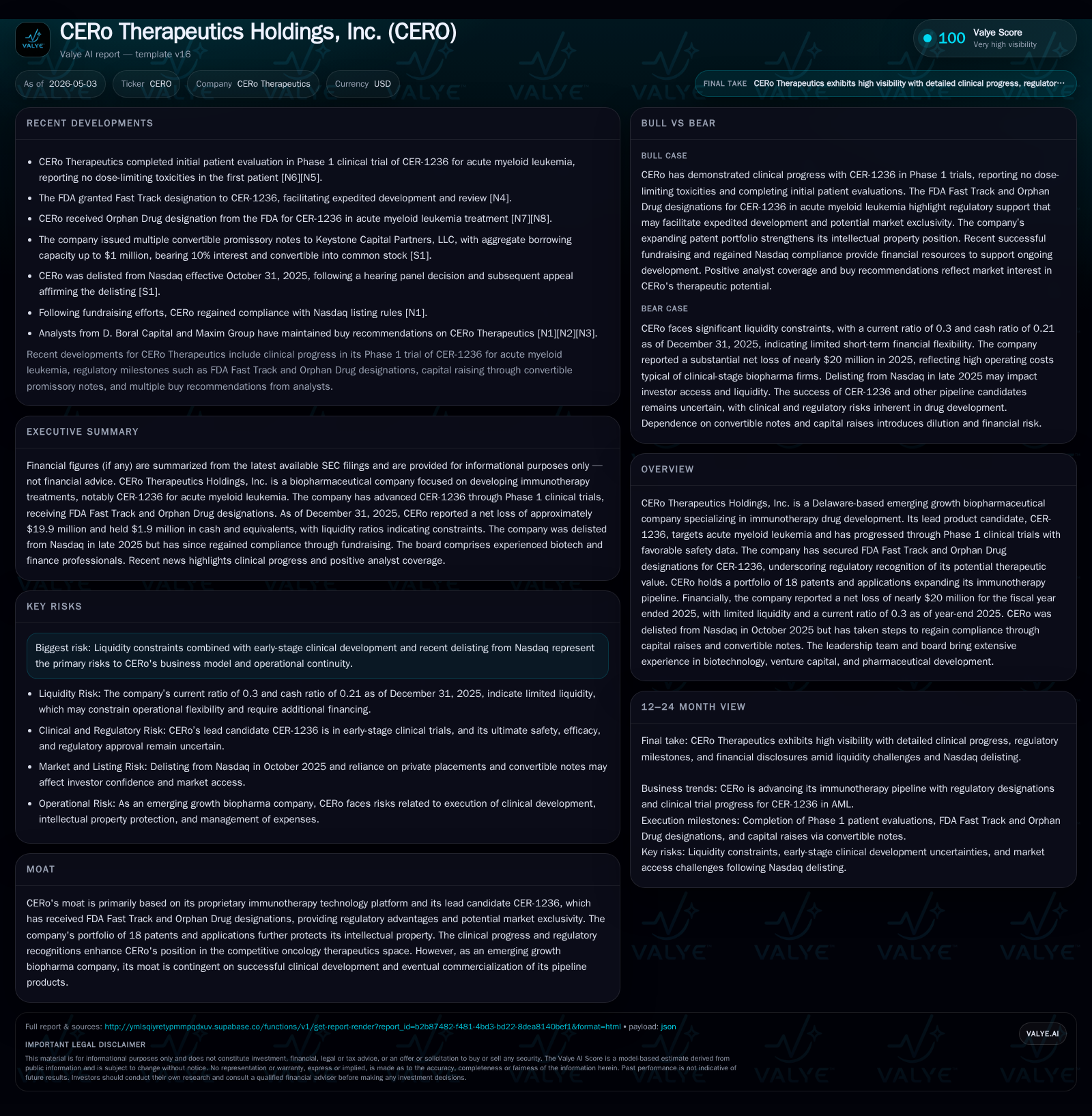
CERo Therapeutics recently issued convertible promissory notes under a private placement exemption, securing incremental funding to extend the clinical development of its lead candidate CER-1236, an immunotherapy targeting acute myeloid leukemia (AML). Despite the new financing, the company faces sharp liquidity pressures highlighted by a current ratio around 0.3 and continuing losses. Its competitive position benefits from FDA Fast Track and Orphan Drug designations alongside a portfolio of proprietary patents protecting its immunotherapy platform. Near-term growth drivers center on clinical trial progress and regulatory milestones, though successful execution remains uncertain amid financial constraints.
Latest Capital Raise and What It Means Now
On April 27, 2026, CERo Therapeutics announced the issuance of a convertible promissory note with an initial purchase price of $400,000 and principal face value of $500,000 to Keystone Capital Partners LLC. This note is one in a series allowing borrowing up to $1 million aggregate principal amount. The note carries a 10% annual interest rate with maturity on April 27, 2027, convertible into common stock at a discounted conversion price capped by beneficial ownership limits. The company relies on Section 4(a)(2) exemption from Securities Act registration for this private transaction without general solicitation or public offering [S3], [S19].
This financing move is critical given CERo's liquidity challenges. Newly issued convertible promissory notes provide incremental but finite funding extending operational runway into mid-2027 but highlight pressing need for either successful clinical progress attracting additional investment or strategic transactions bolstering cash reserves going forward [S3]. The private placement funding extends runway enabling continuation of clinical development activities for CER-1236 amid ongoing operational losses and the company's previous Nasdaq delisting in October 2025 due to continued listing rule noncompliance issues [F1], [S20]. The structured use of convertible debt reflects constrained access to traditional equity markets.
Company Business Model and Core Product Highlights
CERo operates as an emerging growth biopharmaceutical enterprise focused on immunotherapy drug development specifically targeting hematologic cancers. Its primary asset is CER-1236 for acute myeloid leukemia treatment currently progressing through early-phase clinical trials with encouraging safety profiles reported from Phase 1 studies. The drug benefits from FDA Fast Track status alongside Orphan Drug designations which provide regulatory advantages such as expedited review paths and potential market exclusivities upon approval.
Revenue realization remains aspirational pending successful late-stage trials followed by commercialization efforts. Intellectual property protection is substantial through its portfolio comprising eighteen patents and pending applications that cover various facets of its immunotherapeutic technology platform enhancing its competitive moat if commercialized effectively [S1].
Competitive Positioning in AML Immunotherapy
The AML treatment space is highly competitive with several established therapies including chemotherapies, targeted agents, and alternative immunotherapies already approved or in development. Within this ecosystem, CERo's value proposition rests substantially on its innovative mechanism evidenced through proprietary technology protected by patents granting possible strategic exclusivity.
FDA Fast Track and Orphan status confer both expedited regulatory review opportunities and potential seven-year exclusivity upon approval under U.S. orphan drug provisions—critical differentiators that can mitigate competitive pressures temporarily post-launch.
However, pricing power remains uncertain at this stage due to unproven efficacy beyond early trials and strong incumbent therapies providing entrenched alternatives. Adoption dynamics will crucially depend on demonstrating improved outcomes or safety signals compelling enough for clinicians to switch treatment paradigms in an oncology field marked by cautious uptake barring robust clinical evidence [S1].
Pipeline Progress and Regulatory Milestones
CER-1236 completed Phase 1 clinical evaluation with reported favorable safety data including extended platelet transfusion-free intervals observed in select patients with myelodysplastic syndrome overlapping AML phenotypes—highlighting tolerability essential for further dose escalation or combination study considerations.
The FDA recognitions — Fast Track (intended for serious conditions addressing unmet medical needs) and Orphan Drug status (for rare diseases) — accelerate regulatory timelines reducing development uncertainty somewhat but do not eliminate pivotal risks intrinsic to early-stage biologics.
Notably absent thus far are Phase 2 efficacy readouts which will significantly influence the program's valuation trajectory as they test preliminary therapeutic benefit within larger patient cohorts. These next clinical steps represent crucial inflection points for CERo’s pipeline value uplift or attrition risk realization.
Growth Drivers Anchored in Clinical and Regulatory Catalysts
Key growth hinges on multiple axes: successful commencement and positive interim results in Phase 2 studies that validate initial safety signals while demonstrating efficacy; additional FDA feedback potentially expanding accelerated pathways; strategic patent filings broadening protective moats around core technology; securing further capital infusions enabling scale-out of pipeline efforts; and exploration of licensing or partnership deals providing non-dilutive funding plus commercialization expertise.
The dependency on milestone-driven financings via convertible debt adds refinancing risks compounded by potentially volatile share price dynamics impacting conversion economics.
Clinically, the inherent unpredictability of translating early phase safety success into demonstrable efficacy constitutes significant development risk endemic across emerging biopharmaceutical firms—tempering optimism despite regulatory designations aimed at expediting market entry.
Additionally, delisting from Nasdaq stock market restricts public liquidity avenues complicating broader investor access potentially limiting capital raising options outside private placements.
Upcoming Milestones and What Investors Should Monitor Next
Crucial near-term indicators include:
- Progression updates regarding Phase 2 trial recruitment timelines for CER-1236.
- Interim safety/efficacy data releases which could serve as critical inflection points for program validation.
- FDA interactions reflecting regulatory positioning or new designation acknowledgments that could impact approval strategy.
- Updates on capital deployment efficiency following recent note issuances gauging how extended runway advances pipeline progression.
- Any announcements concerning Nasdaq listing reinstatement prospects or strategic partnering/licensing deals enhancing financial stability.
Ongoing transparency from management vis-à-vis these developments will be paramount for stakeholders tracking clinical stage biotech companies balancing high innovation potential against pronounced operational execution risks.
Current Financial Position and Balance Sheet Overview
Latest financial snapshot
| Metric | Value | Period |
|---|---|---|
| Cash & Equivalents | $1.9M | |
| 2025-09-30 | ||
| Total Debt | $1.395M | |
| 2023-09-30 |
Source: SEC companyfacts cache [F1], latest event filing [S3].
Newly issued convertible promissory notes provide incremental but finite funding extending operational runway into mid-2027 but highlight pressing need for either successful clinical progress attracting additional investment or strategic transactions bolstering cash reserves going forward [S3].
This analysis strictly reflects facts drawn directly from SEC filings including recent Form 8-Ks dated May 1st (latest event filing) along with amended annual reports through April end plus data compiled via company facts snapshots consistent with specified policy constraints without speculative inference beyond disclosed information.
Disclaimer: This is research-only, informational analysis and not investment advice. It may include AI-generated interpretation and general industry context. Always verify important details using primary sources.

Comments