
Enterprise Financial Services Boosts Market Reach Through Strategic Branch Expansion and Diverse Lending
EFSC’s recent branch acquisitions and loan portfolio adjustments underpin its enhanced competitive positioning and growth prospects.
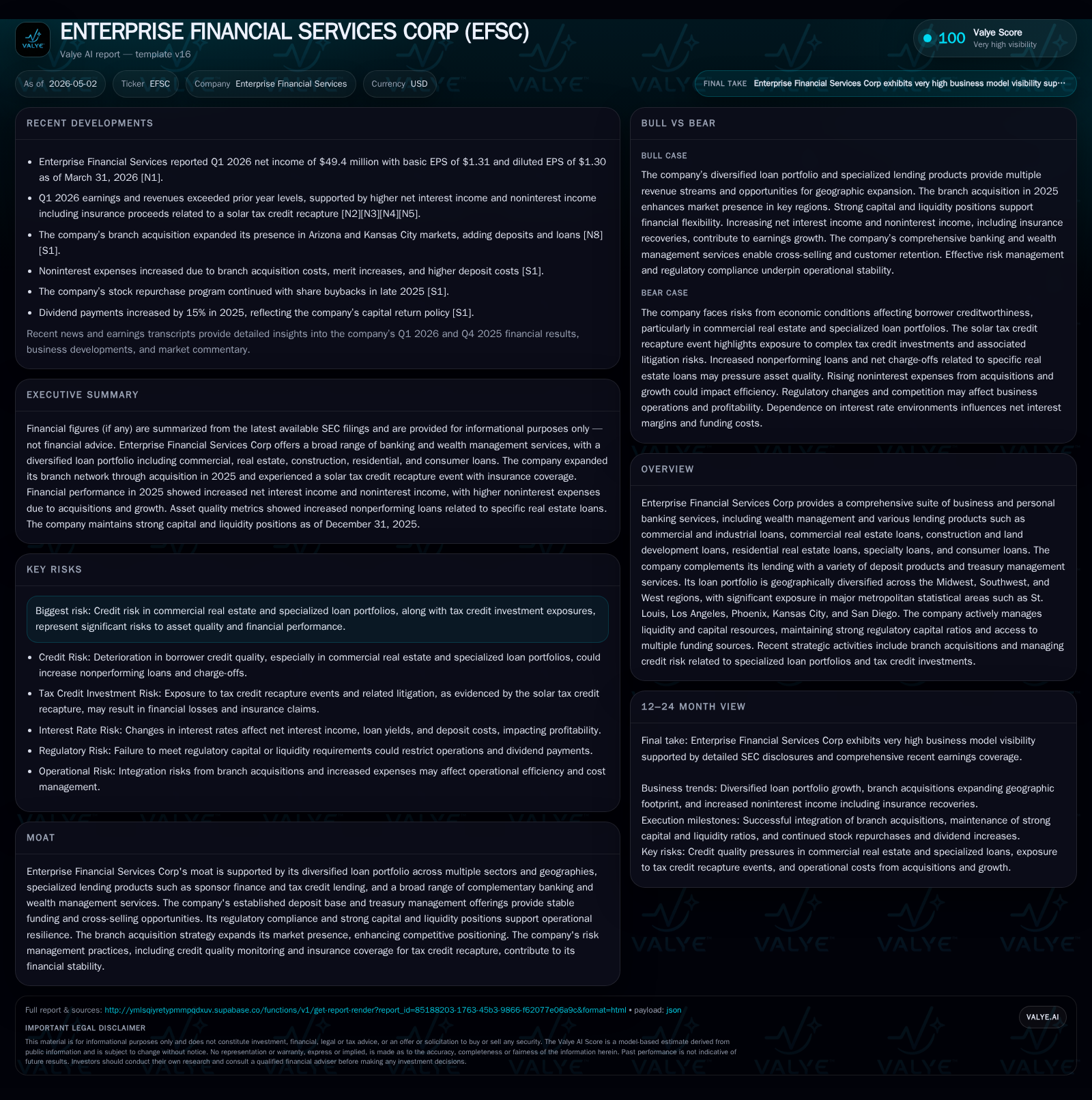
Enterprise Financial Services Corp (EFSC) demonstrated tangible progress in Q1 2026 through the strategic acquisition of branches and significant loan portfolio management, notably reducing nonperforming loans by $17.5 million. The company leverages a diversified lending platform spanning commercial, real estate, specialty, and consumer financing, backed by complementary treasury management and wealth services to solidify its regional prominence. Looking ahead, EFSC’s focus on deposit growth, operational efficiencies, and disciplined credit risk management remain central to sustaining its long-term resilience and expansion across key metropolitan markets.
Q1 2026 Operating Update: Branch Expansion and Portfolio Dynamics
Enterprise Financial Services Corp’s first quarter 2026 disclosures reveal a clear trajectory of operational improvement anchored by its branch acquisition strategy and loan portfolio quality enhancements. Notably, the company recorded $17.5 million in payoffs on previously nonperforming loans early in the quarter, underscoring effective resolution of legacy credit issues primarily tied to commercial real estate credits associated with special purpose entities in Southern California [S2][S3][S16].
Strategically, EFSC expanded its physical footprint through branch acquisitions adding ten branches in Arizona and two in Kansas City—markets that align with the company's broader geographic presence encompassing metropolitan hubs including St. Louis, Los Angeles, Phoenix, Kansas City itself, and San Diego [S1][S26]. This tactical move not only helps deepen market penetration but creates avenues for originating diversified lending relationships while enhancing deposit gathering capabilities.
Core Business Model: Lending Diversity and Complementary Banking Services
EFSC operates a multi-faceted business model centered on lending complemented by deposits and comprehensive banking solutions. The loan portfolio is notably diverse: Approximately 44% comprises commercial and industrial (C&I) loans with specialized niches such as sponsor finance and tax credit lending integrated within this segment. Commercial real estate (CRE), split between investor-owned (25%) and owner-occupied properties (21%), represent a sizable portion of assets supported by rigorous underwriting focused on cash flow coverage and collateral adequacy [S1][S26]. Construction and land development loans constitute roughly 6%, with residential real estate making up about 3%, reflecting the company’s cautious approach toward higher-risk CRE development segments.
Complementing lending growth are core deposit products ranging from noninterest-bearing demand accounts to money markets that secure low-cost funding. The company’s treasury management suite further enhances revenue streams while fostering stronger client retention through value-added services such as liquidity management solutions appropriate for business customers [N8][N9][S1]. Wealth management offerings diversify fee income sources beyond traditional interest margins.
These product lines collectively generate revenues from interest spreads on loans funded by deposits alongside fees from treasury services and wealth advisory mandates. Volume escalations via new branches increase both loan originations and deposit balances providing scalable operating leverage opportunities.
Competitive Landscape: Regional Focus and Niche Lending Strengths
EFSC's competitive positioning benefits from its concentrated yet diversified geographical footprint focused on several robust Metropolitan Statistical Areas spanning the Midwest, Southwest, and West Coast. This regional segmentation allows EFSC to leverage local knowledge while competing effectively against larger national banks less attuned to mid-market deal flow or localized economic patterns [S1].
Furthermore, the firm’s niche expertise in sponsor finance—a product class involving financing corporate sponsors or private equity-backed transactions—and specialized tax credit lending grants differentiation within the competitive landscape where many regional banks limit product complexity due to scale constraints [S1]. These specialist loan categories often entail higher yields reflecting incremental risk profiles but benefit from enhanced underwriting rigor paired with insurance mitigants against tax credit recapture exposures.
Regulatory requirements also shape competitive dynamics: maintaining “well-capitalized” status with CET1 to Risk Weighted Assets approximating 11.6% underscores EFSC’s capacity to withstand stress scenarios relative to peers subject to concentrated CRE exposures or undercapitalization challenges [S9]. Branch acquisition activities further signal both defensive measures against encroachment by peer banks as well as offense to augment market share.
Growth Catalysts: Deposit Base Expansion, Treasury Solutions, and Risk Mitigation
Growth at EFSC is driven structurally through expanding a core deposits franchise which offers a relatively stable base of low-cost funding essential for net interest margin preservation amidst volatile rate environments. Incremental branch additions foster organic deposit increases evidenced recently by an 11% year-over-year rise in total deposits reaching over $14.6 billion at year-end 2025 [S26].
Treasury management features—including digital payments processing, fraud mitigation tools, liquidity optimization—function as sticky client engagement levers generating fee revenue while supporting loan cross-sell potential. This multifaceted approach addresses sophisticated client needs while solidifying the bank’s role as a crucial financial partner rather than purely transactional lender [N8][N9].
Risk management frameworks further buttress this growth thesis: active credit monitoring informed by site visits, stress testing for vacancy/rate risks on CRE loans plus independent centralized controls over construction loan disbursements exemplify disciplined underwriting practices. Importantly, insurance purchased against solar tax credit recapture loss has limited downside risk related to a $24.1 million bankruptcy-related recapture event earlier recognized. Such protective policies reflect a sophisticated enterprise risk philosophy aimed at protecting earnings durability [S16].
Risks and Constraints: Credit Exposure, Tax Credit Investments, and Regulatory Factors
Despite operational strides, material risks persist primarily revolving around commercial real estate concentrations which remain vulnerable amid cyclical economic pressures impacting tenants’ lease renewals or property valuations. Highly specialized segments such as tax credit investments introduce idiosyncratic risks that require careful surveillance given their dependency on regulatory policies and potential recapture scenarios [S15][S16].
Regulatory constraints particularly affect dividend policies where future payouts hinge on capital adequacy metrics that must be preserved given ongoing asset growth ambitions and economic uncertainty [S13]. EFSC’s stewardship of capital ratios near regulatory thresholds necessitates balancing capital allocation towards growth investments versus shareholder returns.
Outlook and Key Milestones: Monitoring Portfolio Quality and Market Penetration Trends
Looking forward into mid-to-late 2026, critical milestones for EFSC include evidencing sustained reductions in nonperforming loan balances beyond the early Q1 payoff achievements as a sign of ongoing asset quality improvement. Successful integration of newly acquired branches will be key performance indicators influencing deposit attrition rates post-acquisition or incremental loan originations coming through these outlets [S2][S3].
Governance signals including declarations around dividends or stock repurchase programs will provide additional context regarding capital deployment philosophy consistent with regulatory expectations for well-capitalized institutions [S13]. Furthermore, quarterly updates on treasury product uptake rates may offer clues on cross-selling effectiveness – a core pillar of the revenue diversification strategy documented in prior periods.
Financial Profile Snapshot: Recent Results Supporting Strategic Initiatives
In full-year 2025 results serving as backdrop for current performance trends, EFSC reported net income of approximately $201 million translating into $5.31 diluted earnings per share – an increase from prior years driven principally by rising net interest income due to organic asset growth combined with favorable funding cost dynamics [F1][S25]. The company maintained firm capital adequacy ratios satisfying well-capitalized thresholds across all measured parameters including Tier 1 leverage ratio above 10%, underscoring resiliency despite increased balance sheet scale [S9].
Investment securities expanded significantly as part of liquidity strategies while deposit balances grew over 11% year-over-year reflecting branch acquisition impact plus organic customer demand enhancements [S26][F1]. Operating expenses rose moderately attributable to acquisition costs balanced against efficiency improvements evidenced via core efficiency ratio stability near 59%.
Disclaimer: This is research-only, informational analysis and not investment advice. It may include AI-generated interpretation and general industry context. Always verify important details using primary sources.

Comments