
Amphenol Advances Interconnect Innovation Amid Market Expansion
Amphenol's latest quarterly report highlights robust growth, strategic acquisitions, and technology leadership in diversified interconnect markets.
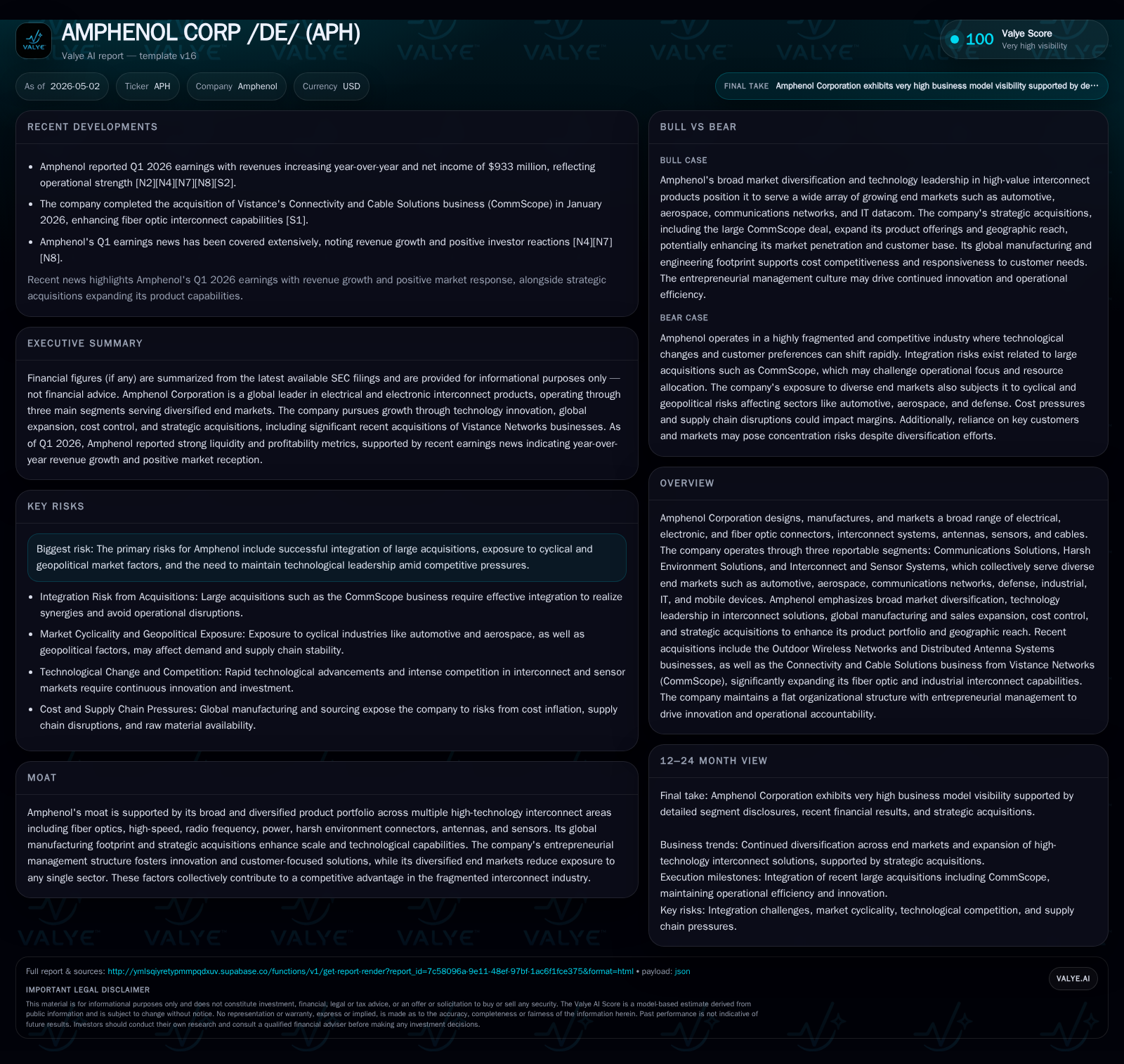
In its Q1 2026 filing, Amphenol Corporation demonstrated sustained segment growth powered by recent acquisitions and technology developments. The company’s broad product portfolio across communications, harsh environment, and sensor systems underpins pricing strength and customer retention. Market diversification and integration of major acquisitions in wireless networks and cable solutions are key growth levers, while cyclical demand and integration risks remain watchpoints. Financially, Amphenol maintains solid liquidity and a manageable debt profile to support ongoing investments.
Latest Quarterly Update: Operational Highlights and Strategic Moves
Amphenol Corporation's Q1 2026 performance underscores steady revenue expansion coupled with margin enhancements across its three core segments as disclosed in the latest Form 10-Q filed May 1, 2026 [S2]. Notably, the Communications Solutions segment showed strong traction fueled by growing demand for advanced fiber optic connectors and antenna products aligned with expanded rollout of next-generation wireless infrastructure technologies. Cost controls remain rigorous during inflationary pressures supporting operating margin resilience.
The quarter also marks a pivotal stage post completion of the transformative $10.5 billion acquisition of Vistance Networks’ Connectivity and Cable Solutions business (rebranded as "CommScope" within Amphenol) early January 2026 plus integration progress on last year’s acquisition of Outdoor Wireless Networks (OWN) and Distributed Antenna Systems businesses [S3]. These complementary additions not only broaden Amphenol’s product portfolio—especially in high-value fiber optics and industrial cabling—but also deepen geographic exposures to fast-growing end markets like communications networks and data centers.
Management commentary from the April earnings call highlights confidence in synergy realization potential through cross-selling initiatives within these recently acquired businesses plus ongoing productivity improvements fostering scalable cost structures [N2][S3]. This corporate strategy positions Amphenol to capitalize on accelerating market expansion while maintaining entrepreneurial agility in a fragmented industry landscape.
Business Model and Product Offering: Diverse High-Technology Interconnect Solutions
Amphenol operates through three reportable segments: Communications Solutions (52% of net sales), Harsh Environment Solutions (26%), and Interconnect & Sensor Systems (22%) based on fiscal 2025 figures [S1]. This segmentation reflects not only product specialization but also distinct end-market focuses enabling tailored solutions.
The Communications Solutions segment delivers a broad range of interconnect systems including high-speed fiber optic connectors, coaxial radio frequency components, power connectors, antennas for mobile devices and network infrastructure, plus cable assemblies critical to IT datacom markets. This segment's relevance is amplified by secular shifts such as 5G network deployment requiring highly reliable antenna systems and fiber optic transmission capabilities.
Harsh Environment Solutions focuses on ruggedized connectors designed for the automotive industry’s electrification trend, commercial aerospace with stringent qualification cycles imposing substantial switching costs, defense systems demanding durability in adverse conditions, plus specialty cables and printed circuit assemblies crafted for hostile operational settings.
Interconnect & Sensor Systems encapsulates sensor-based technologies spanning force, position, temperature, pressure measurements integrated into interconnect solutions with substantial value-add cable harnesses. This segment benefits from proliferating IoT applications where embedded sensing enhances machine intelligence.
This strategically diversified offering mix fosters resilient pricing power stemming from proprietary designs that meet specific customer quality demands alongside long qualification periods typical in aerospace/defense sectors that create high switching barriers [S1].
Competitive Landscape and Industry Dynamics in Interconnect Markets
The global market for interconnect components including connectors, cable assemblies, antennas, sensors, valued at approximately $500 billion in 2025 according to industry analysts cited by Amphenol reflects considerable fragmentation characterized by numerous small players alongside large specialized manufacturers [S1]. Within this context, Amphenol distinguishes itself through a combination of technological breadth spanning fiber optics to harsh environment products; scale; vertical integration; global manufacturing footprint; and a culture fostering decentralized entrepreneurial management empowering agile innovation.
Customer relationships benefit from embedded nature of interconnect products—the need for rigorous qualification protocols creates substantial switching costs which support durable revenue streams once established. Supply chain constraints such as raw material availability occasionally exert short-term cost pressures but have been mitigated through strategic sourcing initiatives.
Competitor sets include other large interconnect firms with varying technological focuses; however, Amphenol's extensive product diversity across multiple technology domains considerably blunts risk of overexposure to evolving technology shifts or single-industry downturns [S1].
Growth Drivers: Market Diversification, Innovation, and Acquisition Synergies
Amphenol's growth strategy exploits multiple vectors simultaneously. The January 2026 acquisition of CommScope notably advances fiber optic interconnect penetration into the IT/datacom sector where bandwidth demands rise rapidly with cloud computing expansion [S3]. Similarly, prior OWN/DAS acquisitions strengthen solutions for outdoor wireless networks catering to expanding 5G/6G deployments.
On the innovation front, continued development of value-add cable assemblies linked with embedded sensor integration positions the Interconnect & Sensor Systems segment well for emerging IoT application demand growth. Design-to-cost programs mentioned in recent filings aim at margin uplift by optimizing product architectures without compromising quality.
Geographic expansion through localized manufacturing facilities ensures proximity to customers particularly in Asia-Pacific markets experiencing fast adoption rates for automotive electrification and data infrastructure buildouts [S1][S17].
As reported in Q1 results commentary [N2], cross-selling opportunities among acquired business units reflect early-stage revenue synergies with measurable backlog improvements indicating scalable incremental sales enabled by portfolio breadth.
Risks and Constraints: Integration Challenges, Cyclicality, and Technological Pressures
Challenges manifest chiefly around integrating multiple sizeable acquisitions effectively to realize anticipated synergies without disrupting core operations or inflating near-term costs. The complexity rises given distinct cultures within newly absorbed businesses requiring alignment under Amphenol’s entrepreneurial framework [S1].
Cyclical exposure rooted mainly in automotive production volatility—particularly related to semiconductor supply fluctuations—and commercial aerospace spending variability may exert uneven demand downstream affecting certain segment revenues periodically.
Maintaining technological leadership necessitates continuous R&D investment amid competition from niche innovators focusing on specialized connector technologies or novel sensor applications. Geopolitical factors including trade tensions could disrupt supply chains or access to key raw materials if not managed prudently.
Operational governance includes cybersecurity risk programs overseen regularly at executive level mitigating potential disruptions stemming from cyber incidents or information system vulnerabilities—a critical risk factor detailed extensively for Amphenol reflecting mature internal controls [S28].
Near-Term Milestones: Guidance, Demand Signals, and Execution Focus
Monitoring Q2 onward hinges on integration progress for CommScope assets especially relating to manufacturing footprint rationalization plus sales channel optimization noted during recent earnings events [N2][S3]. Backlog trends within communications segments serve as a proxy for demand strength amid broader macroeconomic uncertainties.
Management has maintained disciplined cost control programs accompanying acquisition-driven investments helping sustain operating leverage benefits visible already in Q1. Continued effective supply chain management including supplier diversification remains crucial amid ongoing market/materials volatility challenges.
There are no explicit updated earnings guidance figures as per latest filings but forward-looking statements suggest optimism centered on synergistic portfolio scaling combined with structural secular tailwinds across targeted end markets such as data infrastructure rollout acceleration.
Financial Snapshot: Balance Sheet Strength and Earnings Overview
Latest financial snapshot
| Metric | Value | Period |
|---|---|---|
| Cash & equivalents | $4.1bn | |
| 2026-03-31 | ||
| Total debt | $16.6bn | |
| 2026-03-31 | ||
| Net debt | $12.5bn | |
| 2026-03-31 | ||
| Current assets | $15.4bn | |
| 2026-03-31 | ||
| Current liabilities | $9.0bn | |
| 2026-03-31 | ||
| Current ratio | 1.71x | |
| 2026-03-31 |
Source: SEC companyfacts cache [F1].
Amphenol enters Q2 2026 holding $4.13 billion in cash & equivalents against total debt approximating $16.64 billion as per companyfacts at quarter-end March 31 [F1], corresponding to a current ratio of about 1.71 reflecting solid short-term liquidity positioning despite net debt near $12.5 billion.
| Metric | Latest Value |
|---|---|
| Cash & Equivalents | $4.13B |
| Total Debt | $16.64B |
| Net Debt | $12.51B |
| Current Assets | $15.38B |
| Current Liabilities | $8.97B |
| Current Ratio | 1.71 |
This financial foundation complements operational execution efforts enabling Amphenol to navigate cyclical headwinds tactically while funding innovation-led growth vectors sustainably.
This analysis synthesizes public SEC filings up to May 2026 alongside relevant market commentary without offering investment advice or price targets.
Disclaimer: This is research-only, informational analysis and not investment advice. It may include AI-generated interpretation and general industry context. Always verify important details using primary sources.

Comments